\n
## Bar Chart: Generative Accuracy vs. Transformation Type
### Overview
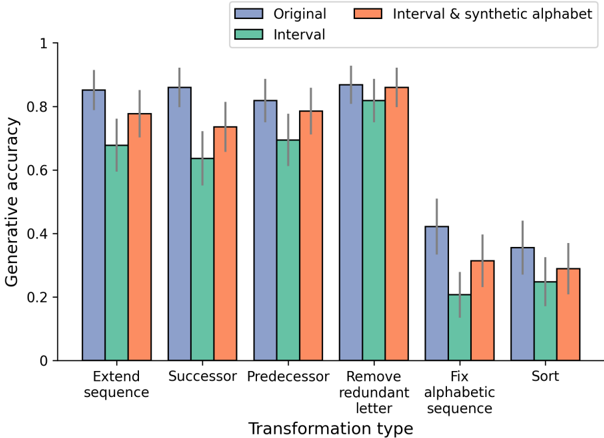
This bar chart compares the generative accuracy of three different methods ("Original", "Interval", and "Interval & synthetic alphabet") across six different transformation types applied to sequences. Error bars are present for each bar, indicating the variability in the accuracy measurements.
### Components/Axes
* **X-axis:** Transformation type. Categories are: "Extend sequence", "Successor", "Predecessor", "Remove redundant letter", "Fix alphabetic sequence", "Sort".
* **Y-axis:** Generative accuracy, ranging from 0 to 1.
* **Legend:** Located at the top-center of the chart.
* "Original" - represented by a dark blue color.
* "Interval & synthetic alphabet" - represented by an orange color.
* "Interval" - represented by a teal color.
* Error bars are present on top of each bar, indicating standard deviation or confidence intervals.
### Detailed Analysis
Let's analyze each transformation type and the accuracy of each method:
* **Extend sequence:**
* Original: Approximately 0.86 (with error bars ranging from ~0.82 to ~0.90).
* Interval & synthetic alphabet: Approximately 0.74 (with error bars ranging from ~0.70 to ~0.78).
* Interval: Approximately 0.69 (with error bars ranging from ~0.65 to ~0.73).
* **Successor:**
* Original: Approximately 0.85 (with error bars ranging from ~0.81 to ~0.89).
* Interval & synthetic alphabet: Approximately 0.72 (with error bars ranging from ~0.68 to ~0.76).
* Interval: Approximately 0.68 (with error bars ranging from ~0.64 to ~0.72).
* **Predecessor:**
* Original: Approximately 0.82 (with error bars ranging from ~0.78 to ~0.86).
* Interval & synthetic alphabet: Approximately 0.76 (with error bars ranging from ~0.72 to ~0.80).
* Interval: Approximately 0.71 (with error bars ranging from ~0.67 to ~0.75).
* **Remove redundant letter:**
* Original: Approximately 0.88 (with error bars ranging from ~0.84 to ~0.92).
* Interval & synthetic alphabet: Approximately 0.78 (with error bars ranging from ~0.74 to ~0.82).
* Interval: Approximately 0.74 (with error bars ranging from ~0.70 to ~0.78).
* **Fix alphabetic sequence:**
* Original: Approximately 0.38 (with error bars ranging from ~0.34 to ~0.42).
* Interval & synthetic alphabet: Approximately 0.24 (with error bars ranging from ~0.20 to ~0.28).
* Interval: Approximately 0.34 (with error bars ranging from ~0.30 to ~0.38).
* **Sort:**
* Original: Approximately 0.35 (with error bars ranging from ~0.31 to ~0.39).
* Interval & synthetic alphabet: Approximately 0.27 (with error bars ranging from ~0.23 to ~0.31).
* Interval: Approximately 0.29 (with error bars ranging from ~0.25 to ~0.33).
### Key Observations
* The "Original" method consistently outperforms the "Interval" and "Interval & synthetic alphabet" methods across all transformation types.
* The "Interval & synthetic alphabet" method generally performs better than the "Interval" method.
* The accuracy is significantly lower for the "Fix alphabetic sequence" and "Sort" transformation types compared to the others, regardless of the method used.
* The error bars suggest that the variability in accuracy is relatively consistent across different transformation types for each method.
### Interpretation
The data suggests that the "Original" method is the most effective for generative accuracy across all tested sequence transformations. The addition of "Interval" or "Interval & synthetic alphabet" consistently reduces accuracy, indicating that these methods introduce some level of distortion or loss of information during the transformation process.
The substantial drop in accuracy for "Fix alphabetic sequence" and "Sort" suggests that these transformations are particularly challenging for the generative models. This could be due to the complexity of these transformations, the need for a deeper understanding of alphabetic order, or the introduction of ambiguity during the process.
The consistent ranking of the methods (Original > Interval & synthetic alphabet > Interval) implies a systematic difference in their ability to handle these transformations. The "Interval & synthetic alphabet" method's slight improvement over "Interval" suggests that the synthetic alphabet component provides some benefit, but it is not enough to close the gap with the "Original" method.
The error bars provide a measure of the uncertainty in the accuracy estimates. The relatively small error bars suggest that the observed differences between methods are likely to be statistically significant.