## Image Comparison: Text Reconstruction Methods
### Overview
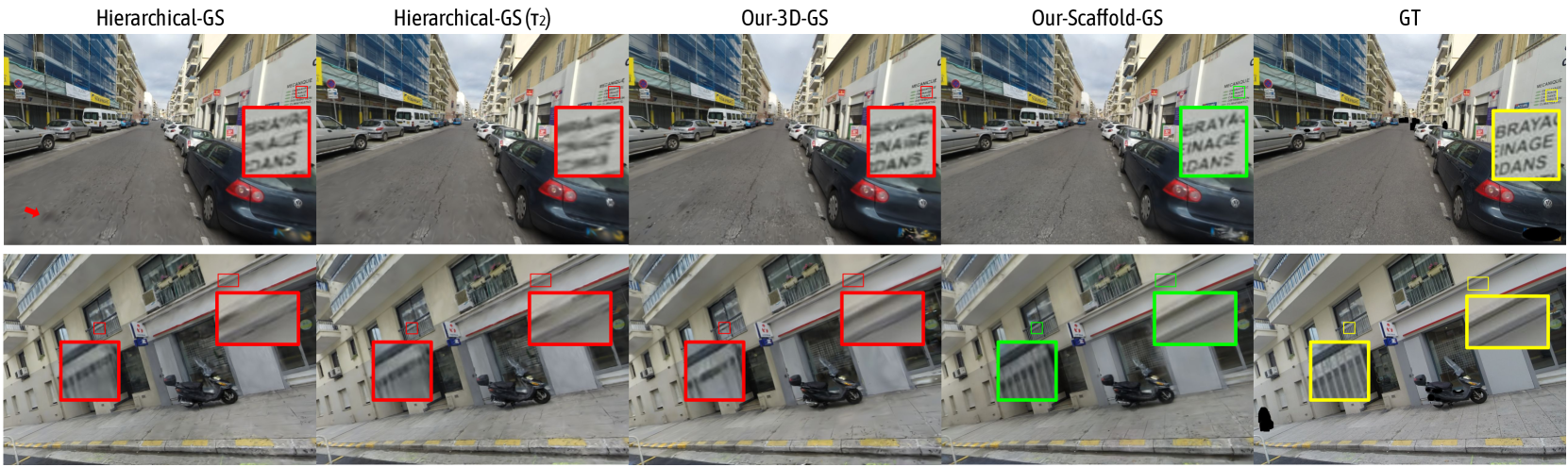
The image presents a visual comparison of different methods for reconstructing text in street-view images. It shows the results of five different approaches: "Hierarchical-GS", "Hierarchical-GS (T2)", "Our-3D-GS", "Our-Scaffold-GS", and "GT" (Ground Truth). Each method is applied to two different scenes, displayed in two rows. The images are annotated with colored bounding boxes highlighting the reconstructed text regions.
### Components/Axes
The image is structured as a grid with two rows and five columns. Each column represents a different text reconstruction method. The rows represent different scenes. The methods are labeled at the top of each column. The bounding boxes are colored red, green, or yellow, depending on the method.
### Detailed Analysis or ### Content Details
**Column 1: Hierarchical-GS**
* **Top Row:** A street scene with a car parked on the side. A red bounding box highlights the reconstructed text on the car's license plate area. A small red arrow points to a spot on the road. A small red bounding box highlights the text on a sign on the building.
* Text in red box on car: "DANS"
* **Bottom Row:** A building facade with a scooter parked in front. Red bounding boxes highlight the reconstructed text on the building's architectural details and a sign.
**Column 2: Hierarchical-GS (T2)**
* **Top Row:** Similar street scene as in Column 1. A red bounding box highlights the reconstructed text on the car's license plate area. A small red bounding box highlights the text on a sign on the building.
* **Bottom Row:** Similar building facade as in Column 1. Red bounding boxes highlight the reconstructed text on the building's architectural details and a sign.
**Column 3: Our-3D-GS**
* **Top Row:** Similar street scene as in Column 1. A red bounding box highlights the reconstructed text on the car's license plate area. A small red bounding box highlights the text on a sign on the building.
* Text in red box on car: "ENAGE DANS"
* **Bottom Row:** Similar building facade as in Column 1. Red bounding boxes highlight the reconstructed text on the building's architectural details and a sign.
**Column 4: Our-Scaffold-GS**
* **Top Row:** Similar street scene as in Column 1. A green bounding box highlights the reconstructed text on the car's license plate area.
* Text in green box on car: "BRAYA FINAGE DANS"
* **Bottom Row:** Similar building facade as in Column 1. Green bounding boxes highlight the reconstructed text on the building's architectural details and a sign.
**Column 5: GT (Ground Truth)**
* **Top Row:** Similar street scene as in Column 1. A yellow bounding box highlights the reconstructed text on the car's license plate area. A yellow bounding box highlights the text on a sign on the building.
* Text in yellow box on car: "BRAYA EINAGE DANS"
* **Bottom Row:** Similar building facade as in Column 1. Yellow bounding boxes highlight the reconstructed text on the building's architectural details and a sign.
### Key Observations
* The "GT" column represents the ground truth, showing the ideal text reconstruction.
* The different methods show varying degrees of success in reconstructing the text.
* "Our-Scaffold-GS" appears to produce results closer to the ground truth compared to "Hierarchical-GS" and "Our-3D-GS".
* The red arrow in the first image of "Hierarchical-GS" does not appear to be related to text reconstruction.
### Interpretation
The image provides a visual comparison of different text reconstruction methods in street-view images. The goal is to assess the accuracy and effectiveness of each method in recovering text from real-world scenes. The "GT" column serves as a benchmark for evaluating the performance of the other methods. The results suggest that "Our-Scaffold-GS" performs better than "Hierarchical-GS" and "Our-3D-GS" in the specific scenes depicted. The differences in performance likely stem from the underlying algorithms and assumptions of each method. The image highlights the challenges of text reconstruction in complex environments and the importance of developing robust and accurate algorithms.