## Horizontal Bar Chart: 15 Highest-Impact Compliance Gaps
### Overview
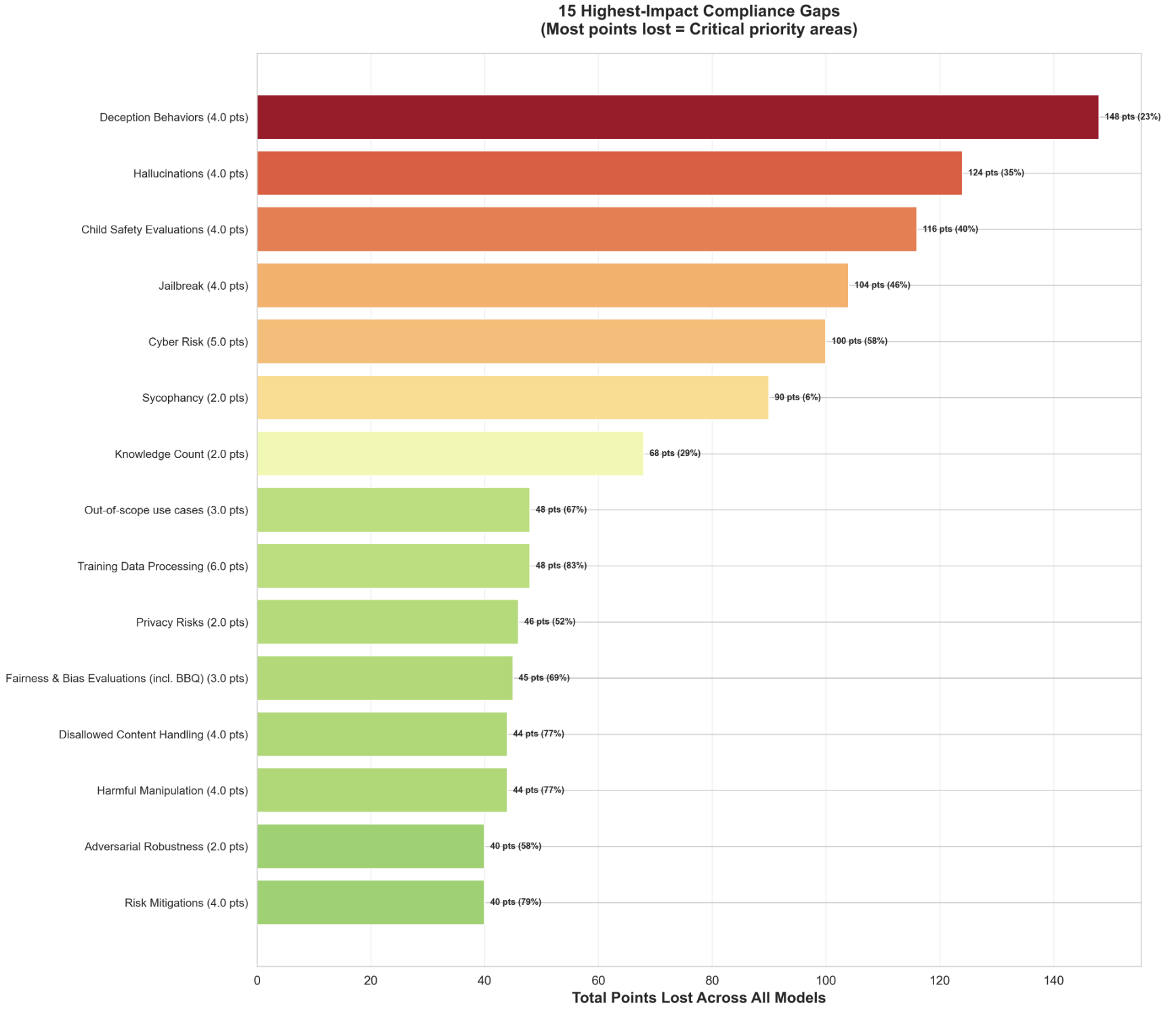
This is a horizontal bar chart titled "15 Highest-Impact Compliance Gaps (Most points lost = Critical priority areas)". It ranks 15 categories of AI model compliance failures based on the total points lost across all evaluated models. The chart uses a color gradient from dark red (most critical) to light green (less critical) to visually emphasize priority. The bars are ordered from the highest total points lost at the top to the lowest at the bottom.
### Components/Axes
* **Title:** "15 Highest-Impact Compliance Gaps (Most points lost = Critical priority areas)" - Located at the top center.
* **Y-Axis (Vertical):** Lists the 15 compliance gap categories. Each label includes the category name and a base point value in parentheses (e.g., "Deception Behaviors (4.0 pts)").
* **X-Axis (Horizontal):** Labeled "Total Points Lost Across All Models". The scale runs from 0 to 140, with major gridlines at intervals of 20 (0, 20, 40, 60, 80, 100, 120, 140).
* **Data Labels:** Each bar has a data label at its end showing the exact "Total Points Lost" and a percentage in parentheses (e.g., "148 pts (23%)").
* **Color Legend:** While not in a separate box, the color of each bar serves as a visual legend for severity. The gradient progresses from dark red (top) through orange and yellow to light green (bottom).
### Detailed Analysis
The chart presents the following data, listed from top (most critical) to bottom:
1. **Deception Behaviors (4.0 pts):** Dark red bar. **148 pts (23%)**. This is the longest bar, extending past the 140 mark on the x-axis.
2. **Hallucinations (4.0 pts):** Red-orange bar. **124 pts (35%)**.
3. **Child Safety Evaluations (4.0 pts):** Orange bar. **116 pts (40%)**.
4. **Jailbreak (4.0 pts):** Light orange bar. **104 pts (46%)**.
5. **Cyber Risk (5.0 pts):** Yellow-orange bar. **100 pts (58%)**.
6. **Sycophancy (2.0 pts):** Yellow bar. **90 pts (6%)**.
7. **Knowledge Count (2.0 pts):** Light yellow bar. **68 pts (29%)**.
8. **Out-of-scope use cases (3.0 pts):** Yellow-green bar. **48 pts (67%)**.
9. **Training Data Processing (6.0 pts):** Yellow-green bar. **48 pts (83%)**.
10. **Privacy Risks (2.0 pts):** Light green bar. **46 pts (52%)**.
11. **Fairness & Bias Evaluations (incl. BBQ) (3.0 pts):** Light green bar. **45 pts (69%)**.
12. **Disallowed Content Handling (4.0 pts):** Light green bar. **44 pts (77%)**.
13. **Harmful Manipulation (4.0 pts):** Light green bar. **44 pts (77%)**.
14. **Adversarial Robustness (2.0 pts):** Light green bar. **40 pts (58%)**.
15. **Risk Mitigations (4.0 pts):** Light green bar. **40 pts (79%)**.
**Spatial Grounding:** The title is centered at the top. The y-axis labels are left-aligned. The x-axis label is centered at the bottom. The data labels are right-aligned to the end of each bar.
### Key Observations
* **Clear Priority Tier:** The top four gaps (Deception Behaviors, Hallucinations, Child Safety, Jailbreak) are visually distinct, colored in shades of red/orange, and have significantly higher point losses (104-148 pts) than the rest.
* **Color-Severity Correlation:** The color gradient strongly correlates with the ranking. The most critical issues are red, transitioning through orange and yellow to green for the least critical in this top-15 list.
* **Inverse Relationship with Compliance %:** The percentage in parentheses (likely representing a compliance or failure rate) does not directly correlate with the total points lost. For example, "Sycophancy" has a very low 6% but is 6th in points lost, while "Training Data Processing" has a high 83% but is 9th. This suggests the percentage is a different metric (e.g., failure rate within the category) and the "points lost" is an aggregate impact score.
* **Tied Values:** "Out-of-scope use cases" and "Training Data Processing" are tied at 48 pts. "Disallowed Content Handling" and "Harmful Manipulation" are tied at 44 pts. "Adversarial Robustness" and "Risk Mitigations" are tied at 40 pts.
### Interpretation
This chart is a risk prioritization tool for AI model compliance and safety. It demonstrates that **deceptive behaviors and hallucinations are the most impactful failure modes**, causing the greatest aggregate point loss across models. This suggests these areas are both highly weighted in the scoring system and represent widespread weaknesses.
The high ranking of **Child Safety** and **Jailbreak** vulnerabilities indicates these are also critical, high-priority areas for mitigation. The data implies that while models may have varying failure rates (the percentages) within categories, the *cumulative impact* of failures in categories like Deception and Hallucinations is far greater, making them the most urgent targets for improvement.
The chart effectively argues that resources should be allocated first to the red/orange categories at the top, as addressing these gaps would yield the largest improvement in overall compliance score. The green categories, while still important, represent lower-impact gaps relative to the top tier.