## Line Chart: Overall Accuracy (%)
### Overview
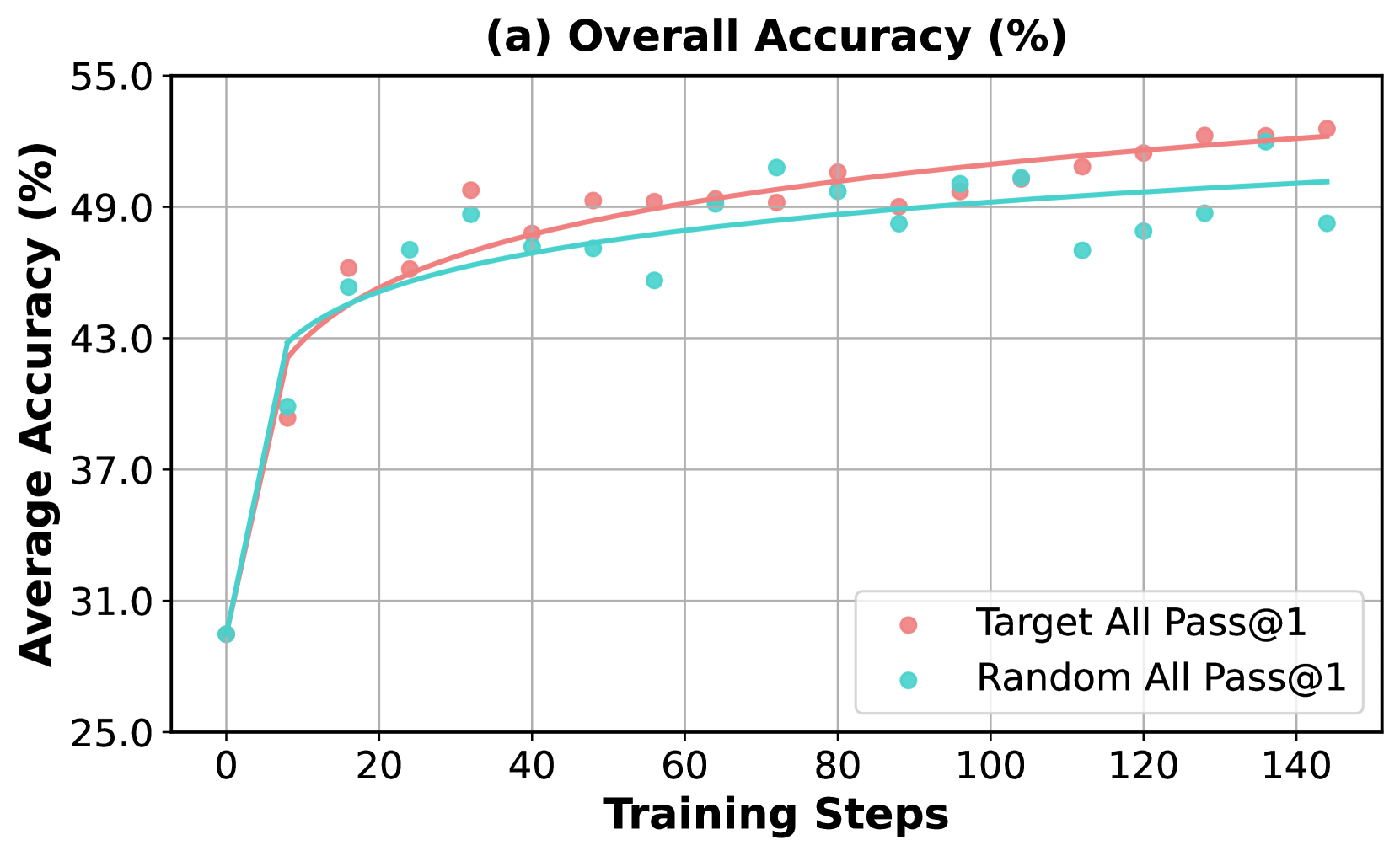
The image is a line chart comparing the "Target All Pass@1" and "Random All Pass@1" models' average accuracy (%) over training steps. Both models show an increase in accuracy as training progresses, with "Target All Pass@1" consistently performing slightly better than "Random All Pass@1".
### Components/Axes
* **Title:** (a) Overall Accuracy (%)
* **X-axis:** Training Steps, with markers at 0, 20, 40, 60, 80, 100, 120, and 140.
* **Y-axis:** Average Accuracy (%), with markers at 25.0, 31.0, 37.0, 43.0, 49.0, and 55.0.
* **Legend:** Located in the bottom-right corner.
* **Pink:** Target All Pass@1
* **Teal:** Random All Pass@1
### Detailed Analysis
* **Target All Pass@1 (Pink):**
* The pink line represents the "Target All Pass@1" model.
* The line starts at approximately 38% accuracy at 0 training steps.
* It rapidly increases to approximately 47% accuracy by 20 training steps.
* From 20 to 140 training steps, the line continues to increase, but at a slower rate, reaching approximately 53% accuracy.
* Data points: (0, ~38%), (20, ~47%), (40, ~49%), (60, ~49.5%), (80, ~50%), (100, ~51%), (120, ~52%), (140, ~53%)
* **Random All Pass@1 (Teal):**
* The teal line represents the "Random All Pass@1" model.
* The line starts at approximately 28% accuracy at 0 training steps.
* It rapidly increases to approximately 43% accuracy by 20 training steps.
* From 20 to 140 training steps, the line continues to increase, but at a slower rate, reaching approximately 49% accuracy.
* Data points: (0, ~28%), (20, ~43%), (40, ~47%), (60, ~47%), (80, ~49%), (100, ~49%), (120, ~49%), (140, ~49%)
### Key Observations
* Both models exhibit a significant increase in accuracy during the initial training steps (0-20).
* The rate of accuracy increase slows down as the number of training steps increases.
* "Target All Pass@1" consistently outperforms "Random All Pass@1" throughout the training process.
* The difference in accuracy between the two models appears to decrease slightly as training progresses.
### Interpretation
The chart demonstrates the learning curves of two models, "Target All Pass@1" and "Random All Pass@1", during training. The initial rapid increase in accuracy suggests that both models quickly learn from the training data. The subsequent slowdown indicates that the models are approaching their maximum potential accuracy with the given training setup. The consistently higher performance of "Target All Pass@1" suggests that it is a more effective model for the given task compared to "Random All Pass@1". The decreasing difference in accuracy between the two models as training progresses could indicate that "Random All Pass@1" is gradually catching up, or that both models are approaching a performance ceiling.