\n
## Diagram: Block-Based System with Hazards and Reward
### Overview
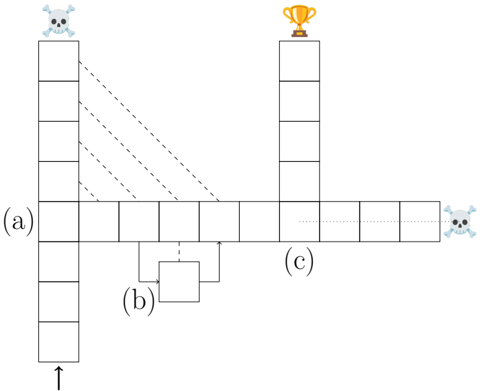
The image depicts a block-based system or level layout, potentially from a game or simulation. It features a path with obstacles (skulls) and a reward (trophy). The diagram illustrates a flow or progression through the blocks, with a branching path and a potential interaction point. There is no numerical data present.
### Components/Axes
The diagram is labeled with the following components:
* **(a)**: A vertical stack of blocks with a skull at the top.
* **(b)**: A square block, potentially representing an interaction point or a switch.
* **(c)**: A horizontal row of blocks with a trophy at the end and a skull at the far right.
* An arrow pointing upwards from the bottom-left corner.
* A dashed line connecting the top of stack (a) to the middle of the horizontal row (c).
* Two skull symbols representing hazards.
* One trophy symbol representing a reward.
### Detailed Analysis or Content Details
The diagram consists of interconnected blocks arranged in a T-shape.
* **Stack (a)**: This is a vertical stack of approximately 7 blocks. A skull is positioned on top of this stack.
* **Interaction Point (b)**: A single square block is positioned at the intersection of the vertical and horizontal sections. An arrow originates from this block, indicating a potential output or activation.
* **Path (c)**: A horizontal row of approximately 8 blocks extends to the right. A trophy is placed on top of the stack at the right end, and a skull is placed at the far right end.
* **Flow**: The arrow at the bottom-left suggests a starting point or input. The dashed line indicates a connection or influence from the vertical stack (a) to the horizontal path (c).
### Key Observations
* The presence of skulls suggests hazards or obstacles.
* The trophy indicates a reward or goal.
* The interaction point (b) could be a trigger or a mechanism to alter the path or overcome obstacles.
* The dashed line implies a relationship between the vertical stack and the horizontal path, potentially a condition for progression.
### Interpretation
The diagram likely represents a challenge or puzzle. The player or agent must navigate the blocks, potentially interacting with the block (b) to overcome the hazards (skulls) and reach the reward (trophy). The dashed line suggests that the vertical stack (a) might influence the availability or accessibility of the trophy. The upward arrow indicates the direction of progression or input. The diagram is a visual representation of a system with inputs, processes, and outputs, where the goal is to achieve a positive outcome (trophy) while avoiding negative consequences (skulls). The diagram does not provide any quantitative data, but it clearly illustrates a conceptual framework for a task or challenge.