## Diagram: Neuro-Symbolic Integration and Neural Network Activation Transfer
### Overview
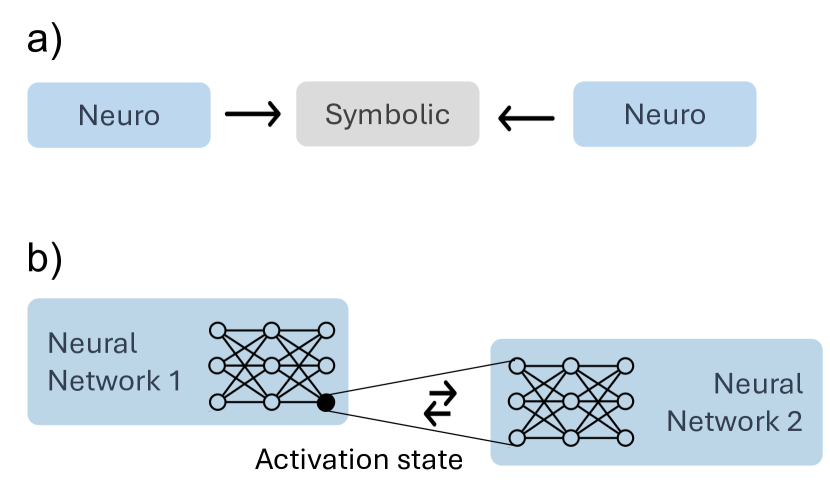
The image is a two-part technical diagram illustrating concepts in artificial intelligence, specifically focusing on neuro-symbolic integration and inter-network communication. It consists of two labeled sections, **a)** and **b)**, presented vertically on a plain white background. The diagram uses simple geometric shapes, lines, and text to convey architectural and process concepts.
### Components/Axes
The diagram is divided into two distinct components:
**Part a) - Neuro-Symbolic Integration Model**
* **Components:** Three rectangular boxes arranged horizontally.
* **Left Box:** Light blue rectangle containing the text "Neuro".
* **Center Box:** Light gray rectangle containing the text "Symbolic".
* **Right Box:** Light blue rectangle containing the text "Neuro".
* **Flow/Relationship:** Two black arrows indicate directionality.
* One arrow points from the left "Neuro" box to the central "Symbolic" box.
* Another arrow points from the right "Neuro" box to the central "Symbolic" box.
* **Spatial Layout:** The "Symbolic" box is centrally positioned, with the two "Neuro" boxes flanking it symmetrically on the left and right.
**Part b) - Neural Network Activation State Transfer**
* **Components:** Two stylized neural network diagrams and connecting elements.
* **Left Network:** A light blue rounded rectangle labeled "Neural Network 1". Inside is a schematic of a neural network with 3 layers of nodes (circles) connected by lines. One node in the middle layer is highlighted as a solid black circle.
* **Right Network:** A light blue rounded rectangle labeled "Neural Network 2". Inside is a similar schematic of a neural network with 3 layers of nodes.
* **Flow/Relationship:** A connection is shown between the two networks.
* Two thin black lines originate from the highlighted black node in "Neural Network 1" and connect to two different nodes in the first layer of "Neural Network 2".
* Between these connecting lines is a double-headed, zig-zag arrow (⇄) symbolizing a bidirectional exchange or transformation.
* Below this arrow is the label "Activation state".
* **Spatial Layout:** The two network boxes are placed side-by-side, with "Neural Network 1" on the left and "Neural Network 2" on the right. The connecting lines and arrow are positioned in the space between them.
### Detailed Analysis
* **Textual Content:** All text is in English. The extracted labels are:
* `a)`
* `Neuro`
* `Symbolic`
* `b)`
* `Neural Network 1`
* `Neural Network 2`
* `Activation state`
* **Visual Elements & Symbolism:**
* **Color Coding:** Light blue is used for neural ("Neuro") components. Light gray is used for the symbolic component. This color distinction visually separates the two paradigms.
* **Arrows in (a):** The arrows are unidirectional, pointing *toward* the "Symbolic" box. This suggests a flow of information or processing from neural modules into a symbolic reasoning or representation module.
* **Network Schematic in (b):** The networks are represented as fully connected layers (a common abstraction). The highlighted black node signifies a specific unit whose internal state (its "activation") is being extracted or referenced.
* **Connection in (b):** The lines from the single black node to multiple nodes in the second network illustrate a one-to-many relationship. The bidirectional arrow (⇄) labeled "Activation state" indicates that the state is not merely copied but may be transformed, compared, or used in a reciprocal process between the two networks.
### Key Observations
1. **Conceptual Progression:** Part **a)** presents a high-level architectural concept (neuro-symbolic integration), while part **b)** zooms in on a potential low-level mechanism (activation state transfer) that could enable such integration or collaboration between neural components.
2. **Directionality is Key:** In **a)**, the flow is convergent (many-to-one) towards the symbolic center. In **b)**, the flow is divergent (one-to-many) from a specific point in one network to another, with a bidirectional process indicated.
3. **Abstraction Level:** The diagram is highly abstract. It does not specify the nature of the "Neuro" modules, the rules of the "Symbolic" system, the architecture of the neural networks, or the mathematical form of the "Activation state".
### Interpretation
This diagram illustrates two complementary ideas in advanced AI systems:
1. **Hybrid Intelligence (Part a):** It proposes a model where sub-symbolic, pattern-recognition systems ("Neuro") feed processed information into a central, structured, rule-based system ("Symbolic"). This is a classic depiction of **neuro-symbolic AI**, aiming to combine the learning and perception strengths of neural networks with the reasoning, explainability, and precision of symbolic AI. The two "Neuro" boxes could represent different sensory modalities (e.g., vision and language) or different processing streams converging for integrated reasoning.
2. **Mechanism for Integration or Collaboration (Part b):** It suggests a technical method for how two distinct neural networks might communicate or share knowledge. By extracting the **activation state** (the pattern of activity) of a specific neuron or layer from "Network 1" and using it to influence or communicate with "Network 2", the system enables a form of **knowledge transfer, distillation, or collaborative processing**. The bidirectional arrow implies this could be part of a training procedure (like in some forms of adversarial or cooperative learning) or an inference-time communication protocol. This mechanism could be a building block for creating the "Neuro" components in part **a)** or for enabling them to interact effectively.
**Overall, the diagram moves from a conceptual framework for hybrid AI (a) to a potential implementation detail for enabling communication between neural components (b), which is a foundational challenge in building such integrated systems.**