\n
## Venn Diagram: Tokenization Method Overlap
### Overview
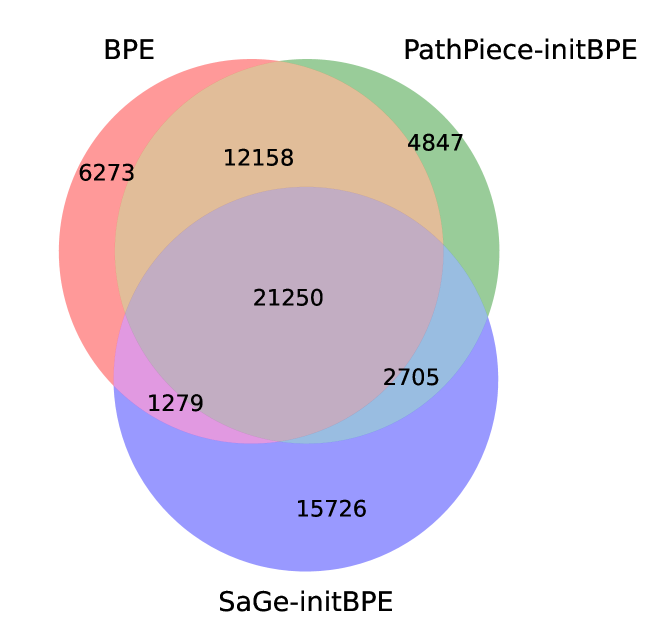
This image is a three-set Venn diagram illustrating the overlap and unique elements between three different tokenization or data processing methods: **BPE**, **PathPiece-initBPE**, and **SaGe-initBPE**. The diagram quantifies the number of items (likely tokens, subwords, or data points) that are exclusive to each method and those shared between two or all three methods.
### Components/Axes
* **Sets (Circles):**
* **BPE:** Represented by a red circle positioned in the top-left quadrant.
* **PathPiece-initBPE:** Represented by a green circle positioned in the top-right quadrant.
* **SaGe-initBPE:** Represented by a blue circle positioned in the bottom-center.
* **Labels:** Each circle is labeled with its method name in black text, placed outside the circle near its top edge.
* **Data Points:** Numerical values are placed directly within each distinct segment of the diagram, indicating the count for that specific intersection or unique set.
### Detailed Analysis
The diagram is divided into seven distinct regions, each with a specific count:
1. **BPE Only (Red, non-overlapping):** `6273`
2. **PathPiece-initBPE Only (Green, non-overlapping):** `4847`
3. **SaGe-initBPE Only (Blue, non-overlapping):** `15726`
4. **BPE ∩ PathPiece-initBPE (Red-Green overlap, excluding blue):** `12158`
5. **PathPiece-initBPE ∩ SaGe-initBPE (Green-Blue overlap, excluding red):** `2705`
6. **BPE ∩ SaGe-initBPE (Red-Blue overlap, excluding green):** `1279`
7. **BPE ∩ PathPiece-initBPE ∩ SaGe-initBPE (Central, all three overlap):** `21250`
**Spatial Grounding & Color Verification:**
* The number `6273` is placed in the red-only segment of the BPE circle (top-left).
* The number `4847` is placed in the green-only segment of the PathPiece-initBPE circle (top-right).
* The number `15726` is placed in the blue-only segment of the SaGe-initBPE circle (bottom-center).
* The number `12158` is in the overlapping area of the red (BPE) and green (PathPiece-initBPE) circles, which appears as a tan/brown color.
* The number `2705` is in the overlapping area of the green (PathPiece-initBPE) and blue (SaGe-initBPE) circles, which appears as a light blue/cyan color.
* The number `1279` is in the overlapping area of the red (BPE) and blue (SaGe-initBPE) circles, which appears as a purple/magenta color.
* The number `21250` is in the central region where all three circles (red, green, blue) overlap, appearing as a muted purple/grey.
### Key Observations
1. **Largest Unique Set:** The **SaGe-initBPE** method has the highest number of unique elements (`15726`), significantly more than BPE (`6273`) or PathPiece-initBPE (`4847`).
2. **Largest Overlap:** The largest intersection is the central region common to all three methods (`21250`), indicating a substantial core set of elements shared by all approaches.
3. **Pairwise Overlap Disparity:** The overlap between BPE and PathPiece-initBPE (`12158`) is much larger than the overlap between PathPiece-initBPE & SaGe-initBPE (`2705`) or BPE & SaGe-initBPE (`1279`). This suggests BPE and PathPiece-initBPE are more similar to each other than either is to SaGe-initBPE.
4. **Smallest Overlap:** The intersection between BPE and SaGe-initBPE (`1279`) is the smallest, highlighting these two methods as the most distinct pair in terms of their exclusive shared elements.
### Interpretation
This Venn diagram provides a quantitative comparison of three tokenization strategies, likely from a natural language processing or machine learning context. The data suggests:
* **Common Foundation:** A large core set of over 21,000 elements is fundamental to all three methods, representing a common vocabulary or data structure.
* **Methodological Divergence:** SaGe-initBPE appears to be the most distinct method, with a large proprietary set of elements (`15726`) and relatively small overlaps with the other two. This could indicate it captures different linguistic features or uses a different initialization strategy.
* **BPE and PathPiece Similarity:** The significant overlap between BPE and PathPiece-initBPE implies that PathPiece-initBPE may be an evolution or variant of standard BPE, retaining a large portion of its core elements while adding its own unique set (`4847`).
* **Practical Implications:** For a practitioner, this diagram helps answer questions like: "If I switch from BPE to SaGe-initBPE, how much of my existing vocabulary will be preserved?" (Answer: `1279 + 21250 = 22529` elements are shared). It also visually argues that SaGe-initBPE introduces the most novel elements into the ecosystem.