## Pseudocode: Residual Vector Quantization Algorithm
### Overview
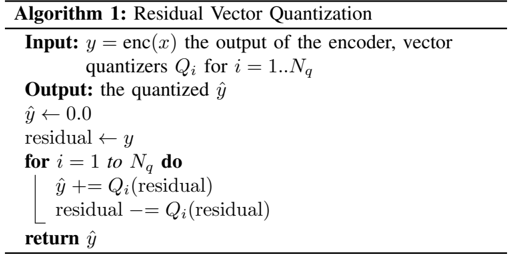
This pseudocode describes a quantization algorithm that iteratively applies a series of quantizers to an input vector `y` (output of an encoder) to produce a quantized output `ŷ`. The process involves updating a residual vector at each step to refine the quantization.
### Components/Axes
- **Input**:
- `y = enc(x)`: Output of an encoder function `enc` applied to input `x`.
- `Q_i` for `i = 1..N_q`: A vector of `N_q` quantizers, where each quantizer `Q_i` operates on the residual vector.
- **Output**:
- `ŷ`: The final quantized vector.
### Detailed Analysis
1. **Initialization**:
- `ŷ ← 0.0`: Initialize the quantized output to zero.
- `residual ← y`: Set the initial residual to the encoder output `y`.
2. **Iterative Quantization**:
For each quantizer `Q_i` (from `i = 1` to `N_q`):
- Update `ŷ` by adding the result of applying `Q_i` to the current residual:
`ŷ += Q_i(residual)`.
- Update the residual by subtracting the quantized value from the current residual:
`residual -= Q_i(residual)`.
3. **Termination**:
Return the final quantized vector `ŷ`.
### Key Observations
- The algorithm processes the input vector `y` sequentially through `N_q` quantizers, refining the quantization at each step.
- The residual vector is progressively reduced, ensuring that each quantizer operates on the remaining unquantized portion of `y`.
- The final output `ŷ` is a cumulative sum of quantized residuals from all `Q_i`.
### Interpretation
This algorithm is likely used in scenarios requiring efficient quantization of high-dimensional data (e.g., in neural network compression or signal processing). By iteratively applying quantizers to the residual, it balances quantization error across multiple stages, potentially improving the quality of the quantized representation compared to a single-stage quantization. The use of a residual ensures that earlier quantization steps do not dominate the final result, allowing finer adjustments in later stages.
No numerical values or trends are present in the image, as it describes an algorithm rather than data.