## Screenshot: Lean/HOL Light Theorem Definitions
### Overview
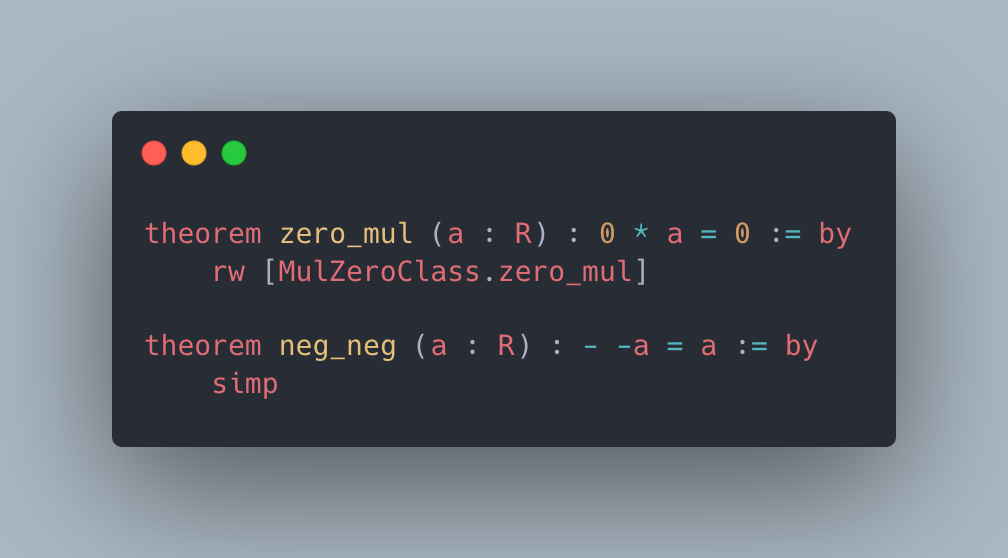
The image shows a code snippet from a formal proof assistant (likely Lean or HOL Light) defining two mathematical theorems. The syntax uses type annotations, proof tactics, and class-based reasoning.
### Components/Axes
- **Text Colors**:
- Red: Keywords (`theorem`, `by`, `rw`, `simp`)
- Yellow: Identifiers (`zero_mul`, `neg_neg`, `MulZeroClass.zero_mul`)
- White: Variables (`a`, `R`), operators (`*`, `-`, `=`), and tactics (`:=`)
- **Structure**:
- Two theorem definitions separated by blank lines.
- Each theorem includes a name, type signature, proposition, and proof tactic.
### Detailed Analysis
1. **Theorem `zero_mul`**:
- **Signature**: `theorem zero_mul (a : R) : 0 * a = 0`
- States that multiplying zero by any element `a` in type `R` yields zero.
- **Proof**: `:= by rw [MulZeroClass.zero_mul]`
- Uses the `rw` (rewrite) tactic with the `MulZeroClass.zero_mul` lemma.
2. **Theorem `neg_neg`**:
- **Signature**: `theorem neg_neg (a : R) : - -a = a`
- States that negating a number twice returns the original value.
- **Proof**: `:= by simp`
- Uses the `simp` (simplification) tactic to auto-derive the result.
### Key Observations
- Both theorems are axiomatic or derived via predefined lemmas (`MulZeroClass.zero_mul`) or automated simplification.
- The `rw` tactic explicitly references a class-based lemma, while `simp` relies on global simplification rules.
- Type `R` is unspecified but likely represents a ring or algebraic structure.
### Interpretation
This code demonstrates formal verification of basic algebraic properties:
- **Zero Multiplication**: Proves `0 * a = 0` using a class instance (`MulZeroClass`), ensuring consistency across algebraic structures.
- **Double Negation**: Proves `- -a = a` via simplification, leveraging built-in arithmetic rules.
- The use of `by` tactics (`rw`, `simp`) highlights the declarative nature of proof assistants, where proofs are constructed by chaining existing lemmas or automated steps.
No numerical data or trends are present; the focus is on symbolic reasoning and proof construction.