\n
## Diagram: Neural Network and Memristor Operation
### Overview
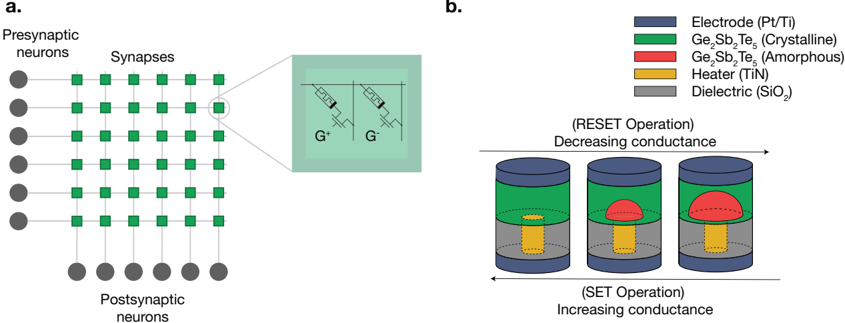
The image presents a diagram illustrating a neural network structure alongside a schematic of a memristor device and its operational states. Part (a) depicts a simplified neural network with presynaptic and postsynaptic neurons connected by synapses. Part (b) details the layered structure of a memristor and illustrates the "SET" and "RESET" operations, which correspond to increasing and decreasing conductance, respectively.
### Components/Axes
**Part (a): Neural Network**
* **Labels:** "Presynaptic neurons", "Synapses", "Postsynaptic neurons".
* The diagram shows a grid-like arrangement of neurons. Presynaptic neurons are on the left, postsynaptic neurons on the right, and synapses connect them.
**Part (b): Memristor Operation**
* **Legend:**
* Blue: Electrode (Pt/Ti)
* Green: Ge₂Sb₂Te₅ (Crystalline)
* Red: Ge₂Sb₂Te₅ (Amorphous)
* Yellow: Heater (TiN)
* Gray: Dielectric (SiO₂)
* **Labels:** "(RESET Operation) Decreasing conductance", "(SET Operation) Increasing conductance".
* The diagram shows a cylindrical structure representing the memristor, with layers corresponding to the legend. Two states are depicted: one with a crystalline Ge₂Sb₂Te₅ region (SET) and one with an amorphous Ge₂Sb₂Te₅ region (RESET).
### Detailed Analysis or Content Details
**Part (a): Neural Network**
* There are approximately 8 presynaptic neurons and 8 postsynaptic neurons.
* Each presynaptic neuron appears to connect to each postsynaptic neuron via a synapse.
* The inset shows a simplified circuit diagram with two transistors labeled "G+".
**Part (b): Memristor Operation**
* **Memristor Structure:** The memristor consists of a cylindrical structure with the following layers (from top to bottom): Electrode (Pt/Ti), Ge₂Sb₂Te₅ (Crystalline or Amorphous), Heater (TiN), and Dielectric (SiO₂).
* **RESET Operation:** In the RESET state, the Ge₂Sb₂Te₅ layer is amorphous (red). This corresponds to decreasing conductance.
* **SET Operation:** In the SET state, the Ge₂Sb₂Te₅ layer is crystalline (green). This corresponds to increasing conductance.
* The diagram visually demonstrates the change in the Ge₂Sb₂Te₅ phase as the mechanism for altering the memristor's conductance.
### Key Observations
* The diagram links the concept of a neural network to the physical operation of a memristor.
* The memristor's ability to change its conductance (SET/RESET) is presented as a potential mechanism for implementing synaptic plasticity in artificial neural networks.
* The crystalline/amorphous phase change of Ge₂Sb₂Te₅ is the core principle behind the memristor's functionality.
### Interpretation
The diagram illustrates a potential hardware implementation of artificial synapses using memristors. The neural network diagram (a) represents the computational structure, while the memristor diagram (b) provides a physical mechanism for implementing the synaptic connections and their plasticity. The ability to switch between crystalline and amorphous states in the Ge₂Sb₂Te₅ layer allows the memristor to mimic the behavior of a biological synapse, where the strength of the connection can be modified based on activity. This suggests a pathway towards building more energy-efficient and biologically inspired computing systems. The inset circuit diagram in (a) hints at the electronic control mechanisms involved in modulating the synaptic connections. The diagram highlights the potential of memristive devices to overcome the limitations of traditional CMOS-based neural networks.