## Diagram: Model Output Comparison
### Overview
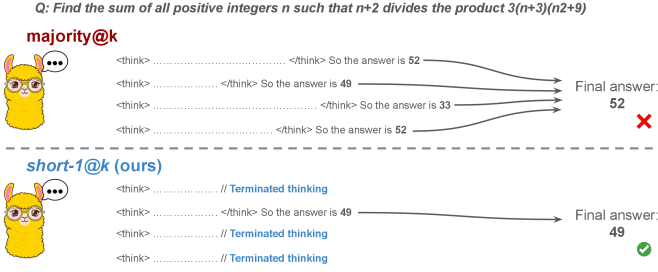
The image presents a comparison of the outputs from two models, "majority@k" and "short-1@k (ours)", in response to a mathematical question. It illustrates the reasoning steps (indicated by " So the answer is 49". The other three blocks are followed by "// Terminated thinking".
* Final answer: 49 (marked with a green checkmark, indicating a correct answer).
* **Visual elements:** Each model is represented by a cartoon llama with glasses and a speech bubble containing three dots. Arrows connect the reasoning steps to the final answers. A dashed line separates the two models.
### Detailed Analysis
* **majority@k:**
* The model outputs four potential answers during its reasoning process: 52, 49, 33, and 52.
* The final answer selected by the model is 52, which is marked as incorrect.
* **short-1@k (ours):**
* The model outputs one potential answer during its reasoning process: 49.
* The model terminates its thinking in three steps.
* The final answer selected by the model is 49, which is marked as correct.
### Key Observations
* The "majority@k" model provides multiple potential answers during its reasoning process, ultimately selecting an incorrect one.
* The "short-1@k (ours)" model provides one potential answer during its reasoning process, which is the correct answer.
* The "short-1@k (ours)" model explicitly indicates terminated thinking steps.
### Interpretation
The diagram demonstrates a comparison between two models' performance on a mathematical problem. The "majority@k" model, despite generating multiple potential answers, arrives at an incorrect final answer. In contrast, the "short-1@k (ours)" model arrives at the correct answer. The inclusion of "// Terminated thinking" in the "short-1@k (ours)" model suggests a more controlled or efficient reasoning process. The image suggests that "short-1@k (ours)" is a more reliable model for this type of problem.