## Diagram: Comparison of Reasoning Methods (majority@k vs. short-1@k)
### Overview
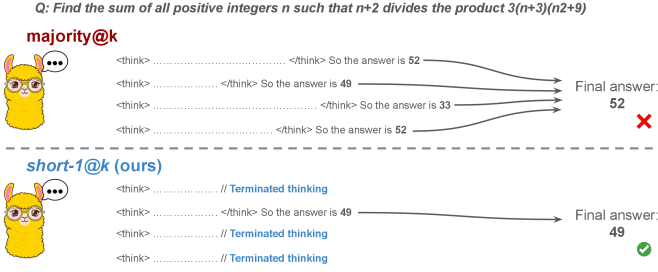
The image is a comparative diagram illustrating two different strategies for AI reasoning: "majority@k" and "short-1@k (ours)". It uses a mathematical problem as a test case to demonstrate how each method processes multiple reasoning paths.
#### Top Section: majority@k
* **Trend/Flow:** This method generates four reasoning paths and aggregates the final answers.
* **Data Points:**
* Path 1: ` So the answer is 52`
* Path 2: ` So the answer is 49`
* Path 3: ` So the answer is 33`
* Path 4: ` So the answer is 52`
* **Logic:** The method aggregates the results. Because "52" appears twice (the majority), the system selects 52 as the final answer.
* **Result:** The final answer is 52, marked with a red 'X', indicating this is an incorrect result.
#### Bottom Section: short-1@k (ours)
* **Trend/Flow:** This method generates four reasoning paths, but actively filters them.
* **Data Points:**
* Path 1: ` So the answer is 49`
* Path 3: `<think> ... // Terminated thinking`
* Path 4: `<think> ... // Terminated thinking`
* **Logic:** The system identifies and terminates invalid or incomplete reasoning paths (marked as "// Terminated thinking"). It isolates the single valid path that concludes with 49.
* **Result:** The final answer is 49, marked with a green checkmark, indicating this is the correct result.
### Key Observations
* **Majority Bias:** The "majority@k" method is shown to be flawed because it relies on the frequency of an answer rather than the correctness of the reasoning. It incorrectly converges on 52 because that answer was hallucinated or derived incorrectly twice.
* **Active Pruning:** The "short-1@k" method demonstrates a "pruning" or "early stopping" capability. By terminating invalid reasoning chains, it prevents incorrect answers from polluting the final output, allowing the correct answer (49) to be selected even when it is not the majority.
* **Visual Indicators:** The use of red text/X for the top section and blue text/checkmark for the bottom section creates a clear visual dichotomy between the "failed" method and the "successful" method.
### Interpretation
This diagram serves as a technical argument for a specific optimization in Large Language Model (LLM) reasoning.
The data suggests that standard "majority voting" (majority@k) is insufficient for complex mathematical problems because models can be consistently biased toward specific incorrect answers. The "short-1@k" method represents an improvement where the model (or a wrapper around the model) evaluates the quality of the reasoning process in real-time. By terminating paths that are likely to be incorrect (or "terminated thinking"), the system avoids the trap of consensus-based errors. This implies that the "short-1@k" approach is more robust, as it prioritizes the validity of the reasoning chain over the frequency of the output.