\n
## Diagram: Communication Protocol Problems & Solution
### Overview
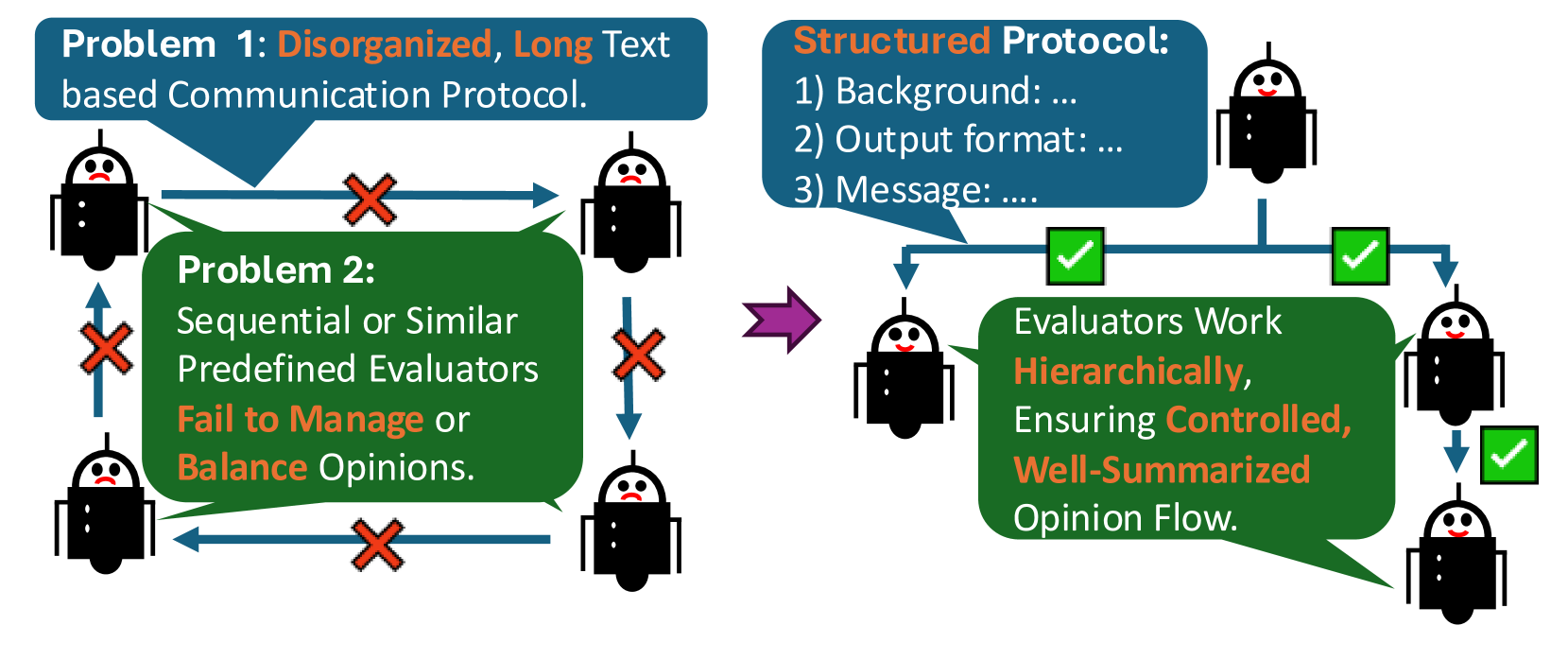
The image presents a diagram illustrating two problems with communication protocols and a proposed structured protocol as a solution. The left side depicts two problematic scenarios, while the right side shows the improved flow with the structured protocol. The diagram uses stylized robot icons and arrows to represent communication and evaluation processes.
### Components/Axes
The diagram is divided into two main sections: "Problem 1 & 2" on the left and "Structured Protocol" on the right.
* **Problem 1:** "Disorganized, Long Text based Communication Protocol."
* **Problem 2:** "Sequential or Similar Predefined Evaluators Fail to Manage or Balance Opinions."
* **Structured Protocol:**
* 1) Background: ...
* 2) Output format: ...
* 3) Message: ...
* **Icons:** Stylized robot heads representing communicators/evaluators.
* **Arrows:** Blue arrows with red "X" marks indicate failed or problematic communication. Green arrows with checkmarks indicate successful communication.
* **Text Box:** "Evaluators Work Hierarchically, Ensuring Controlled, Well-Summarized Opinion Flow."
### Detailed Analysis or Content Details
**Problem 1:** Two robot icons are connected by a bidirectional blue arrow with a red "X" mark in the center. This indicates a failed communication attempt due to a disorganized, long-text protocol.
**Problem 2:** Four robot icons are arranged in a square, with bidirectional blue arrows and red "X" marks between them. This illustrates a failure in managing or balancing opinions when using sequential or similar predefined evaluators.
**Structured Protocol:** A series of three robot icons are connected by green arrows with checkmarks. The first robot sends a message to the second, which then passes it to the third. The flow is unidirectional. A text box positioned near the middle of the flow states: "Evaluators Work Hierarchically, Ensuring Controlled, Well-Summarized Opinion Flow." The protocol is defined by three steps: Background, Output format, and Message. The content of each step is represented by "...".
### Key Observations
* The diagram clearly contrasts problematic communication scenarios with a proposed solution.
* The use of red "X" marks and green checkmarks effectively highlights the success or failure of communication.
* The hierarchical structure of the "Structured Protocol" is emphasized by the unidirectional flow and the text box.
* The problems are presented as cyclical, while the solution is linear.
### Interpretation
The diagram suggests that unstructured, long-form communication and the use of similar evaluators can lead to communication breakdowns and unbalanced opinions. The proposed "Structured Protocol" aims to address these issues by introducing a hierarchical evaluation process that ensures controlled and well-summarized opinion flow. The three-step protocol (Background, Output format, Message) likely represents a framework for organizing communication to improve clarity and efficiency. The diagram implies that a structured approach is crucial for effective communication, particularly when dealing with multiple evaluators and potentially conflicting opinions. The use of robots suggests this protocol is intended for automated or AI-driven communication systems. The "..." in the protocol steps indicate that the specific details of each step are not defined within the diagram, but the framework is presented.