## Directed Acyclic Graph (DAG) Diagram: Causal or Probabilistic Relationships
### Overview
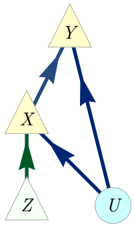
The image displays a directed acyclic graph (DAG) consisting of four nodes connected by directed edges (arrows). The diagram visually represents relationships, likely causal or probabilistic dependencies, between variables labeled X, Y, Z, and U. The nodes are distinguished by shape and color, and the edges are distinguished by color.
### Components/Axes
**Nodes:**
1. **Node Y**: A light yellow triangle positioned at the top-center of the diagram.
2. **Node X**: A light yellow triangle positioned in the middle-left area, below and to the left of Y.
3. **Node Z**: A white triangle positioned at the bottom-left corner.
4. **Node U**: A light cyan circle positioned at the bottom-right corner.
**Edges (Directed Arrows):**
* **From Z to X**: A thick, dark green arrow pointing upward from Z to X.
* **From X to Y**: A thick, dark blue arrow pointing upward and to the right from X to Y.
* **From U to X**: A thick, dark blue arrow pointing upward and to the left from U to X.
* **From U to Y**: A thick, dark blue arrow pointing upward from U to Y.
**Spatial Layout:**
* The overall structure forms a rough diamond or kite shape.
* **Y** is the apex node.
* **Z** and **U** form the base corners (left and right, respectively).
* **X** is an intermediate node between Z and Y, and also receives an input from U.
### Detailed Analysis
**Node Characteristics:**
* **Shape Meaning**: The use of triangles (X, Y, Z) versus a circle (U) suggests a categorical distinction between the variables. In causal diagrams, different shapes can represent different types of variables (e.g., observed vs. latent, treatment vs. outcome).
* **Color Meaning**: The color difference (yellow/white triangles vs. cyan circle) reinforces the categorical distinction implied by the shapes.
**Edge Characteristics & Flow:**
1. **Primary Path (Z → X → Y)**: A green arrow connects Z to X, and a blue arrow connects X to Y. This suggests a potential causal chain where Z influences X, which in turn influences Y.
2. **Direct Influences from U**: Node U has two outgoing blue arrows: one to X and one to Y. This indicates that U is a common cause or confounder affecting both X and Y directly.
3. **Color Coding of Edges**: The single green arrow (Z→X) is visually distinct from the three blue arrows. This likely signifies a different type of relationship. For example, green could represent a direct experimental manipulation or a specific pathway of interest, while blue represents standard probabilistic dependencies or confounding paths.
### Key Observations
1. **U is a Confounder**: Node U is a parent to both X and Y. In a causal context, this creates a "backdoor path" (U → X and U → Y) that induces a non-causal association between X and Y, even if X does not directly cause Y.
2. **X is a Mediator**: Node X sits on the path from Z to Y, potentially mediating the effect of Z on Y.
3. **No Direct Z→Y Link**: There is no arrow directly from Z to Y. Any effect of Z on Y must be mediated through X.
4. **Acyclic Structure**: No node is reachable from itself by following the arrows, confirming it is a DAG.
### Interpretation
This diagram is a classic representation used in causal inference, statistics, and machine learning to model assumptions about data-generating processes.
* **What it Suggests**: The model posits that variable **Y** (often an outcome) is influenced by two direct causes: **X** (a treatment or mediator) and **U** (a confounder). **X** itself is influenced by **Z** (an instrument or upstream cause) and **U**. **Z**'s influence on **Y** is fully mediated by **X**.
* **Relationships**: The core relationship under study is likely the effect of **X** on **Y**. However, this relationship is confounded by **U**, which affects both. The variable **Z** may be used as an instrumental variable to estimate the causal effect of **X** on **Y**, provided **Z** satisfies the instrumental variable assumptions (it affects Y only through X, and does not share common causes with Y).
* **Notable Implications**:
* The green arrow (Z→X) highlights the specific, possibly exogenous, influence of Z on X, which is critical for instrumental variable analysis.
* The diagram makes explicit that simply observing a correlation between X and Y is insufficient to infer causation due to the confounding path through U.
* To estimate the causal effect of X on Y, one must "block" the backdoor path via U (e.g., by conditioning on U if measured) or use methods like instrumental variable regression leveraging Z.
**In summary, this is not a data chart but a conceptual model. It encodes assumptions about causal structure, identifying U as a confounder, X as a mediator, and Z as a potential instrument for isolating the causal effect of X on Y.**