## Nonogram Puzzle: Partially Solved 10x10 Grid
### Overview
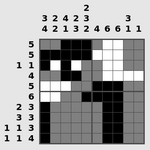
The image displays a nonogram (also known as picross or griddlers) puzzle. It consists of a 10x10 grid with numerical clues placed above each column and to the left of each row. The grid is partially filled with black (filled), white (empty), and gray (likely uncertain or in-progress) cells. The puzzle appears to be in a state of partial solution.
### Components/Axes
- **Main Grid**: 10 rows × 10 columns.
- **Column Clues**: Positioned above the grid in a tabular layout with 8 rows and 10 columns. Each column's clues are listed vertically.
- **Row Clues**: Positioned to the left of the grid in a tabular layout with 10 rows and up to 3 columns. Each row's clues are listed horizontally.
- **Cell States**:
- Black: Filled cell.
- White: Empty cell.
- Gray: Uncertain or partially filled cell (common in puzzle interfaces).
### Detailed Analysis
#### Column Clues (from left to right, top to bottom for each column)
- **Column 1**: [3, 2, 4, 2] (rows 1–4)
- **Column 2**: [2, 3, 2, 4, 6, 0, 1, 1] (rows 1–8)
- **Column 3**: [4, 2, 3, 2] (rows 1–4)
- **Column 4**: [2, 4, 6, 0, 1, 1] (rows 1–6)
- **Column 5**: [2, 3] (rows 1–2)
- **Column 6**: [2, 4, 6, 0, 1, 1] (rows 1–6)
- **Column 7**: [3] (row 1)
- **Column 8**: [2, 3] (rows 1–2)
- **Column 9**: [2, 4, 6, 0, 1, 1] (rows 1–6)
- **Column 10**: [1, 1] (rows 1–2)
#### Row Clues (from top to bottom, left to right for each row)
- **Row 1**: [5, 5]
- **Row 2**: [1, 1]
- **Row 3**: [4, 4]
- **Row 4**: [1, 1]
- **Row 5**: [5, 5]
- **Row 6**: [2, 2]
- **Row 7**: [3, 3]
- **Row 8**: [1, 1, 3]
- **Row 9**: [1, 1, 3]
- **Row 10**: [1, 1, 4]
#### Grid State (Approximate Visual Pattern)
- **Upper Left Quadrant (Rows 1–4, Columns 1–4)**: Contains a cluster of black cells, suggesting filled blocks. For example, Row 1 has black cells in Columns 1–4.
- **Upper Right Quadrant (Rows 1–4, Columns 5–10)**: Mostly white cells, indicating empty spaces.
- **Lower Left Quadrant (Rows 5–10, Columns 1–4)**: Mix of white and black cells, with some gray cells appearing.
- **Lower Right Quadrant (Rows 5–10, Columns 5–10)**: Dominated by gray cells, with a few black cells in Columns 8–9 (e.g., Row 6 Column 8, Row 7 Column 9). This area appears unresolved or in progress.
### Key Observations
1. **Clue Complexity**: Column 2 has an unusually high number of clues (8 blocks), which is atypical for a 10-row grid, as the minimum required cells would exceed 10. This suggests the clues might represent a different encoding or the puzzle is non-standard.
2. **Gray Cells**: The concentration of gray cells in the lower right indicates this section is likely unsolved or under consideration.
3. **Pattern Asymmetry**: The black cells are not uniformly distributed, hinting at an underlying image or shape once solved.
4. **Clue Repetition**: Columns 4, 6, and 9 share identical clue sequences [2, 4, 6, 0, 1, 1], which is unusual and may indicate a repeating pattern or error.
### Interpretation
This nonogram puzzle presents a logical challenge where the solver must use the numerical clues to determine which cells to fill. The clues represent the lengths of consecutive filled cells in each row and column, separated by at least one empty cell. However, the extracted clues for some columns (e.g., Column 2) seem mathematically inconsistent with a 10-cell grid, suggesting either:
- The puzzle uses a non-standard rule set (e.g., allowing zero-length blocks or overlapping).
- The image captures a work-in-progress where clues are being adjusted.
- The gray cells represent a "guess" mode in a digital solver, where the user is testing hypotheses.
The partially filled grid implies the solver has made progress, particularly in the upper left, but the lower right remains ambiguous. The repetition in column clues might hint at a symmetrical or patterned final image. Overall, the puzzle demonstrates the interplay between numerical constraints and spatial reasoning, with the gray areas highlighting the iterative nature of problem-solving.