## Line Chart: DeepProbLog Loss Curve
### Overview
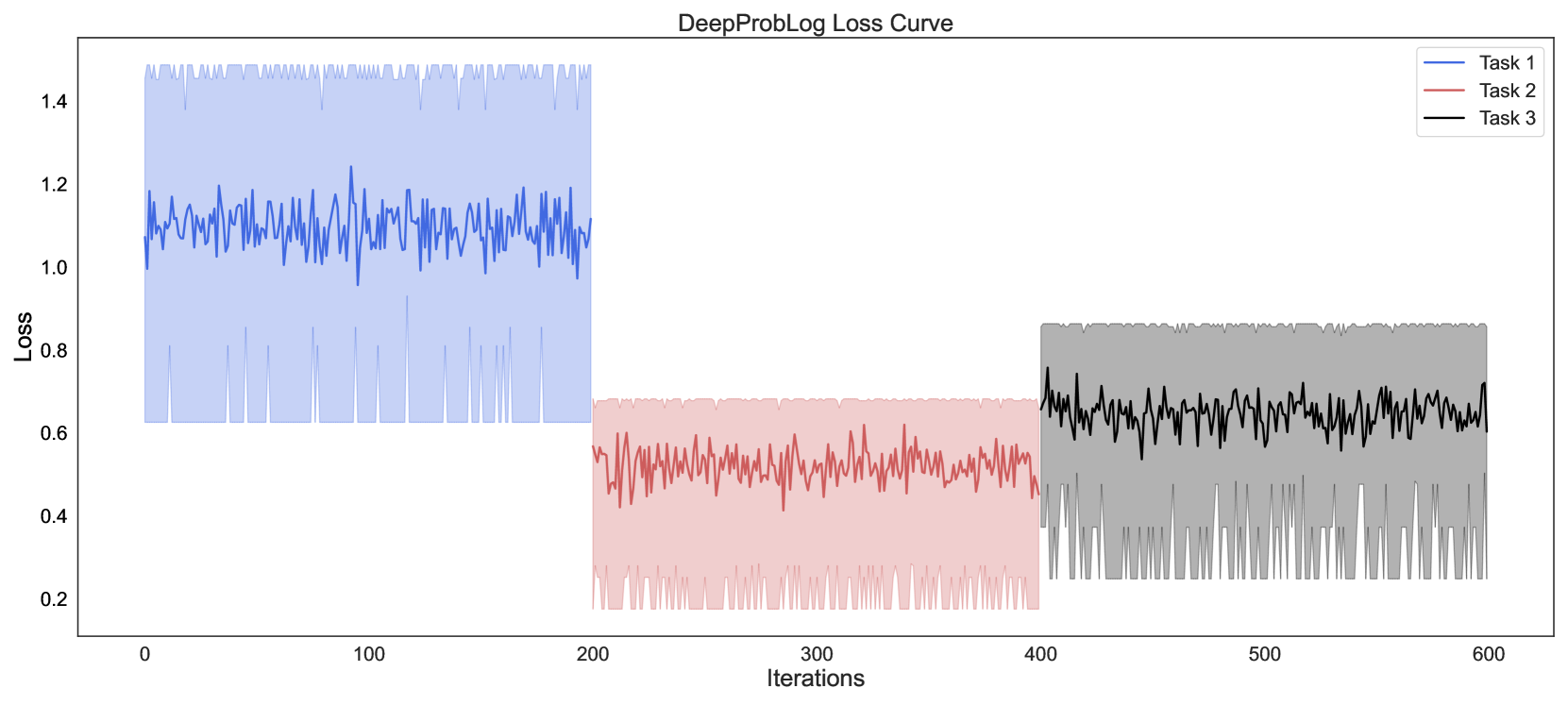
The image is a line chart titled "DeepProbLog Loss Curve". It displays the loss values for three tasks (Task 1, Task 2, and Task 3) over a range of iterations. Each task's loss is represented by a different colored line: blue for Task 1, red for Task 2, and black for Task 3. The chart shows how the loss changes over iterations for each task.
### Components/Axes
* **Title:** DeepProbLog Loss Curve
* **X-axis:** Iterations, with tick marks at 0, 100, 200, 300, 400, 500, and 600.
* **Y-axis:** Loss, with tick marks at 0.2, 0.4, 0.6, 0.8, 1.0, 1.2, and 1.4.
* **Legend:** Located in the top-right corner, it identifies the lines as:
* Task 1 (blue)
* Task 2 (red)
* Task 3 (black)
### Detailed Analysis
* **Task 1 (Blue):** The blue line representing Task 1 starts at iteration 0 and extends to approximately iteration 200. The loss fluctuates around an average value of approximately 1.1, with variations between approximately 0.6 and 1.5.
* **Task 2 (Red):** The red line representing Task 2 starts at approximately iteration 200 and extends to approximately iteration 400. The loss fluctuates around an average value of approximately 0.5, with variations between approximately 0.2 and 0.7.
* **Task 3 (Black):** The black line representing Task 3 starts at approximately iteration 400 and extends to approximately iteration 600. The loss fluctuates around an average value of approximately 0.7, with variations between approximately 0.4 and 0.9.
### Key Observations
* Each task is active for a specific range of iterations.
* Task 1 has the highest loss values, followed by Task 3, and then Task 2.
* The loss values for each task fluctuate, indicating variations in performance during training.
### Interpretation
The chart illustrates the training progress of three different tasks within the DeepProbLog framework. The loss curve for each task shows how well the model is learning over iterations. The fact that each task is active for a specific range of iterations suggests a sequential or staged training process. The different loss values indicate varying levels of difficulty or complexity for each task. The fluctuations in loss suggest that the model is still learning and adapting during the active iterations for each task.