## Diagram: LLM Workflow for Reasoning and Code Generation
### Overview
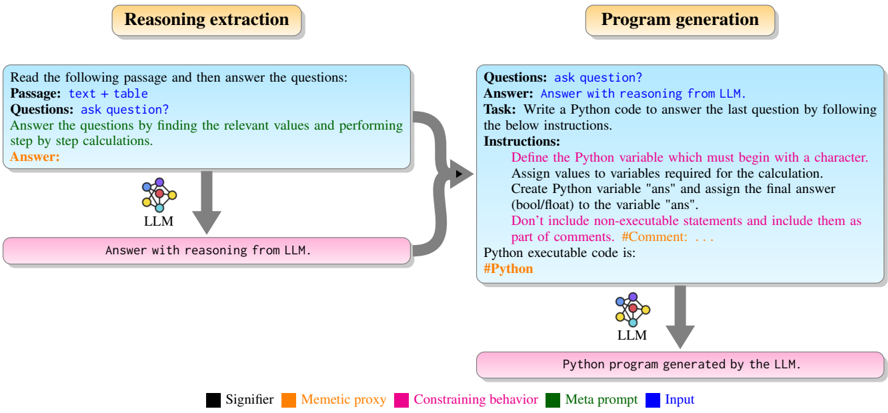
The diagram illustrates a two-stage process for utilizing a Large Language Model (LLM) to extract reasoning from text and generate executable Python code. The workflow is divided into **Reasoning Extraction** (left) and **Program Generation** (right), with bidirectional arrows indicating iterative refinement between stages.
---
### Components/Axes
1. **Header**:
- Title: "Reasoning extraction" (left) and "Program generation" (right), both in bold yellow boxes.
2. **Main Sections**:
- **Reasoning Extraction**:
- Input: "Read the following passage and then answer the questions: Passage: text + table"
- Output: "Answer with reasoning from LLM."
- Includes a flowchart with interconnected nodes (colored circles) representing LLM processing steps.
- **Program Generation**:
- Input: "Questions: ask question?" and "Answer: Answer with reasoning from LLM."
- Task: "Write a Python code to answer the last question by following the below instructions."
- Instructions include variable naming rules (e.g., "Define the Python variables required for the calculation") and constraints (e.g., "Don’t include non-executable statements").
3. **Legend** (bottom center):
- Colors and labels:
- **Signifier**: Black (not visibly used in diagram).
- **Mementic proxy**: Orange (not visibly used).
- **Constraining behavior**: Pink (used for "Answer with reasoning from LLM" text).
- **Meta prompt**: Green (not visibly used).
- **Input**: Blue (used for LLM icons and text boxes).
---
### Detailed Analysis
1. **Reasoning Extraction**:
- **Input**: Text + table (unspecified content).
- **Process**: LLM analyzes the passage to identify relevant values and perform step-by-step calculations.
- **Output**: Structured answer with embedded reasoning (e.g., "Answer: [LLM-generated text]").
2. **Program Generation**:
- **Input**: Previous LLM answer (e.g., "Answer: ...").
- **Task**: Generate Python code adhering to strict formatting rules:
- Variables must start with a character.
- Final answer assigned to variable `ans`.
- Comments must include `#Comment: ...` and exclude non-executable code.
- **Output**: Python program generated by LLM (e.g., "Python program generated by the LLM").
---
### Key Observations
1. **Bidirectional Flow**: Arrows between sections suggest iterative refinement (e.g., revising reasoning to improve code generation).
2. **Color Coding**:
- Pink highlights critical outputs ("Answer with reasoning from LLM").
- Blue dominates LLM-related elements (icons, text boxes).
3. **Constraints**: Explicit rules for code generation (e.g., variable naming, comment formatting) emphasize precision.
---
### Interpretation
This diagram outlines a structured workflow for leveraging LLMs in technical tasks:
1. **Reasoning Extraction** focuses on deriving logical steps from unstructured text/tables.
2. **Program Generation** translates these steps into executable code, enforcing syntactic and semantic constraints to ensure validity.
3. The use of color-coded labels (e.g., "Constraining behavior") suggests a framework for controlling LLM outputs, balancing creativity with adherence to technical requirements.
The process emphasizes **iterative refinement**, where reasoning and code generation are interdependent. For example, ambiguous reasoning might require revisiting the text passage, while code errors could prompt revisiting the LLM’s initial answer. This mirrors real-world scenarios where LLMs assist in bridging natural language understanding and technical implementation.