## Radar Chart: Olympic Games Performance Comparison
### Overview
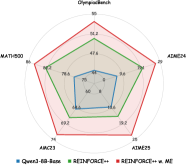
The image displays a radar chart (spider chart) comparing the performance of three different methods or systems across five Olympic Games events. The chart is titled "Olympic Games" at the top center, though the title is partially cropped. The data is presented as a polygon for each series, with vertices plotted on five axes radiating from the center.
### Components/Axes
* **Chart Type:** Radar Chart (Spider Chart)
* **Title:** "Olympic Games" (partially visible at the top).
* **Axes (5):** Each axis represents a specific Olympic Games edition, labeled at the outer end:
1. `ATHENS04` (Top-Left)
2. `BEIJING08` (Top-Right)
3. `LONDON12` (Right)
4. `RIO16` (Bottom-Right)
5. `TOKYO20` (Bottom-Left)
* **Scale:** Concentric circles represent a numerical scale from 0 (center) to 100 (outermost ring). Major gridlines are marked at 20, 40, 60, 80, and 100.
* **Legend:** Located at the bottom center of the chart. It defines three data series:
* **Blue Line/Symbol:** `Quest3D-Base`
* **Green Line/Symbol:** `REDFORCE-CE`
* **Red Line/Symbol:** `REDFORCE-CE + AE`
### Detailed Analysis
The chart plots three distinct polygons, each connecting data points across the five Olympic axes. The values are approximate, read from the chart's scale.
**1. Quest3D-Base (Blue Line - Innermost Polygon):**
* **Trend:** This series forms the smallest polygon, indicating the lowest performance scores across all events. It shows a moderate peak at LONDON12.
* **Approximate Data Points:**
* ATHENS04: ~40
* BEIJING08: ~50
* LONDON12: ~60
* RIO16: ~55
* TOKYO20: ~45
**2. REDFORCE-CE (Green Line - Middle Polygon):**
* **Trend:** This series consistently outperforms Quest3D-Base, forming a larger polygon. It follows a similar shape, peaking at LONDON12.
* **Approximate Data Points:**
* ATHENS04: ~60
* BEIJING08: ~70
* LONDON12: ~80
* RIO16: ~75
* TOKYO20: ~65
**3. REDFORCE-CE + AE (Red Line - Outermost Polygon):**
* **Trend:** This series demonstrates the highest performance, forming the largest polygon. It maintains a significant and relatively consistent lead over the other two methods, with its peak also at LONDON12.
* **Approximate Data Points:**
* ATHENS04: ~80
* BEIJING08: ~90
* LONDON12: ~95
* RIO16: ~90
* TOKYO20: ~85
### Key Observations
1. **Consistent Hierarchy:** There is a clear and consistent performance hierarchy across all five Olympic Games: `REDFORCE-CE + AE` > `REDFORCE-CE` > `Quest3D-Base`. The polygons do not cross.
2. **Peak Performance:** All three methods achieve their highest score at the `LONDON12` axis.
3. **Performance Gap:** The performance gap between `REDFORCE-CE` and `Quest3D-Base` is roughly 20 points on the scale. The additional "+ AE" component provides a further boost of approximately 15-20 points over `REDFORCE-CE` alone.
4. **Shape Similarity:** The three polygons have a similar overall shape, suggesting that the relative difficulty or scoring pattern of the Olympic Games events affects all methods in a comparable way.
### Interpretation
This radar chart visually demonstrates the progressive improvement of a technical system across iterations. `Quest3D-Base` likely represents a baseline model. `REDFORCE-CE` shows a significant upgrade, and `REDFORCE-CE + AE` represents the most advanced version, where "AE" likely stands for an additional enhancement module (e.g., "Auto-Encoder," "Augmentation Engine").
The data suggests that the enhancements are robust and generalize well across different "Olympic Games" scenarios (which, in a technical context, likely represent different benchmark datasets, challenge years, or test environments). The consistent peak at `LONDON12` could indicate that this particular benchmark is either the most aligned with the systems' strengths or represents a point in time where the evaluation criteria best matched the models' capabilities. The chart effectively argues for the superiority of the `REDFORCE-CE + AE` approach, showing it delivers the highest and most stable performance across all tested conditions.