## Diagrams: Transformer Architectures Comparison
### Overview
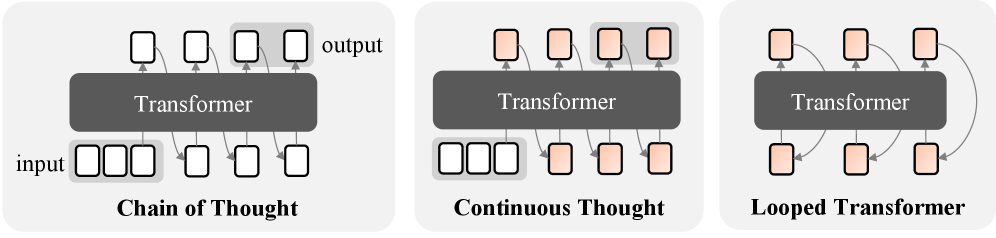
The image presents three side-by-side diagrams illustrating variations of Transformer-based architectures: **Chain of Thought**, **Continuous Thought**, and **Looped Transformer**. Each diagram depicts a "Transformer" block with distinct input-output configurations, emphasizing differences in processing flow and structural design.
### Components/Axes
1. **Chain of Thought**:
- **Input**: Three white boxes labeled "input" connected to the Transformer.
- **Transformer**: Central gray block labeled "Transformer."
- **Output**: Three white boxes labeled "output" receiving processed data.
- **Flow**: Linear progression from input → Transformer → output.
2. **Continuous Thought**:
- **Input**: Three white boxes labeled "input" connected to the Transformer.
- **Transformer**: Central gray block labeled "Transformer."
- **Output**: Four beige boxes labeled "output," with two highlighted in light gray.
- **Flow**: Linear input → Transformer → output, with additional intermediate processing steps (beige boxes).
3. **Looped Transformer**:
- **Input**: Three beige boxes connected to the Transformer.
- **Transformer**: Central gray block labeled "Transformer."
- **Output**: Three beige boxes with a feedback loop (curved arrow) connecting the Transformer to the output.
- **Flow**: Input → Transformer → output, with a recursive loop enabling iterative processing.
### Detailed Analysis
- **Chain of Thought**:
- Simplest architecture with direct input-output mapping.
- No feedback or intermediate steps.
- All boxes are uniformly white, emphasizing a static, one-pass processing model.
- **Continuous Thought**:
- Introduces **intermediate processing steps** (beige boxes) between the Transformer and output.
- Two output boxes are highlighted in light gray, suggesting prioritization or selective processing.
- Maintains linear flow but adds complexity via additional computational stages.
- **Looped Transformer**:
- Features a **feedback loop** (curved arrow) from the Transformer to the output, enabling iterative refinement.
- Input and output boxes are beige, potentially indicating dynamic or adaptive data handling.
- Loop suggests memory retention or recurrent processing capabilities.
### Key Observations
1. **Structural Complexity**:
- Chain of Thought is the most basic, while Looped Transformer introduces recursion.
- Continuous Thought bridges the two with intermediate steps but no feedback.
2. **Color Coding**:
- White boxes (Chain of Thought) vs. beige boxes (Continuous/Looped) may denote input/output types or processing stages.
- Highlighted gray boxes in Continuous Thought imply selective focus.
3. **Flow Direction**:
- All diagrams use top-to-bottom flow, but Looped Transformer adds lateral feedback.
### Interpretation
These diagrams likely represent theoretical or conceptual models for enhancing Transformer architectures:
- **Chain of Thought** aligns with traditional, non-recurrent models.
- **Continuous Thought** introduces modular processing, possibly for tasks requiring staged computation (e.g., multi-step reasoning).
- **Looped Transformer** incorporates feedback loops, suggesting applications in dynamic environments (e.g., real-time adaptation, memory-augmented systems).
The progression from linear to recursive architectures highlights efforts to improve context retention, iterative learning, or task-specific optimization in Transformer-based systems. The absence of numerical data implies these are conceptual frameworks rather than empirical results.