## Diagram: Autoregressive Model Architecture
### Overview
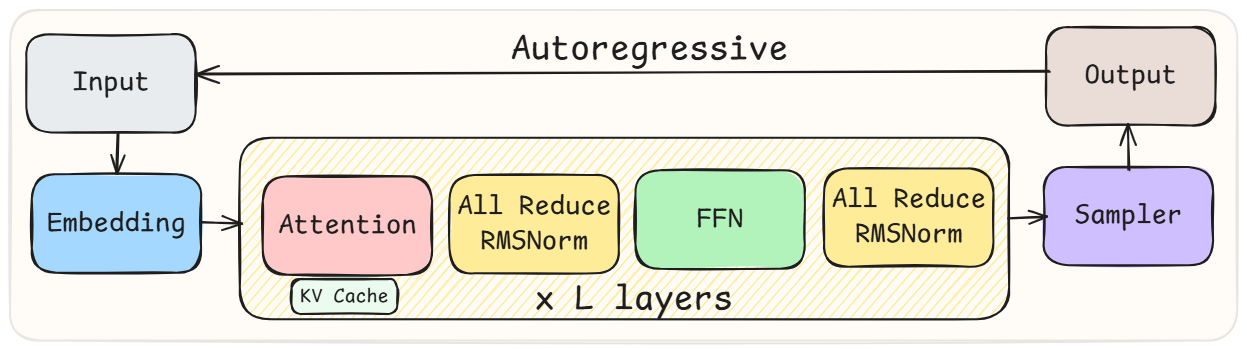
This image is a schematic flow diagram illustrating the high-level architecture of an autoregressive model, likely a Transformer-based Large Language Model (LLM). It depicts the data processing pipeline, emphasizing the iterative nature of the model, the internal layer structure, and the distributed computing components.
### Components/Axes
The diagram is organized as a loop with a central processing block.
**External Components:**
* **Top-Left:** "Input" block (white/grey).
* **Middle-Left:** "Embedding" block (light blue).
* **Middle-Right:** "Sampler" block (light purple).
* **Top-Right:** "Output" block (light brown).
* **Top (Arcing Arrow):** Labeled "Autoregressive" with an arrow pointing from the Output block back to the Input block.
**Central Processing Container:**
* A large, light-yellow rounded rectangle spans the center of the diagram, labeled "**x L layers**" at the bottom center. This indicates that the sequence of operations inside this box is repeated $L$ times.
**Internal Components (Inside the "x L layers" container, ordered left-to-right):**
1. **Attention:** A pink block. Below this block is a smaller, distinct label: "**KV Cache**".
2. **All Reduce RMSNorm:** A yellow block.
3. **FFN:** A green block (Feed-Forward Network).
4. **All Reduce RMSNorm:** A yellow block.
### Detailed Analysis
The flow of data follows a sequential path through the architecture:
1. **Initialization:** Data enters the system at the **Input** block.
2. **Embedding:** The input is passed to the **Embedding** block, which converts tokens into vector representations.
3. **Processing (The "L layers" block):** The embedded data enters the large container, which represents the core Transformer blocks. The data passes through:
* **Attention:** The primary mechanism for contextual understanding, supported by a **KV Cache** (Key-Value Cache) to store previous states and optimize inference speed.
* **All Reduce RMSNorm:** A normalization step (Root Mean Square Layer Normalization) combined with an "All Reduce" operation.
* **FFN:** The Feed-Forward Network, which processes the attention output.
* **All Reduce RMSNorm:** A second normalization and synchronization step.
* *Note:* The "x L layers" label indicates this entire sequence is stacked $L$ times.
4. **Generation:** The processed data exits the layers and enters the **Sampler** block, which selects the next token.
5. **Output:** The result is produced at the **Output** block.
6. **Feedback Loop:** The "Autoregressive" arrow indicates that the generated output is fed back into the "Input" block to generate the next token, completing the cycle.
### Key Observations
* **Distributed Computing Focus:** The inclusion of "All Reduce" within the layer structure is significant. It indicates that this architecture is designed for distributed environments (e.g., multi-GPU or multi-node setups), where synchronization (All Reduce) is required after the Attention and FFN operations to ensure consistency across parallel processors.
* **Inference Optimization:** The explicit labeling of "KV Cache" under the "Attention" block highlights the importance of memory management in autoregressive inference, where caching previous keys and values is critical to avoid redundant computation.
* **Standard Transformer Structure:** The sequence (Attention -> Norm -> FFN -> Norm) is a standard configuration for modern decoder-only Transformer architectures.
### Interpretation
This diagram represents the operational loop of a distributed LLM inference engine.
The "Autoregressive" label is the defining characteristic: the model generates one token at a time, and that token becomes part of the input for the next step. The diagram explicitly calls out the two most computationally expensive and communication-heavy parts of the Transformer block: the Attention mechanism and the Feed-Forward Network (FFN).
By placing "All Reduce" operations after both the Attention and FFN blocks, the diagram suggests a parallelized architecture where the model's weights or activations are sharded across multiple devices. The "All Reduce" operation is the synchronization point where these devices communicate to aggregate results before proceeding to the next stage. The "KV Cache" is the critical component that allows the model to maintain context without recomputing the entire sequence history at every step of the autoregressive loop.