## Flowchart Diagram: Logical Inheritance and Constraints for "Tweety"
### Overview
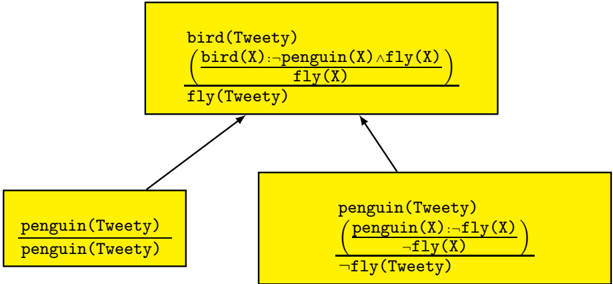
The diagram illustrates a hierarchical logical structure defining relationships and constraints between entities labeled "bird(Tweety)" and "penguin(Tweety)". Arrows indicate directional dependencies or inheritance, with logical formulas specifying rules governing these relationships.
### Components/Axes
1. **Top Rectangle**:
- Label: `bird(Tweety)`
- Formula:
```
(bird(X) := penguin(X) ∧ fly(X))
fly(X)
fly(Tweety)
```
- Position: Top-center, acting as the root node.
2. **Left Rectangle**:
- Label: `penguin(Tweety)`
- Formula:
```
penguin(X) := penguin(X) ∧ ¬fly(X)
¬fly(X)
¬fly(Tweety)
```
- Position: Bottom-left, connected to the root via an arrow.
3. **Right Rectangle**:
- Label: `penguin(Tweety)`
- Formula:
```
penguin(X) := penguin(X) ∧ ¬fly(X)
¬fly(X)
¬fly(Tweety)
```
- Position: Bottom-right, connected to the root via an arrow.
### Detailed Analysis
- **Logical Formulas**:
- The root node defines `bird(X)` as a penguin that can fly (`penguin(X) ∧ fly(X)`), with `fly(Tweety)` asserting Tweety flies.
- Both penguin nodes define `penguin(X)` as a penguin that cannot fly (`penguin(X) ∧ ¬fly(X)`), with `¬fly(Tweety)` asserting Tweety does not fly.
- Contradiction: The root claims `fly(Tweety)`, while the penguin nodes claim `¬fly(Tweety)`.
- **Arrows**:
- Two arrows from the root node point to the penguin nodes, suggesting inheritance or derivation of properties from the root to the penguin instances.
### Key Observations
1. **Contradiction**: The root node asserts `fly(Tweety)`, while the penguin nodes assert `¬fly(Tweety)`. This creates a logical inconsistency.
2. **Redundancy**: Both penguin nodes share identical labels and formulas, possibly indicating a duplication or emphasis on the penguin constraint.
3. **Variable Scope**: The use of `X` in formulas suggests generalization, but the specific instance `Tweety` is used in conclusions.
### Interpretation
This diagram appears to model a logical paradox or constraint violation in a type hierarchy:
- **Inheritance Conflict**: The root node (`bird(Tweety)`) inherits properties from `penguin(Tweety)` (via the arrow), but the penguin nodes explicitly negate the `fly` property. This creates a contradiction: Tweety is both a flying bird and a non-flying penguin.
- **Possible Use Case**: The diagram might represent a scenario in logic programming (e.g., Prolog) or type theory where conflicting constraints are being analyzed. The redundancy in penguin nodes could highlight a design flaw or a deliberate test case for resolving inconsistencies.
- **Implications**: The contradiction suggests an error in the logical model or a deliberate exploration of how systems handle conflicting rules. Resolving this would require redefining the hierarchy (e.g., separating "bird" and "penguin" as disjoint types) or relaxing constraints (e.g., allowing some penguins to fly).
This analysis underscores the importance of consistency in logical hierarchies and the challenges of modeling real-world entities with overlapping or conflicting attributes.