\n
## Diagram: PRP-RM Reasoning Process
### Overview
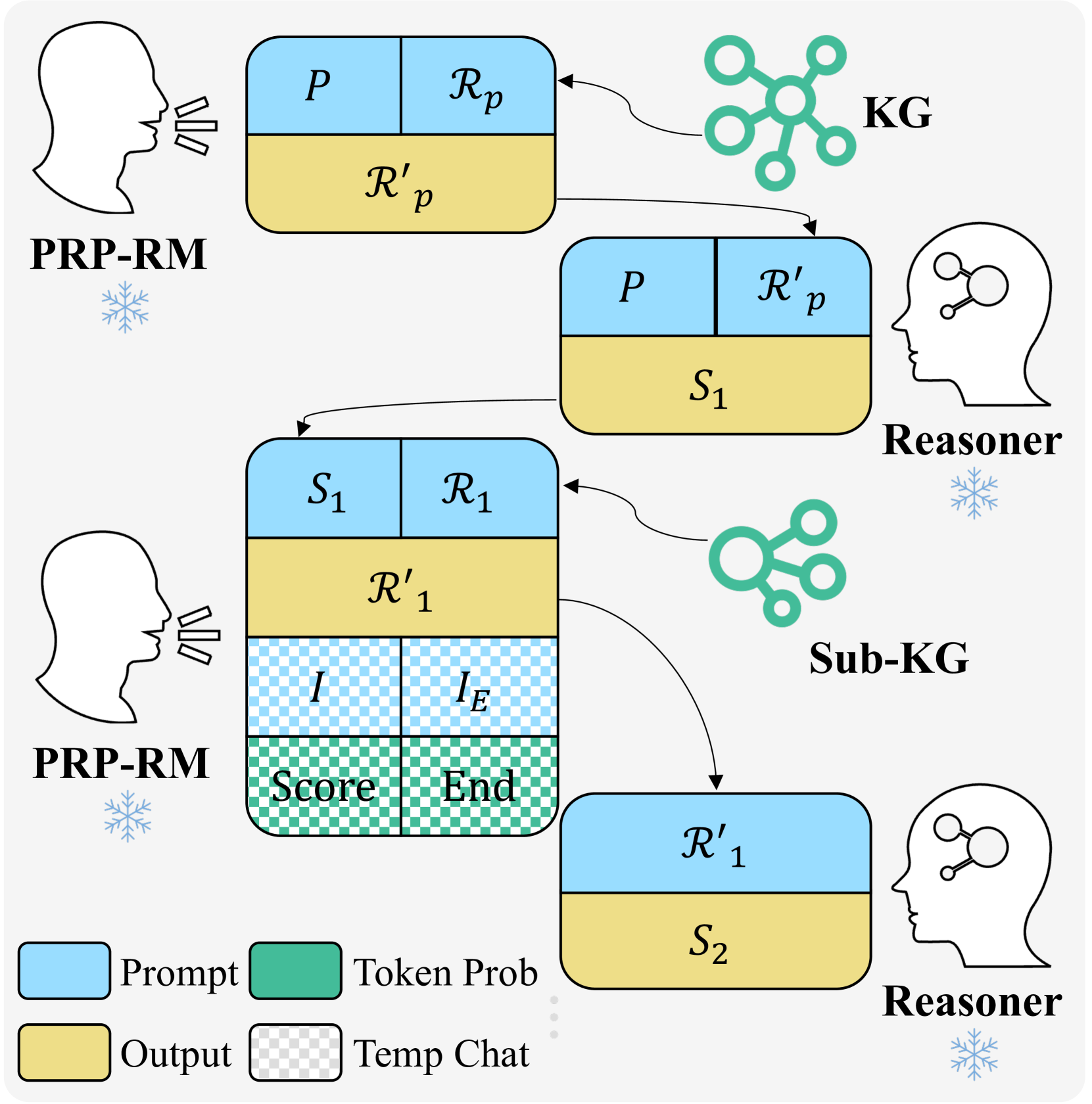
This diagram illustrates the iterative reasoning process of a system called PRP-RM (likely Prompt-Reasoning-Response Model). It depicts two cycles of interaction between a user (represented by a head silhouette), a Knowledge Graph (KG), a Reasoner, and intermediate outputs. The process involves prompting, reasoning, generating sub-knowledge graphs, and ultimately producing a response.
### Components/Axes
The diagram consists of several key components:
* **PRP-RM (Prompt-Reasoning-Response Model):** Represented by a head silhouette with a snowflake icon, indicating user interaction.
* **KG (Knowledge Graph):** Represented by interconnected green circles.
* **Sub-KG (Sub Knowledge Graph):** Similar to KG, but smaller and representing a focused subset of knowledge.
* **Reasoner:** Represented by a brain silhouette with a snowflake icon, indicating the reasoning engine.
* **Prompt (P):** Represented by a blue rectangle.
* **Response (R):** Represented by a light blue rectangle.
* **Intermediate State (S1, S2):** Represented by a yellow rectangle.
* **Token Probability (I, IE):** Represented by a series of small blue rectangles within a larger rectangle.
* **Score & End:** Represented by a green and red striped rectangle.
* **Temp Chat:** Represented by a light gray rectangle.
* **Arrows:** Indicate the flow of information between components.
### Detailed Analysis or Content Details
The diagram shows two iterations of the reasoning process.
**Iteration 1:**
1. The top PRP-RM provides a **Prompt (P)**, which is passed to the **KG**.
2. The KG generates a **Response (Rp)**, and a revised prompt **(Rp')**.
3. The revised prompt **(Rp')** and the original **Prompt (P)** are passed to the **Reasoner**.
4. The Reasoner generates an intermediate state **(S1)**.
5. **S1** is then passed back to the PRP-RM.
**Iteration 2:**
1. The bottom PRP-RM provides **S1** as a new prompt.
2. **S1** is passed to the **Sub-KG**.
3. The **Sub-KG** generates a **Response (R1)**, and a revised prompt **(R1')**.
4. The revised prompt **(R1')** is passed to the **Reasoner**.
5. The Reasoner generates an intermediate state **(S2)**.
6. Within the bottom PRP-RM block, there is a section labeled with **Token Probability** containing two sub-sections **I** and **IE**. Below this is a section labeled **Score** and **End**.
7. **S2** is then passed to the Reasoner.
**Legend:**
* **Prompt:** Blue rectangle
* **Output:** Yellow rectangle
* **Token Prob:** Series of small blue rectangles
* **Temp Chat:** Light gray rectangle
### Key Observations
* The process is iterative, with the output of one cycle feeding into the next.
* The use of both a KG and a Sub-KG suggests a hierarchical knowledge representation.
* The Reasoner plays a central role in transforming prompts and knowledge into intermediate states.
* The "Token Prob," "Score," and "End" elements within the second PRP-RM block suggest a mechanism for generating and evaluating responses.
* The snowflake icons next to PRP-RM and Reasoner suggest a potential connection to a specific framework or technology.
### Interpretation
This diagram illustrates a complex reasoning pipeline. The PRP-RM acts as the interface, initiating the process with a prompt. The KG and Sub-KG provide the knowledge base, while the Reasoner performs the core reasoning steps. The iterative nature of the process allows the system to refine its understanding and generate more accurate responses. The inclusion of "Token Prob," "Score," and "End" suggests that the system employs a probabilistic approach to response generation, potentially using techniques like beam search or sampling. The diagram highlights the importance of knowledge representation, reasoning algorithms, and iterative refinement in building intelligent systems. The use of a Sub-KG suggests a strategy for focusing reasoning on relevant knowledge, improving efficiency and accuracy. The diagram does not provide specific data or numerical values, but rather a conceptual overview of the system's architecture and workflow.