TECHNICAL ASSET FINGERPRINT
2e3ed0eca7f2cea8f378732d
Click to view fullscreen
Press ESC or click to close
FOUND IN PAPERS
EXPERT: healer-alpha-free VERSION 1
RUNTIME: free/openrouter/healer-alpha
INTEL_VERIFIED
\n
## System Architecture Diagram: PRP-RM and Reasoner Interaction with Knowledge Graphs
### Overview
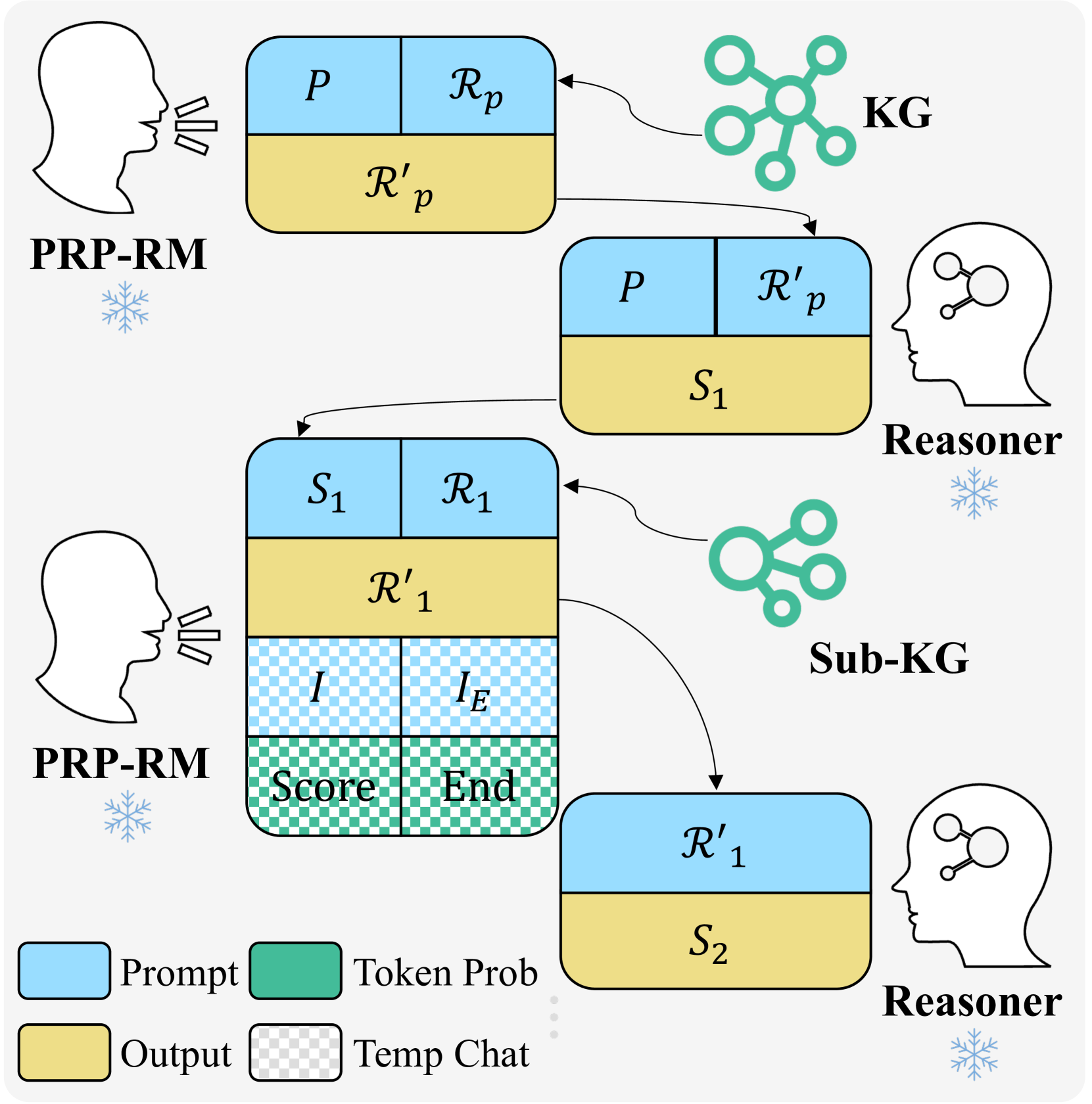
The image is a technical system architecture diagram illustrating a multi-step reasoning process involving two primary entity types: "PRP-RM" and "Reasoner." The process involves the exchange of prompts, outputs, and reasoning steps, augmented by interactions with a Knowledge Graph (KG) and a Sub-Knowledge Graph (Sub-KG). The diagram uses color-coded blocks to represent different data types and shows a cyclical or sequential flow of information.
### Components/Axes
**Entities:**
1. **PRP-RM**: Depicted as a speaking human head silhouette. Appears twice (top-left and middle-left). Each instance is accompanied by a blue snowflake icon.
2. **Reasoner**: Depicted as a human head silhouette with a network/brain icon inside. Appears twice (top-right and bottom-right). Each instance is accompanied by a blue snowflake icon.
3. **KG (Knowledge Graph)**: Represented by a teal-colored network node icon (top-right).
4. **Sub-KG (Sub-Knowledge Graph)**: Represented by a smaller teal-colored network node icon (center-right).
**Data Blocks (Color-Coded per Legend):**
* **Prompt (Light Blue)**: Represents input data.
* **Output (Yellow)**: Represents generated data.
* **Token Prob (Green)**: Represents token probability data.
* **Temp Chat (Checkered Blue/White)**: Represents temporary chat or intermediate data.
**Legend (Bottom-Left):**
* Light Blue Rectangle: "Prompt"
* Yellow Rectangle: "Output"
* Green Rectangle: "Token Prob"
* Checkered Blue/White Rectangle: "Temp Chat"
### Detailed Analysis
The diagram shows a flow involving four main data blocks and two knowledge graph components.
**1. Top-Left Block (Associated with first PRP-RM):**
* **Position:** Top-left quadrant.
* **Structure:** A rounded rectangle divided into three sections.
* Top (Prompt - Blue): Contains two sub-cells labeled `P` and `R_p`.
* Bottom (Output - Yellow): Contains one cell labeled `R'_p`.
* **Connections:**
* An arrow points from the `KG` icon to the `R_p` cell in the Prompt section.
* An arrow originates from the `R'_p` Output cell and points to the next block (Top-Right).
**2. Top-Right Block (Associated with first Reasoner):**
* **Position:** Top-right quadrant.
* **Structure:** A rounded rectangle divided into two horizontal sections.
* Top (Prompt - Blue): Contains two sub-cells labeled `P` and `R'_p`.
* Bottom (Output - Yellow): Contains one cell labeled `S₁`.
* **Connections:**
* Receives input from the Top-Left Block's `R'_p` Output.
* An arrow originates from the `S₁` Output cell and points to the next block (Center-Left).
**3. Center-Left Block (Associated with second PRP-RM):**
* **Position:** Center-left, below the first PRP-RM.
* **Structure:** A larger, complex rounded rectangle divided into four horizontal sections.
* **Section 1 (Prompt - Blue):** Divided into two sub-cells labeled `S₁` and `R₁`.
* **Section 2 (Output - Yellow):** Contains one cell labeled `R'₁`.
* **Section 3 (Temp Chat - Checkered):** Divided into two sub-cells labeled `I` and `I_E`.
* **Section 4 (Token Prob - Green):** Divided into two sub-cells labeled `Score` and `End`.
* **Connections:**
* Receives input from the Top-Right Block's `S₁` Output.
* An arrow points from the `Sub-KG` icon to the `R₁` cell in the Prompt section.
* An arrow originates from the `R'₁` Output cell and points to the next block (Bottom-Right).
**4. Bottom-Right Block (Associated with second Reasoner):**
* **Position:** Bottom-right quadrant.
* **Structure:** A rounded rectangle divided into two horizontal sections.
* Top (Prompt - Blue): Contains one cell labeled `R'₁`.
* Bottom (Output - Yellow): Contains one cell labeled `S₂`.
* **Connections:**
* Receives input from the Center-Left Block's `R'₁` Output.
**Flow Summary:**
The process appears to follow this path:
1. **PRP-RM (1)** generates `R'_p` using a prompt `P` and information `R_p` from the main **KG**.
2. **Reasoner (1)** takes `P` and `R'_p` to produce a reasoning step `S₁`.
3. **PRP-RM (2)** takes `S₁` and a new reasoning component `R₁` (informed by a **Sub-KG**) to produce `R'₁`. This block also generates temporary chat data (`I`, `I_E`) and token probability scores (`Score`, `End`).
4. **Reasoner (2)** takes `R'₁` to produce the next reasoning step `S₂`.
### Key Observations
1. **Cyclical/Iterative Nature:** The output of one component (`R'_p`, `S₁`, `R'₁`) becomes the prompt for the next, suggesting an iterative reasoning or refinement loop.
2. **Knowledge Graph Integration:** The main KG informs the initial reasoning (`R_p`), while a more specific Sub-KG informs a later stage (`R₁`), indicating a hierarchical or focused knowledge retrieval process.
3. **Snowflake Icons:** The blue snowflake icons next to both PRP-RM and Reasoner entities are consistent. In technical diagrams, this often symbolizes a "frozen" or non-trainable (static) component, suggesting these are pre-trained or fixed models.
4. **Complex Middle Block:** The Center-Left PRP-RM block is the most complex, containing not only Prompt/Output but also Temp Chat and Token Prob sections. This suggests this stage involves evaluation, scoring, and potentially interactive or intermediate steps.
5. **Symbol Progression:** The mathematical notation shows a progression: `R_p` -> `R'_p` -> `S₁` -> `R₁` -> `R'₁` -> `S₂`. The prime symbol (') likely denotes a processed or updated version of a variable.
### Interpretation
This diagram models a sophisticated, multi-stage reasoning system that combines large language models (the "PRP-RM" and "Reasoner") with structured knowledge from graphs. The process is not a single forward pass but an interactive dialogue between components.
* **What it demonstrates:** The system likely aims to solve complex problems by breaking them down. The PRP-RM acts as a bridge between raw prompts/knowledge and the Reasoner, which performs core logical deduction. The inclusion of `Score` and `End` tokens in the middle stage implies a mechanism for evaluating the quality of a reasoning path and deciding when to terminate the process.
* **Relationships:** The PRP-RM and Reasoner have a symbiotic, turn-taking relationship. The KG provides external factual grounding, preventing the models from relying solely on parametric knowledge. The Sub-KG suggests the system can dynamically focus on relevant knowledge subsets.
* **Notable Anomalies/Patterns:** The most significant pattern is the transformation of data types. Information starts as a prompt (`P`) and knowledge (`R_p`), is transformed into an output (`R'_p`), then becomes a reasoning step (`S₁`), which is further refined (`R₁`, `R'₁`), and finally yields a subsequent step (`S₂`). This mirrors a chain-of-thought or tree-of-thought reasoning process, formalized into a system architecture. The "Temp Chat" section is particularly intriguing, as it may represent an internal dialogue or scratchpad used by the model during complex reasoning.
DECODING INTELLIGENCE...