## Diagram: Lambda Node Transitions and Network Structures
### Overview
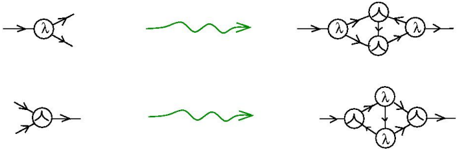
The image depicts two schematic diagrams illustrating transitions between lambda (λ) nodes and complex network structures. Both diagrams feature directional arrows, lambda symbols, and green squiggly lines representing transitions. The diagrams are arranged vertically, with the top diagram showing a two-path lambda node and the bottom diagram showing a three-path lambda node.
### Components/Axes
- **Lambda Nodes (λ)**:
- Represented as circles with the Greek letter λ inside.
- Positioned at the start and end of each transition pathway.
- **Directional Arrows**:
- Black arrows indicate flow direction between nodes.
- In the top diagram, the initial λ node splits into two outgoing arrows.
- In the bottom diagram, the initial λ node splits into three outgoing arrows.
- **Green Squiggly Lines**:
- Connect the initial λ nodes to complex network structures.
- Positioned centrally between the diagrams.
- **Network Structures**:
- Top diagram: A diamond-shaped structure with four λ nodes interconnected by bidirectional arrows.
- Bottom diagram: A similar diamond-shaped structure with four λ nodes, but with a different internal arrow configuration (one central λ node with bidirectional arrows to three peripheral nodes).
### Detailed Analysis
1. **Top Diagram**:
- **Initial Node**: A single λ node with two outgoing arrows.
- **Transition**: A green squiggly line connects this node to a diamond-shaped network.
- **Network Structure**: Four λ nodes arranged in a diamond, with bidirectional arrows between adjacent nodes (forming a cycle).
2. **Bottom Diagram**:
- **Initial Node**: A single λ node with three outgoing arrows.
- **Transition**: A green squiggly line connects this node to a diamond-shaped network.
- **Network Structure**: Four λ nodes arranged in a diamond, with a central λ node connected via bidirectional arrows to three peripheral nodes (no direct connections between peripheral nodes).
### Key Observations
- The diagrams emphasize **branching pathways** (two paths in the top diagram, three in the bottom) from a single λ node to a centralized network structure.
- The **green squiggly lines** likely represent probabilistic or stochastic transitions, given their non-linear, wavy appearance.
- The **diamond-shaped networks** suggest modular or hierarchical processing, with the top diagram showing a fully connected cycle and the bottom diagram showing a star-like topology.
### Interpretation
The diagrams likely model **decision trees**, **network routing protocols**, or **probabilistic state transitions** in a computational or theoretical system. The lambda nodes (λ) could represent:
- **Decision points** with multiple outcomes (branching paths).
- **Quantum states** or **probabilistic events** in a theoretical framework.
The green squiggly lines imply **non-deterministic transitions**, possibly weighted probabilities or environmental influences. The diamond-shaped networks may represent:
- **Feedback loops** (top diagram’s cyclic connections).
- **Centralized control nodes** (bottom diagram’s star topology with a dominant central λ node).
The difference in branching (two vs. three paths) could indicate **scalability** or **complexity trade-offs** in the system. For example, the three-path diagram might represent a more complex or adaptive process compared to the two-path version.
### Notable Patterns
- **Symmetry**: Both diagrams use diamond-shaped networks, suggesting a standardized framework for processing transitions.
- **Directionality**: All arrows point toward the network structures, indicating a unidirectional flow from the initial λ node to the network.
- **Modularity**: The separation of the initial node and network structure implies modular design principles.
### Conclusion
This diagram illustrates how lambda nodes (λ) transition into complex network structures via probabilistic pathways. The differences in branching and network topology highlight variations in system complexity, adaptability, or redundancy. The use of green squiggly lines for transitions underscores the non-deterministic nature of these processes.