## Diagram: Decoding Methods Comparison
### Overview
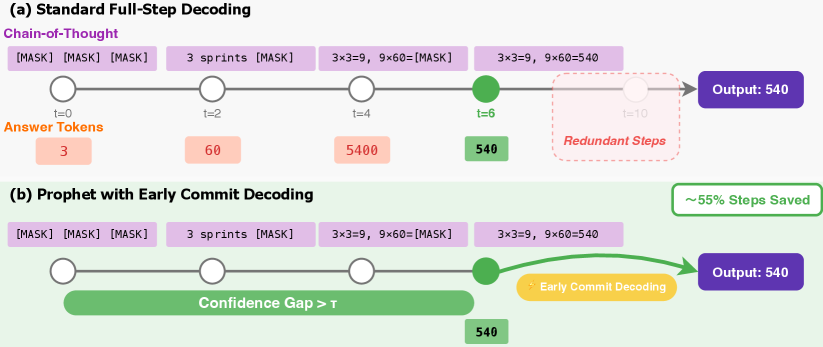
The image presents a comparison between two decoding methods: "Standard Full-Step Decoding" and "Prophet with Early Commit Decoding". It visually illustrates the process of reaching an output of 540 through a series of steps, highlighting the efficiency gains of the latter method. The diagram uses a timeline-like representation with labeled steps and associated "Answer Tokens" values.
### Components/Axes
The diagram consists of two main sections, labeled (a) and (b), representing the two decoding methods. Each section includes:
* **Chain-of-Thought:** A sequence of steps represented by purple boxes containing mathematical expressions.
* **Timeline:** A horizontal line with circles representing time steps (t=0, t=2, t=4, t=6, t=10).
* **Answer Tokens:** Values displayed below each time step, indicating the number of answer tokens generated.
* **Output:** A final purple box labeled "Output: 540".
* **Annotations:** Text labels describing specific aspects of each method, such as "Redundant Steps" and "Early Commit Decoding".
* **Confidence Gap > τ:** A green area indicating a confidence gap in the Prophet method.
* **Percentage Saved:** A label indicating the percentage of steps saved (~55%).
### Detailed Analysis or Content Details
**(a) Standard Full-Step Decoding**
* **t=0:** [MASK] [MASK] [MASK]. Answer Tokens: 3 (light blue).
* **t=2:** 3 sprints [MASK]. Answer Tokens: 60 (orange).
* **t=4:** 3x3=9, 9x60=[MASK]. Answer Tokens: 5400 (orange).
* **t=6:** 3x3=9, 9x60=540. Answer Tokens: 540 (orange).
* **t=10:** "Redundant Steps" annotation with a dashed arrow pointing to the final output.
* **Output:** 540 (purple).
**(b) Prophet with Early Commit Decoding**
* **t=0:** [MASK] [MASK] [MASK]. Answer Tokens: 3 (light blue).
* **t=2:** 3 sprints [MASK]. Answer Tokens: 60 (orange).
* **t=4:** 3x3=9, 9x60=[MASK]. Answer Tokens: 5400 (orange).
* **t=6:** 3x3=9, 9x60=540. Answer Tokens: 540 (orange).
* **Early Commit Decoding:** A curved green arrow indicating early commitment.
* **Confidence Gap > τ:** A green area spanning from t=0 to t=6.
* **Output:** 540 (purple).
* **~55% Steps Saved:** Annotation in the top-right corner.
### Key Observations
* The "Standard Full-Step Decoding" method requires an additional step (t=10) labeled as "Redundant Steps" to reach the final output.
* The "Prophet with Early Commit Decoding" method bypasses this redundant step by committing to the solution earlier, indicated by the green curved arrow.
* The "Prophet" method has a "Confidence Gap > τ" which is represented by the green area.
* The "Prophet" method saves approximately 55% of the steps compared to the standard method.
* The Answer Tokens values increase significantly at t=4, suggesting a crucial calculation step.
### Interpretation
The diagram demonstrates the efficiency of the "Prophet with Early Commit Decoding" method over the "Standard Full-Step Decoding" method. The "Prophet" method leverages a confidence gap to commit to a solution earlier, reducing the number of redundant steps required. This results in a significant reduction in computational effort, as indicated by the ~55% steps saved. The diagram suggests that the "Prophet" method is particularly effective when a certain level of confidence can be achieved before completing all steps. The [MASK] tokens suggest that the intermediate steps are not fully revealed, focusing instead on the overall process and efficiency comparison. The diagram is a visual argument for the benefits of early commitment in decoding processes, potentially in the context of large language models or similar AI systems.