## Data Processing Pipeline Diagram: RuozhiBench Data Generation and Categorization
### Overview
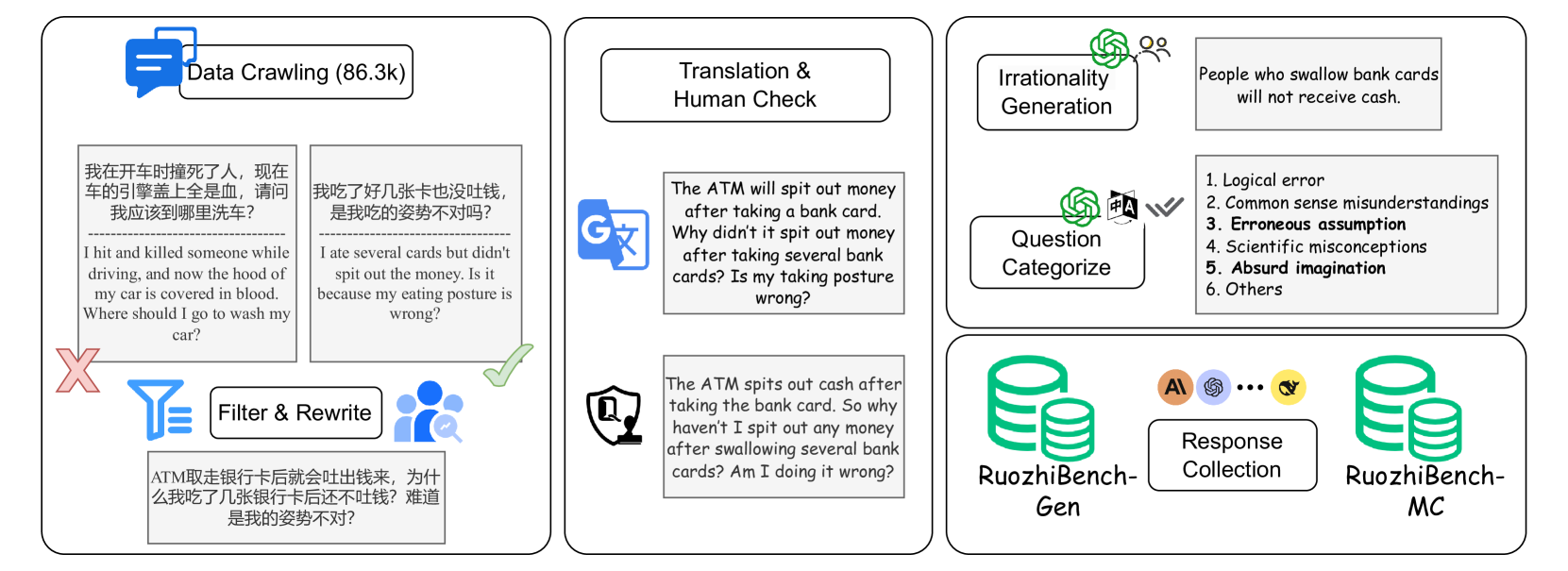
The image presents a diagram illustrating a data processing pipeline, likely for a natural language processing (NLP) or machine learning (ML) task. The pipeline consists of several stages: Data Crawling, Translation & Human Check, Irrationality Generation, Question Categorization, Response Collection, and two RuozhiBench datasets (Gen and MC). Each stage involves specific actions and data transformations, with examples of input and output at each step.
### Components/Axes
* **Data Crawling (86.3k):** This is the initial stage, indicated by a speech bubble icon. The number "86.3k" likely represents the volume of data collected at this stage.
* Example 1 (Incorrect):
* Chinese: 我在开车时撞死了人,现在车的引擎盖上全是血,请问我应该到哪里洗车?
* English Translation: I hit and killed someone while driving, and now the hood of my car is covered in blood. Where should I go to wash my car?
* Example 2 (Correct):
* Chinese: 我吃了好几张卡也没吐钱,是我吃的姿势不对吗?
* English Translation: I ate several cards but didn't spit out the money. Is it because my eating posture is wrong?
* A red "X" indicates the first example is incorrect, while a green checkmark indicates the second example is correct.
* **Filter & Rewrite:** This stage is represented by a filter icon and involves refining the crawled data.
* Example:
* Chinese: ATM取走银行卡后就会吐出钱来,为什么我吃了几张银行卡后还不吐钱?难道是我的姿势不对?
* English Translation: The ATM spits out cash after taking the bank card. So why haven't I spit out any money after swallowing several bank cards? Am I doing it wrong?
* **Translation & Human Check:** This stage, indicated by a Google Translate icon, involves translating the data and verifying its accuracy.
* Example 1: "The ATM will spit out money after taking a bank card. Why didn't it spit out money after taking several bank cards? Is my taking posture wrong?"
* Example 2: "The ATM spits out cash after taking the bank card. So why haven't I spit out any money after swallowing several bank cards? Am I doing it wrong?"
* **Irrationality Generation:** This stage generates irrational or nonsensical statements, indicated by an icon of two people and a brain.
* Example: "People who swallow bank cards will not receive cash."
* **Question Categorize:** This stage categorizes the questions based on their type of irrationality, indicated by an icon of a brain and a document.
* Categories:
1. Logical error
2. Common sense misunderstandings
3. Erroneous assumption
4. Scientific misconceptions
5. Absurd imagination
6. Others
* **Response Collection:** This stage collects responses to the generated questions, indicated by icons of AI and other symbols.
* **RuozhiBench-Gen:** This represents the generated dataset, visualized as a stack of coins.
* **RuozhiBench-MC:** This represents the multiple-choice dataset, also visualized as a stack of coins.
### Detailed Analysis or ### Content Details
* **Data Crawling:** The initial data crawling stage collects a large volume of data (86.3k). The examples show questions that are either nonsensical or based on flawed logic.
* **Filter & Rewrite:** This stage refines the crawled data, likely removing irrelevant or low-quality entries and potentially rephrasing questions for clarity.
* **Translation & Human Check:** This stage ensures the accuracy of the translated data, which is crucial for maintaining the integrity of the dataset.
* **Irrationality Generation:** This stage generates irrational statements, which are then used to create questions for the dataset.
* **Question Categorize:** The questions are categorized based on the type of irrationality they exhibit. This categorization allows for a more nuanced analysis of the dataset.
* **Response Collection:** Responses are collected for the generated questions, likely from human annotators or AI models.
* **RuozhiBench-Gen and RuozhiBench-MC:** These are the final datasets, with "Gen" likely referring to a generative dataset and "MC" referring to a multiple-choice dataset.
### Key Observations
* The pipeline focuses on generating and categorizing irrational or nonsensical questions.
* The pipeline includes a human check stage to ensure the quality of the data.
* The final datasets are likely used for evaluating the ability of AI models to understand and reason about irrationality.
### Interpretation
The diagram illustrates a data processing pipeline designed to create datasets for evaluating AI models' ability to understand and reason about irrationality. The pipeline starts with data crawling, followed by filtering, translation, and human verification. Irrational statements are then generated and categorized, and responses are collected. The final datasets, RuozhiBench-Gen and RuozhiBench-MC, are likely used to benchmark AI models' performance on tasks involving irrationality. The inclusion of a human check stage highlights the importance of ensuring the quality and accuracy of the data, especially when dealing with complex concepts like irrationality. The categorization of questions based on the type of irrationality allows for a more granular analysis of the models' performance.