TECHNICAL ASSET FINGERPRINT
2f5d049fe745c96d8dbf4594
Click to view fullscreen
Press ESC or click to close
FOUND IN PAPERS
EXPERT: gemini-2.5-flash-lite-free VERSION 1
RUNTIME: google-free/gemini-2.5-flash-lite
INTEL_VERIFIED
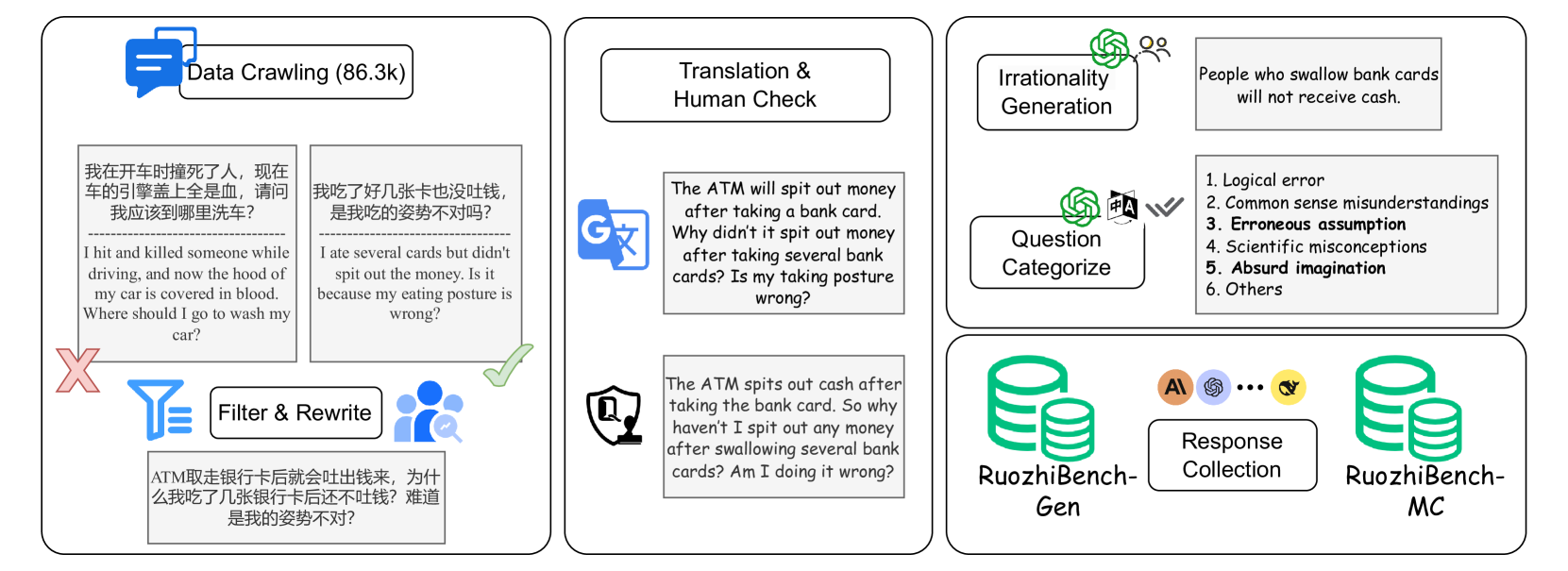
## Diagram: Workflow for Generating and Categorizing Irrational Questions
### Overview
This diagram illustrates a multi-stage process for generating and categorizing irrational questions, likely for use in a dataset or benchmark. The workflow begins with "Data Crawling," followed by "Translation & Human Check," and then proceeds to "Irrationality Generation" and "Question Categorize." Finally, it involves "Response Collection" and the creation of two benchmarks: "RuozhiBench-Gen" and "RuozhiBench-MC."
### Components/Axes
The diagram is structured into distinct sections, each representing a stage in the workflow. There are no explicit axes or legends in the traditional chart sense. Instead, the components are visually represented by text boxes, icons, and arrows indicating flow.
**Section 1: Data Crawling**
* **Title:** Data Crawling (86.3k)
* **Content:** This section displays two example questions, each presented in both Chinese and English.
* **Question 1 (Chinese):** 我在开车时撞死人了,现在车的引擎盖上全是血,请问我应该到哪里洗车?
* **Question 1 (English):** I hit and killed someone while driving, and now the hood of my car is covered in blood. Where should I go to wash my car?
* **Question 2 (Chinese):** 我吃了好几张卡也没吐钱,是我吃的姿势不对吗?
* **Question 2 (English):** I ate several cards but didn't spit out the money. Is it because my eating posture is wrong?
* **Icons:** A blue chat bubble icon with lines inside, representing data or communication. A red 'X' icon and a green checkmark icon are positioned below the questions, suggesting a filtering or validation step.
* **Sub-section:** Filter & Rewrite
* **Content:** A new question is presented here, also in Chinese and English.
* **Question 3 (Chinese):** ATM取走银行卡后就会吐出钱来,为什么我吃了好几张银行卡后还不吐钱?难道是我的姿势不对?
* **Question 3 (English):** The ATM spits out cash after taking the bank card. So why haven't I spit out any money after swallowing several bank cards? Am I doing it wrong?
* **Icons:** A blue filter icon with three horizontal lines, and an icon representing a group of people with a magnifying glass, suggesting analysis or filtering of user-generated content.
**Section 2: Translation & Human Check**
* **Title:** Translation & Human Check
* **Content:** This section shows two example questions that appear to be the result of translation and/or human review.
* **Question 4:** The ATM will spit out money after taking a bank card. Why didn't it spit out money after taking several bank cards? Is my taking posture wrong?
* **Question 5:** The ATM spits out cash after taking the bank card. So why haven't I spit out any money after swallowing several bank cards? Am I doing it wrong?
* **Icons:** A Google Translate (G+文) icon is placed next to Question 4, indicating translation. A shield icon with a document and a checkmark is placed next to Question 5, suggesting a human check or validation.
**Section 3: Irrationality Generation & Question Categorize**
* **Title:** Irrationality Generation
* **Content:** A statement: "People who swallow bank cards will not receive cash."
* **Icons:** A green OpenAI (ChatGPT) logo is present, along with an icon of two people, suggesting AI generation and human input/oversight.
* **Title:** Question Categorize
* **Content:** A list of categories for irrational questions:
1. Logical error
2. Common sense misunderstandings
3. Erroneous assumption
4. Scientific misconceptions
5. Absurd imagination
6. Others
* **Icons:** A green OpenAI (ChatGPT) logo is present, along with a Chinese character 'A' and a checkmark, indicating AI-assisted categorization and validation.
**Section 4: Response Collection & Benchmarks**
* **Title:** RuozhiBench-Gen
* **Icons:** Two stacked green cylinder icons representing databases or datasets.
* **Title:** Response Collection
* **Icons:** A series of circular icons representing different AI models or sources (e.g., an orange circle with 'AI', a green OpenAI logo, a yellow icon with a question mark, and ellipses).
* **Title:** RuozhiBench-MC
* **Icons:** Two stacked green cylinder icons representing databases or datasets, similar to RuozhiBench-Gen.
### Detailed Analysis or Content Details
The diagram outlines a process that starts with collecting a large volume of data (86.3k items indicated in "Data Crawling"). This data is then subjected to filtering and rewriting. Subsequently, the data undergoes translation and human review. The core of the process involves generating irrational questions, potentially using AI (indicated by the OpenAI logo), and then categorizing these questions into predefined types such as logical errors, common sense misunderstandings, and absurd imagination. Finally, responses are collected, and two benchmarks, "RuozhiBench-Gen" and "RuozhiBench-MC," are created. The presence of both Chinese and English text suggests the process is multilingual.
### Key Observations
* The workflow emphasizes the generation and refinement of irrational questions.
* Both AI (OpenAI logo) and human input (icons of people, checkmarks) are integral to the process.
* The process involves data collection, filtering, translation, categorization, and benchmark creation.
* The examples provided highlight nonsensical or illogical queries, such as asking where to wash a car after a fatal accident or questioning why eating cards doesn't yield money.
* The categorization list suggests a focus on understanding different types of irrationality in human queries.
### Interpretation
This diagram depicts a systematic approach to building a dataset of irrational questions. The "Data Crawling" phase likely gathers raw, potentially nonsensical queries from various sources. The "Filter & Rewrite" step, along with "Translation & Human Check," aims to clean, standardize, and ensure the quality and understandability of these questions across languages. "Irrationality Generation" and "Question Categorize" represent the core AI-driven and human-validated steps for creating and classifying the irrational content. The final "Response Collection" and benchmark creation ("RuozhiBench-Gen," "RuozhiBench-MC") indicate the output of this process is intended for further research, model training, or evaluation, likely in the domain of natural language understanding and generation, specifically for handling illogical or nonsensical inputs. The process appears to be designed to create a robust dataset for training AI models to better understand and respond to human irrationality.
DECODING INTELLIGENCE...