## Bar Chart: Violation Count by Linguistic Category
### Overview
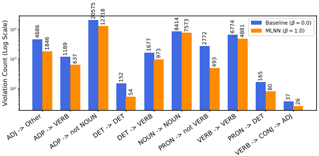
This image displays a grouped bar chart comparing the "Violation Count" across ten distinct linguistic transition categories for two different models: a "Baseline" model (where $\beta=0.0$) and an "MLNN" model (where $\beta=1.0$). The y-axis uses a logarithmic scale to accommodate the wide range of violation counts.
### Components/Axes
* **Y-Axis:** Labeled "Violation Count (Log Scale)". The scale is logarithmic, representing orders of magnitude.
* **X-Axis:** Contains ten categorical labels representing linguistic transitions:
1. `ADJ -> Other`
2. `ADP -> VERB`
3. `ADP -> not NOUN`
4. `DET -> DET`
5. `DET -> VERB`
6. `NOUN -> NOUN`
7. `PRON -> not VERB`
8. `VERB -> DET`
9. `PRON -> DET`
10. `VERB -> CONJ -> ADJ`
* **Legend:** Located in the top-right corner.
* **Blue Bar:** Baseline ($\beta=0.0$)
* **Orange Bar:** MLNN ($\beta=1.0$)
### Detailed Analysis
The following data points represent the violation counts for each category, extracted from the chart. In every instance, the MLNN model (Orange) shows a lower violation count than the Baseline model (Blue).
| Category | Baseline ($\beta=0.0$) | MLNN ($\beta=1.0$) |
| :--- | :--- | :--- |
| **ADJ -> Other** | 4686 | 1846 |
| **ADP -> VERB** | 1189 | 637 |
| **ADP -> not NOUN** | 20575 | 12118 |
| **DET -> DET** | 152 | 54 |
| **DET -> VERB** | 1677 | 973 |
| **NOUN -> NOUN** | 8414 | 7573 |
| **PRON -> not VERB** | 2772 | 493 |
| **VERB -> DET** | 6774 | 4881 |
| **PRON -> DET** | 165 | 80 |
| **VERB -> CONJ -> ADJ** | 37 | 26 |
### Key Observations
* **Consistent Improvement:** The MLNN model consistently produces fewer violations than the Baseline model across all ten categories.
* **Highest Violation Category:** The category `ADP -> not NOUN` exhibits the highest number of violations for both models (20,575 for Baseline and 12,118 for MLNN), indicating this is the most challenging linguistic transition for both systems.
* **Lowest Violation Category:** The category `VERB -> CONJ -> ADJ` exhibits the lowest number of violations for both models (37 for Baseline and 26 for MLNN).
* **Significant Reductions:** The most dramatic relative reduction in violations occurs in the `PRON -> not VERB` category, where the count drops from 2,772 to 493 (a reduction of over 80%).
* **Minimal Reductions:** The category `NOUN -> NOUN` shows the smallest relative improvement, with the count dropping from 8,414 to 7,573.
### Interpretation
The data demonstrates that the MLNN model (with $\beta=1.0$) is significantly more effective at reducing linguistic violations than the Baseline model ($\beta=0.0$).
The use of a logarithmic scale is critical here, as the violation counts span several orders of magnitude (from tens to tens of thousands). The fact that the MLNN model consistently outperforms the Baseline suggests that the mechanism introduced by the MLNN (likely a regularization or constraint-based approach, given the $\beta$ parameter) successfully enforces linguistic rules or constraints that the Baseline model fails to capture. The high violation counts in `ADP -> not NOUN` suggest that prepositional phrases and their complements are a particularly difficult area for these models to parse correctly, representing a potential area for future model refinement.