\n
## Diagram: Child-Environment Interaction Model
### Overview
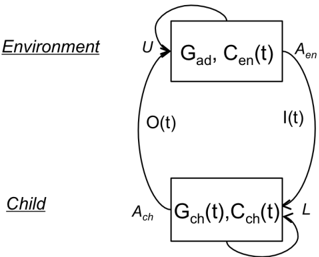
The image depicts a diagram illustrating the interaction between a "Child" and an "Environment". It's a closed-loop system represented by two rectangular blocks connected by directional arrows, indicating a flow of information and influence. The diagram uses variables and labels to describe the components and interactions within the system.
### Components/Axes
The diagram consists of the following labeled elements:
* **Environment:** Located at the top-left, labeled above the top rectangle.
* **Child:** Located at the bottom-left, labeled below the bottom rectangle.
* **U:** Input from the Environment to the Child.
* **O(t):** Output from the Child to the Environment.
* **I(t):** Input from the Environment to itself (feedback).
* **L:** Input from the Child to itself (feedback).
* **A<sub>en</sub>:** Output from the Environment.
* **A<sub>ch</sub>:** Output from the Child.
* **G<sub>ad</sub>, C<sub>en</sub>(t):** Inside the Environment rectangle.
* **G<sub>ch</sub>(t), C<sub>ch</sub>(t):** Inside the Child rectangle.
The diagram uses curved arrows to represent the flow of information and influence between the components.
### Detailed Analysis / Content Details
The diagram represents a system with two main components: the Environment and the Child.
* **Environment Block:** The top rectangle is labeled "G<sub>ad</sub>, C<sub>en</sub>(t)". This suggests a system with an adaptive gain (G<sub>ad</sub>) and an environmental context dependent on time (C<sub>en</sub>(t)). An arrow labeled "U" enters this block from the Child, and an arrow labeled "A<sub>en</sub>" exits. A feedback loop exists within the Environment, indicated by the arrow labeled "I(t)".
* **Child Block:** The bottom rectangle is labeled "G<sub>ch</sub>(t), C<sub>ch</sub>(t)". This suggests a system with a time-dependent gain (G<sub>ch</sub>(t)) and a child-specific context dependent on time (C<sub>ch</sub>(t)). An arrow labeled "O(t)" exits this block towards the Environment, and an arrow labeled "A<sub>ch</sub>" enters. A feedback loop exists within the Child, indicated by the arrow labeled "L".
The arrows indicate the following interactions:
* The Environment receives input "U" from the Child.
* The Child receives input "O(t)" from the Environment.
* The Environment has a self-feedback loop "I(t)".
* The Child has a self-feedback loop "L".
* The Environment produces output "A<sub>en</sub>".
* The Child produces output "A<sub>ch</sub>".
### Key Observations
The diagram highlights a reciprocal relationship between the Environment and the Child, with each influencing the other. The inclusion of time-dependent variables (C<sub>en</sub>(t), C<sub>ch</sub>(t), G<sub>ch</sub>(t)) suggests that the system is dynamic and changes over time. The feedback loops within each component indicate self-regulation or internal dynamics.
### Interpretation
This diagram likely represents a model of development or learning, where the Child interacts with the Environment, and both adapt and change over time. The "G" terms likely represent gains or amplification factors, while the "C" terms represent contextual factors. The feedback loops suggest that both the Child and the Environment are not passive recipients of influence but actively shape their own development. The model emphasizes the dynamic and reciprocal nature of the interaction, suggesting that the Child's behavior influences the Environment, and the Environment's response, in turn, influences the Child. The diagram is abstract and does not provide specific data points, but it offers a conceptual framework for understanding complex interactions. It is a theoretical model, and the specific meaning of the variables would depend on the context in which the diagram is used. The diagram is a simplified representation of a complex system, and it likely omits many details.