TECHNICAL ASSET FINGERPRINT
2fc2184d2b5b242e9d7ad679
Click to view fullscreen
Press ESC or click to close
FOUND IN PAPERS
EXPERT: healer-alpha-free VERSION 1
RUNTIME: free/openrouter/healer-alpha
INTEL_VERIFIED
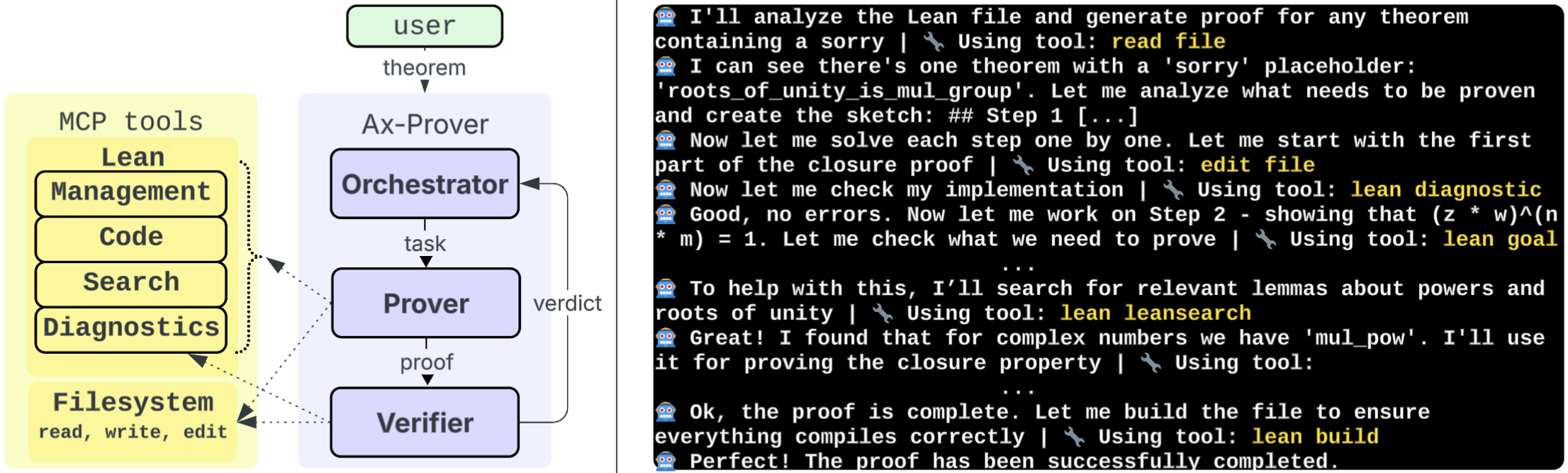
## Diagram: System Architecture and Automated Proof Generation Log
### Overview
The image is a composite diagram split into two distinct panels. The left panel illustrates a system architecture for automated theorem proving, showing the interaction between a user, an "Ax-Prover" system, and external tools. The right panel is a terminal log displaying a real-time, step-by-step execution trace of an AI agent using the described system to prove a mathematical theorem in the Lean proof assistant.
### Components/Axes
**Left Panel - System Architecture Diagram:**
* **Primary Components:**
* **User:** A green rounded rectangle at the top, labeled "user". It initiates the process by providing a "theorem".
* **Ax-Prover:** A large, light purple container box. It houses three internal components:
* **Orchestrator:** A purple rounded rectangle. It receives the "task" from the user and coordinates the process.
* **Prover:** A purple rounded rectangle. It receives a "task" from the Orchestrator and generates a "proof".
* **Verifier:** A purple rounded rectangle. It receives the "proof" from the Prover and returns a "verdict" to the Orchestrator.
* **MCP Tools:** A yellow container box on the left. It lists external tools available to the system:
* **Lean:** A sub-container with four specific tool categories: "Management", "Code", "Search", and "Diagnostics".
* **Filesystem:** A separate box below Lean, with the operations "read, write, edit".
* **Data Flow & Relationships:**
* A solid arrow labeled "theorem" points from the **User** to the **Orchestrator**.
* A solid arrow labeled "task" points from the **Orchestrator** to the **Prover**.
* A solid arrow labeled "proof" points from the **Prover** to the **Verifier**.
* A solid arrow labeled "verdict" points from the **Verifier** back to the **Orchestrator**.
* Dotted arrows indicate tool usage: The **Prover** has dotted arrows pointing to both the **Lean** tools and the **Filesystem** tools, showing it can invoke them. The **Verifier** also has a dotted arrow pointing to the **Filesystem**.
**Right Panel - Terminal Log:**
* **Format:** A black terminal window with white text. Each line of agent output is prefixed with a robot emoji (🤖). Tool invocations are highlighted in yellow and prefixed with a wrench emoji (🔧).
* **Content:** A sequential log of an AI agent's actions and reasoning.
### Detailed Analysis
**Left Panel - Architecture Flow:**
The diagram depicts a closed-loop, agentic workflow. The Orchestrator acts as the central coordinator. The Prover is the active agent that formulates proofs and interacts with external tools (Lean and Filesystem). The Verifier acts as a judge, providing feedback (a "verdict") to the Orchestrator, which can then issue new tasks to the Prover, creating an iterative refinement cycle.
**Right Panel - Terminal Log Transcription & Analysis:**
The log shows an agent proving the theorem `roots_of_unity_is_mul_group`. The process is as follows:
1. **Initial Analysis:** The agent states its goal: "I'll analyze the Lean file and generate proof for any theorem containing a sorry". It uses the `read file` tool.
2. **Problem Identification:** It identifies one theorem with a 'sorry' placeholder: `'roots_of_unity_is_mul_group'`. It begins creating a proof sketch.
3. **Step-by-Step Proof Construction:**
* **Step 1 (Closure Proof):** The agent starts solving the first part of the closure proof. It uses the `edit file` tool to implement the step.
* **Verification:** It checks its implementation using the `lean diagnostic` tool. Result: "Good, no errors."
* **Step 2:** It moves to the next step: "showing that (z * w)^(n * m) = 1". It uses the `lean goal` tool to check what needs to be proven.
4. **Knowledge Retrieval:** To assist with Step 2, the agent searches for relevant lemmas using the `lean leansearch` tool. It reports finding the lemma `'mul_pow'` for complex numbers and decides to use it to prove the closure property.
5. **Finalization:** After completing the proof steps (indicated by "..."), the agent states the proof is complete. It uses the `lean build` tool to compile the file and ensure correctness.
6. **Conclusion:** The final line reads: "Perfect! The proof has been successfully completed."
### Key Observations
1. **Iterative Tool Use:** The agent does not write the entire proof at once. It follows a cycle of: **Plan -> Implement (edit file) -> Verify (lean diagnostic) -> Research (lean leansearch) -> Finalize (lean build)**.
2. **Specific Theorem:** The target theorem is `roots_of_unity_is_mul_group`, which likely concerns proving that the set of roots of unity forms a multiplicative group.
3. **Tool Integration:** The log explicitly shows the use of four distinct tools from the "Lean" MCP tools category: `read file`, `edit file`, `lean diagnostic`, `lean goal`, `lean leansearch`, and `lean build`. This maps directly to the "Management", "Code", "Search", and "Diagnostics" categories in the architecture diagram.
4. **Successful Outcome:** The process concludes with a successful compilation and proof completion.
### Interpretation
This image demonstrates a sophisticated **agentic AI system for formal mathematical verification**. The architecture (left) is designed for autonomy and robustness: the separation of the Prover (creative, tool-using agent) from the Verifier (critical judge) creates a self-correcting system. The Orchestrator manages this dialogue.
The terminal log (right) is a concrete instantiation of this architecture in action. It reveals the agent's **reasoning process**, which is not monolithic but methodical and interactive. The agent exhibits behaviors analogous to a human mathematician: breaking down a problem, implementing partial solutions, checking for errors, searching for existing knowledge (lemmas), and finally compiling the complete argument.
The key takeaway is the **feasibility of automating complex, creative intellectual tasks** like theorem proving by combining a structured system architecture with an LLM-based agent capable of strategic tool use. The "verdict" loop is crucial, as it allows the system to learn from failure (e.g., if the Verifier rejects a proof) and iteratively improve, moving beyond simple one-shot generation. The specific example of proving a group theory property about roots of unity shows the system handling non-trivial abstract mathematics.
DECODING INTELLIGENCE...