## Heatmaps and Line Graphs: Frequency vs. IPD and Concentration/Position
### Overview
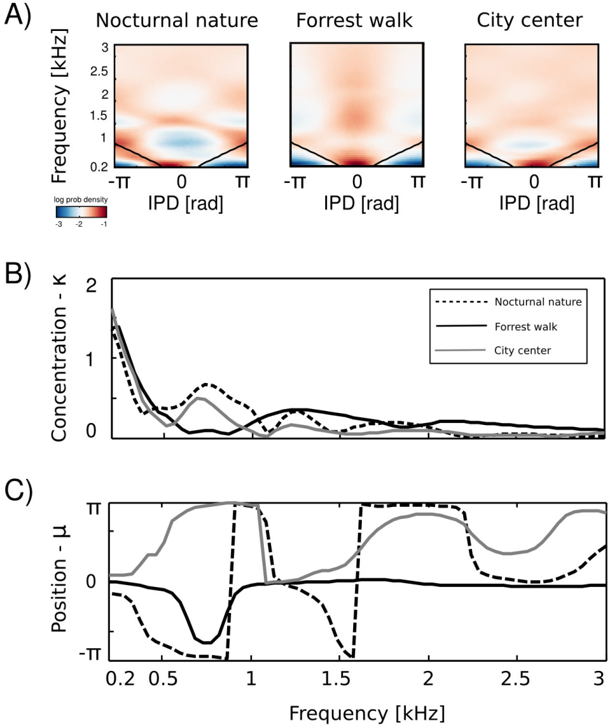
The image contains three visualizations comparing environmental data across three categories: "Nocturnal nature," "Forrest walk," and "City center." Part A shows heatmaps of frequency (kHz) vs. interaural phase difference (IPD, radians), while Parts B and C display line graphs of concentration (K) and position (μ) vs. frequency (kHz). All visualizations use color-coded lines and legends to differentiate categories.
---
### Components/Axes
#### Part A (Heatmaps)
- **X-axis**: IPD [rad] (labeled with -π, 0, π)
- **Y-axis**: Frequency [kHz] (0.2 to 3 kHz)
- **Color legend**: Log prob density (-3 to -1, blue to red gradient)
- **Legend placement**: Bottom-left corner
- **Categories**: Nocturnal nature, Forrest walk, City center (labeled at top)
#### Part B (Concentration vs. Frequency)
- **X-axis**: Frequency [kHz] (0.2 to 3 kHz)
- **Y-axis**: Concentration - K (0 to 2)
- **Lines**:
- Dashed: Nocturnal nature
- Solid: Forrest walk
- Gray: City center
- **Legend placement**: Top-right corner
#### Part C (Position vs. Frequency)
- **X-axis**: Frequency [kHz] (0.2 to 3 kHz)
- **Y-axis**: Position - μ (-π to π)
- **Lines**:
- Dashed: Nocturnal nature
- Solid: Forrest walk
- Gray: City center
- **Legend placement**: Top-right corner
---
### Detailed Analysis
#### Part A (Heatmaps)
- **Nocturnal nature**:
- High log prob density (red) near 0.2 kHz and -π/π IPD.
- Gradual decline in intensity toward higher frequencies.
- **Forrest walk**:
- Concentrated red region near 1.5 kHz and 0 IPD.
- Symmetric distribution around 0 IPD.
- **City center**:
- Broad red band centered at 1 kHz and 0 IPD.
- Lower intensity at extremes of IPD (±π).
#### Part B (Concentration vs. Frequency)
- **Nocturnal nature (dashed)**:
- Sharp peak at ~0.3 kHz (K ≈ 1.8).
- Rapid decline to ~0.1 kHz at 1.5 kHz.
- **Forrest walk (solid)**:
- Moderate peak at ~0.5 kHz (K ≈ 1.2).
- Gradual decline to ~0.05 kHz at 2.5 kHz.
- **City center (gray)**:
- Flat baseline (K ≈ 0.1) until ~1.2 kHz.
- Sharp rise to K ≈ 0.3 at 2.5 kHz.
#### Part C (Position vs. Frequency)
- **Nocturnal nature (dashed)**:
- Sharp drop from π to -π at ~0.3 kHz.
- Oscillatory behavior with minima at ~1.5 kHz.
- **Forrest walk (solid)**:
- Stable position near 0 until ~1 kHz.
- Sudden shift to -π at ~1.2 kHz.
- **City center (gray)**:
- Gradual oscillation between π and -π.
- Peaks at ~0.8 kHz and ~2.2 kHz.
---
### Key Observations
1. **Environmental differences**:
- City center shows higher frequency-dependent variability in concentration (Part B) and position (Part C).
- Forrest walk exhibits intermediate IPD sensitivity compared to nocturnal nature and city center.
2. **IPD-frequency relationships**:
- Nocturnal nature has strong IPD coupling at low frequencies (<1 kHz).
- City center shows broader IPD distribution across frequencies.
3. **Anomalies**:
- Forrest walk’s abrupt position shift at 1.2 kHz (Part C) suggests a threshold effect.
- City center’s late-frequency concentration spike (Part B) may indicate urban noise interference.
---
### Interpretation
The data suggests that environmental context significantly influences auditory processing metrics:
- **Nocturnal nature** prioritizes low-frequency IPD coupling, likely for spatial localization in quiet environments.
- **Forrest walk** balances IPD sensitivity and position stability, reflecting moderate acoustic complexity.
- **City center** demonstrates frequency-dependent position variability, consistent with broadband noise masking spatial cues.
The heatmaps (Part A) reveal that IPD sensitivity peaks at distinct frequencies for each environment, while the line graphs (Parts B-C) quantify how concentration and position metrics evolve with frequency. The abrupt shifts in Part C (Forrest walk) and Part B (City center) highlight critical frequency thresholds where environmental acoustics alter perceptual processing.