## Diagram: Paradigm-Dependent Multi-Agent Systems Architecture
### Overview
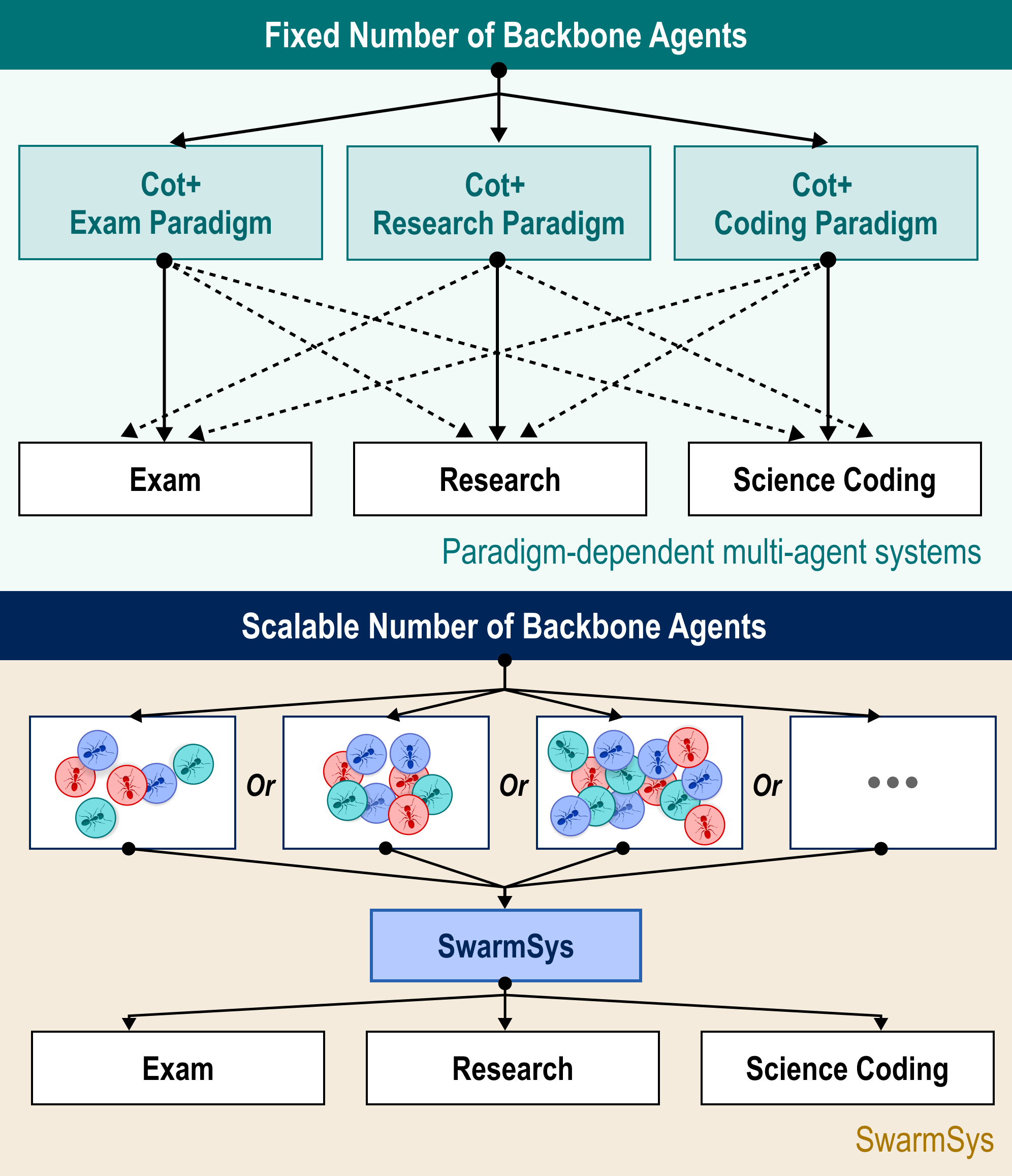
The diagram contrasts two multi-agent system architectures: one with a fixed number of backbone agents and another with scalable agents. It illustrates how paradigms (Cot+ Exam, Research, Coding) interact with core domains (Exam, Research, Science Coding) through different agent configurations.
### Components/Axes
1. **Header Section (Fixed Agents)**
- **Paradigms**:
- Cot+ Exam Paradigm
- Cot+ Research Paradigm
- Cot+ Coding Paradigm
- **Core Domains**:
- Exam
- Research
- Science Coding
- **Connections**:
- Solid arrows from paradigms to domains
- Dotted lines between paradigms and domains (indicating multi-agent interactions)
2. **Footer Section (Scalable Agents)**
- **SwarmSys**: Central node with variable agent configurations
- **Agent Representation**:
- Colored circles (red, blue, green) in clusters
- "Or" operators between configurations
- **Core Domains**: Same as header section
### Detailed Analysis
1. **Fixed Number Architecture**
- Paradigms directly connect to domains via solid arrows
- Dotted lines between paradigms suggest cross-domain agent interactions
- No explicit agent count specified (implied fixed but unspecified quantity)
2. **Scalable Number Architecture**
- SwarmSys node connects to domains via solid arrows
- Agent configurations shown as:
- Small clusters (2-3 agents)
- Medium clusters (4-6 agents)
- Large clusters (7+ agents)
- "Or" operators indicate alternative configurations
- Color-coded agents (red/blue/green) without explicit legend
### Key Observations
1. Paradigm influence propagates through both fixed and scalable architectures
2. Scalable system uses visual clustering to represent agent multiplicity
3. Color coding in scalable system lacks explicit legend (possible agent types/roles)
4. Both architectures share identical domain connections despite different agent models
### Interpretation
The diagram demonstrates a transition from rigid, paradigm-specific agent systems to flexible swarm-based architectures. The fixed model emphasizes direct paradigm-domain relationships, while the scalable model introduces agent multiplicity as a mediating factor. The absence of agent count specifications in the fixed model suggests conceptual rather than quantitative comparison. The color-coded agents in SwarmSys likely represent specialized agent roles (e.g., red=executors, blue=analyzers, green=validators) despite the missing legend. This architecture evolution implies increasing system adaptability at the cost of explicit paradigm control.