\n
## Network Graph Diagram: Unlabeled Node-Edge Structure
### Overview
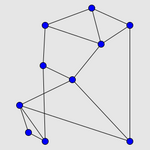
The image displays an undirected graph diagram consisting of nodes (vertices) and edges (connections) on a plain light gray background. There is no textual information, labels, titles, legends, or numerical data present in the image. The diagram is purely structural, showing relationships between points.
### Components/Axes
* **Nodes:** 10 distinct nodes, represented as solid blue circles.
* **Edges:** Straight gray lines connecting the nodes. The graph is undirected (no arrowheads).
* **Layout:** The nodes are arranged in a roughly hierarchical, three-layer structure.
* **Top Layer:** 3 nodes.
* **Middle Layer:** 4 nodes.
* **Bottom Layer:** 3 nodes.
* **Text/Labels:** None present. No axis titles, legends, or annotations are visible.
### Detailed Analysis
**Graph Topology and Connectivity:**
The graph's structure can be described by the connections between its layers. Using relative positioning (top-left, center, etc.) for description:
1. **Top Layer (3 nodes):**
* The top-left node connects to two nodes in the middle layer (the leftmost and the center-left).
* The top-center node connects to two nodes in the middle layer (the center-left and center-right).
* The top-right node connects to two nodes in the middle layer (the center-right and the rightmost).
2. **Middle Layer (4 nodes):**
* The leftmost node connects to the top-left node, the center-left node, and two nodes in the bottom layer (left and center).
* The center-left node connects to the top-left, top-center, leftmost, and center-right nodes.
* The center-right node connects to the top-center, top-right, center-left, and rightmost nodes.
* The rightmost node connects to the top-right, center-right, and one node in the bottom layer (right).
3. **Bottom Layer (3 nodes):**
* The bottom-left node connects to the middle-leftmost node and the bottom-center node.
* The bottom-center node connects to the middle-leftmost node, the bottom-left node, and the bottom-right node.
* The bottom-right node connects to the middle-rightmost node and the bottom-center node.
**Visual Style:**
* **Node Color:** Uniform medium blue (#3366CC approx.).
* **Edge Color:** Uniform medium gray.
* **Background:** Solid light gray (#E0E0E0 approx.).
* **Node Size:** All nodes appear to be of equal size.
### Key Observations
1. **No Textual Data:** The image contains zero alphanumeric characters. All information is conveyed through the visual structure of the graph.
2. **Symmetry:** The graph exhibits approximate bilateral symmetry along a vertical axis running through the center of the image.
3. **Connectivity Pattern:** Each node in the top layer connects to two nodes in the middle layer. Nodes in the middle layer have varying degrees of connectivity (number of edges), ranging from 3 to 4. The bottom layer nodes are less connected, primarily linking to the middle layer and each other.
4. **Planar Drawing:** The graph is drawn in a way that edges do not cross, suggesting it may represent a planar graph.
### Interpretation
This image is a pure structural diagram, not a data chart. Its purpose is to illustrate relationships or connections within a system.
* **What it Demonstrates:** It visualizes a network topology. The specific meaning of the nodes (e.g., people, computers, concepts) and edges (e.g., friendships, network links, relationships) is undefined due to the lack of labels.
* **Relationships Between Elements:** The diagram shows a clear hierarchical flow from the top layer to the bottom, with the middle layer acting as a highly interconnected hub. The symmetry suggests a balanced or mirrored system design.
* **Notable Patterns:** The most notable feature is the complete absence of explanatory text. This makes the diagram abstract; its interpretation is entirely dependent on external context not provided in the image. It could represent anything from a social network and a computer network topology to an organizational chart or a conceptual map. The structured, non-random layout implies it was deliberately designed to show a specific pattern of connections.
**Conclusion for Technical Documentation:** This image provides a visual representation of a 10-node network graph with a specific, symmetrical connection pattern. To be useful in a technical document, it requires accompanying text or labels to define what the nodes and edges represent. Without that context, it only conveys abstract relational structure.