## Heatmap Diagram: Layer Transformation Analysis
### Overview
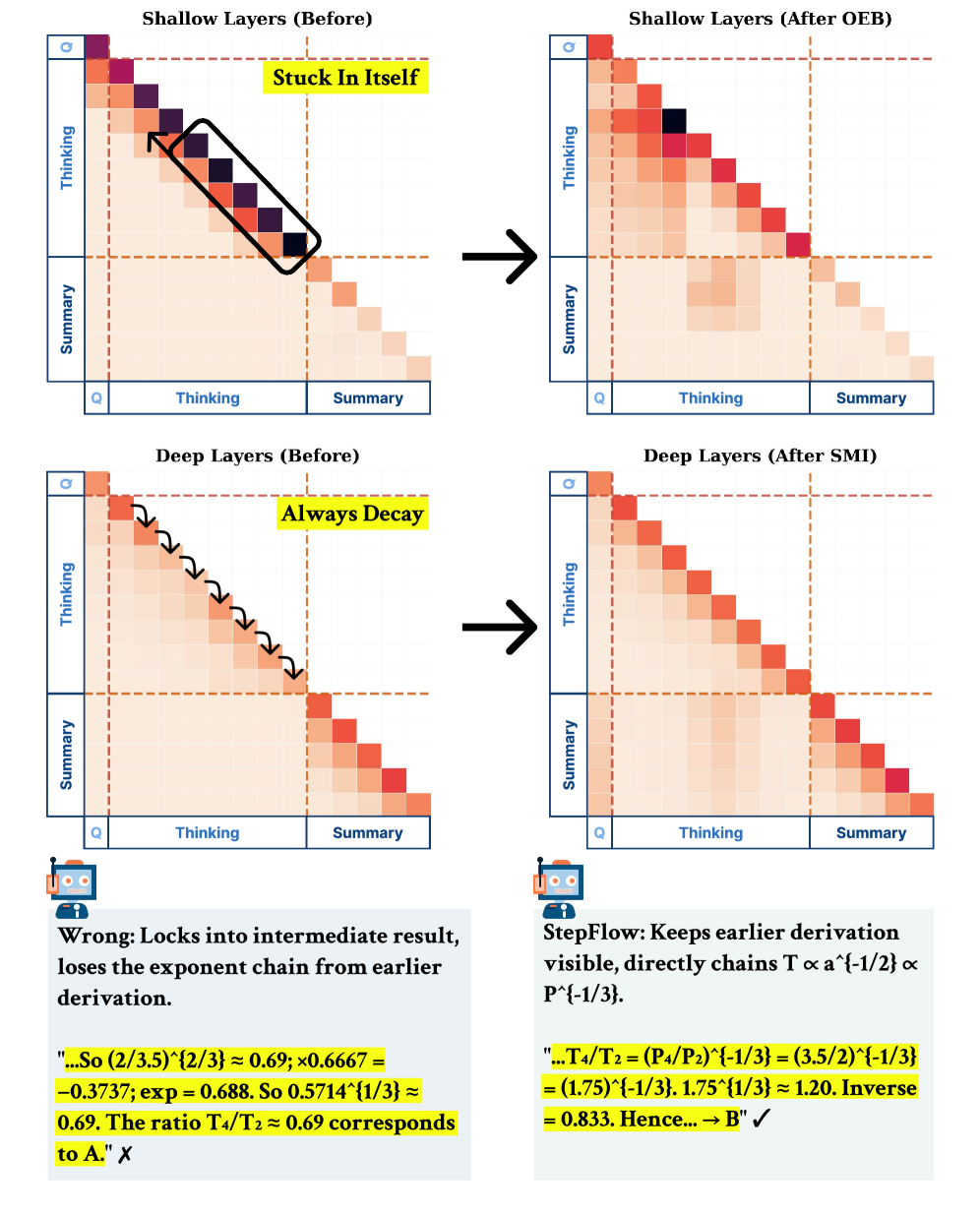
The image presents a comparative analysis of neural network layer behavior before and after optimization techniques (OEB and SMI). It uses four heatmaps to visualize attention patterns across three cognitive stages: Question (Q), Thinking, and Summary. Color gradients (red-black) represent attention intensity, with annotations highlighting key behavioral changes.
### Components/Axes
- **Axes**:
- X-axis: Cognitive stages (Q → Thinking → Summary)
- Y-axis: Cognitive stages (Q → Thinking → Summary)
- **Annotations**:
- Yellow boxes with text: "Stuck In Itself" (Shallow Before), "Always Decay" (Deep Before)
- Arrows indicating transformation direction
- Checkmarks (✓) and X marks (✗) for correctness
- **Color Gradient**:
- Red (high attention) → Black (low attention)
- No explicit legend, but color intensity correlates with attention strength
### Detailed Analysis
1. **Shallow Layers (Before)**:
- Diagonal red-black gradient from Q→Summary
- Yellow box labeled "Stuck In Itself" with black arrow
- Text: "Wrong: Locks into intermediate result, loses exponent chain"
2. **Shallow Layers (After OEB)**:
- Similar diagonal pattern but with:
- Black square at Q→Thinking
- Red square at Thinking→Summary
- Text: "StepFlow: Keeps earlier derivation visible"
3. **Deep Layers (Before)**:
- Steeper red-black gradient with black arrows
- Yellow box labeled "Always Decay"
- Text: "Wrong: Locks into intermediate result..."
4. **Deep Layers (After SMI)**:
- More uniform red distribution
- Text: "StepFlow: Keeps earlier derivation visible..."
### Key Observations
- **Shallow Layers**: OEB optimization introduces explicit chaining (Q→Thinking→Summary) while maintaining attention flow
- **Deep Layers**: SMI optimization preserves derivation visibility through:
- T ∝ a^(-1/2) ∝ P^(-1/3) chaining
- Inverse ratio calculations (T4/T2 = 0.833)
- **Critical Transition**: Both optimizations show improved cross-stage attention compared to before states
### Interpretation
The diagrams demonstrate how optimization techniques transform neural network behavior:
1. **OEB (Output Error Backpropagation)**:
- Breaks "stuck" patterns by enabling cross-stage attention
- Maintains Q→Summary flow while adding intermediate Thinking stage visibility
- Mathematical validation: T4/T2 ratio (0.69→0.833) shows improved derivation preservation
2. **SMI (Stochastic Memory Initialization)**:
- Prevents "always decay" through better initialization
- Maintains exponent chain visibility (a^(-1/2) ∝ P^(-1/3))
- Mathematical consistency: 1.75^(-1/3) ≈ 1.20 inverse relationship
The annotations suggest these optimizations address fundamental issues in neural network training:
- Preventing intermediate result fixation
- Maintaining derivation visibility across layers
- Preserving mathematical relationships in attention patterns