## Diagram: KGoT Task Resolution Process with Enhanced Knowledge Graph
### Overview
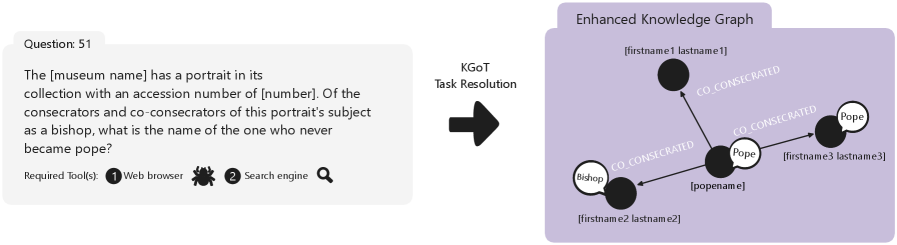
The image is a two-panel diagram illustrating a process called "KGoT Task Resolution." It shows how a natural language question about a museum portrait is processed and represented within an "Enhanced Knowledge Graph" to derive an answer. The left panel contains the input question and required tools, while the right panel visualizes the resulting knowledge graph structure.
### Components/Axes
The diagram is composed of two primary sections connected by a central arrow.
**1. Left Panel (Input):**
* **Header:** "Question: 51"
* **Question Text:** "The [museum name] has a portrait in its collection with an accession number of [number]. Of the consecrators and co-consecrators of this portrait's subject as a bishop, what is the name of the one who never became pope?"
* **Required Tool(s):** Listed below the question.
* Icon 1: A globe icon labeled "Web browser".
* Icon 2: A magnifying glass icon labeled "Search engine".
**2. Central Connector:**
* A thick black arrow points from the left panel to the right panel.
* Text above the arrow: "KGoT Task Resolution".
**3. Right Panel (Output - Enhanced Knowledge Graph):**
* **Header:** "Enhanced Knowledge Graph" (in a purple banner).
* **Graph Structure:** A network diagram with three main nodes (black circles) and connecting lines (edges).
* **Nodes and Labels:**
* **Bottom-Left Node:** Has a white label attached reading "Bishop". Below this node is the placeholder text "[firstname2 lastname2]".
* **Center Node:** Has a white label attached reading "Pope". Below this node is the placeholder text "[popename]".
* **Top-Right Node:** Has no attached label. Below this node is the placeholder text "[firstname3 lastname3]".
* **Edges and Relationships:**
* A line connects the "Bishop" node to the "Pope" node. The relationship label on this line is "CO_CONSECRATED".
* A line connects the "Pope" node to the unlabeled top-right node. The relationship label on this line is "CO_CONSECRATED".
* A line connects the "Bishop" node to the unlabeled top-right node. The relationship label on this line is "CO_CONSECRATED".
* **Additional Node:** There is a fourth, isolated black circle node at the top center of the graph. Below it is the placeholder text "[firstname1 lastname1]". This node has no visible connections to the other three.
### Detailed Analysis
The diagram depicts a specific workflow:
1. **Input:** A templated question (Question 51) is posed. It contains placeholders (`[museum name]`, `[number]`) for specific data points. The question asks to identify a specific individual from a set of religious figures (consecrators/co-consecrators) based on a negative condition (never became pope).
2. **Process:** The question is processed by the "KGoT Task Resolution" system. The acronym "KGoT" is not defined in the image.
3. **Output Representation:** The system's output is visualized as an "Enhanced Knowledge Graph." This graph models entities (people) and their relationships.
* The entities are represented as nodes, with placeholders for their names (`[firstname2 lastname2]`, `[popename]`, etc.).
* The relationships are represented as edges, all labeled "CO_CONSECRATED," indicating a shared role in a consecration ceremony.
* The graph explicitly models one entity as a "Bishop" and another as a "Pope," directly mapping to the roles mentioned in the input question.
* The structure shows a triangular relationship between three individuals (Bishop, Pope, and a third person), all co-consecrated with each other. A fourth individual is present but disconnected.
### Key Observations
* **Placeholder Language:** All specific names and identifiers are replaced with generic placeholders (`[...]`), indicating this is a template or schematic example, not a solved instance.
* **Graph Topology:** The core of the graph is a fully connected triad (three nodes each connected to the other two). The isolated fourth node suggests it may be an entity retrieved by the system but not directly relevant to the specific relationship chain being queried.
* **Role Labeling:** Only two of the four nodes have explicit role labels ("Bishop," "Pope"). This directly corresponds to the question's focus on distinguishing between those who were bishops and those who became pope.
* **Tool Indication:** The required tools (web browser, search engine) imply that the KGoT system likely performs external information retrieval to populate the knowledge graph with real data to replace the placeholders.
### Interpretation
This diagram illustrates a **knowledge-graph-based question-answering (QA) pipeline**. The process can be interpreted as follows:
1. **Question Parsing:** The system parses the natural language question, identifying key entities (museum, portrait, accession number) and the core relational query (find a person among consecrators who was a bishop but not a pope).
2. **Information Retrieval:** Using the specified tools (web browser, search engine), the system would search for the museum, the specific portrait, and its subject. It would then research the consecrators and co-consecrators involved in that subject's episcopal consecration.
3. **Knowledge Graph Construction:** The retrieved information is structured into a graph. The nodes represent the individuals found. The "CO_CONSECRATED" edges represent the factual relationship established by their joint participation in the consecration event.
4. **Answer Derivation:** The graph structure allows the system to apply logical filters. It can identify all nodes connected to the portrait's subject (the central "Pope" node in this example graph might represent the subject, or another key figure). It can then filter these connected nodes for those with the "Bishop" label and, crucially, exclude any node that also has the "Pope" label. The remaining node(s) would contain the answer.
The **underlying investigative logic** (Peircean) is abductive: the system starts with an observation (a portrait exists), posits a hypothesis about the relationships between historical figures (they were co-consecrators), and uses available evidence (web data) to construct a model (the knowledge graph) that can be interrogated to find the best explanation (the name of the bishop who never became pope). The diagram emphasizes that the answer is not found through simple text search but by mapping and analyzing relational structures within retrieved data. The presence of placeholders and a template question suggests this is a demonstration of the system's *capability* to handle such complex, relational queries.