TECHNICAL ASSET FINGERPRINT
3205b30abd6212133dbf244c
Click to view fullscreen
Press ESC or click to close
FOUND IN PAPERS
EXPERT: gemma-3-27b-it-free VERSION 1
RUNTIME: google-free/gemma-3-27b-it
INTEL_VERIFIED
## Charts: Performance Comparison of Fairness Interventions
### Overview
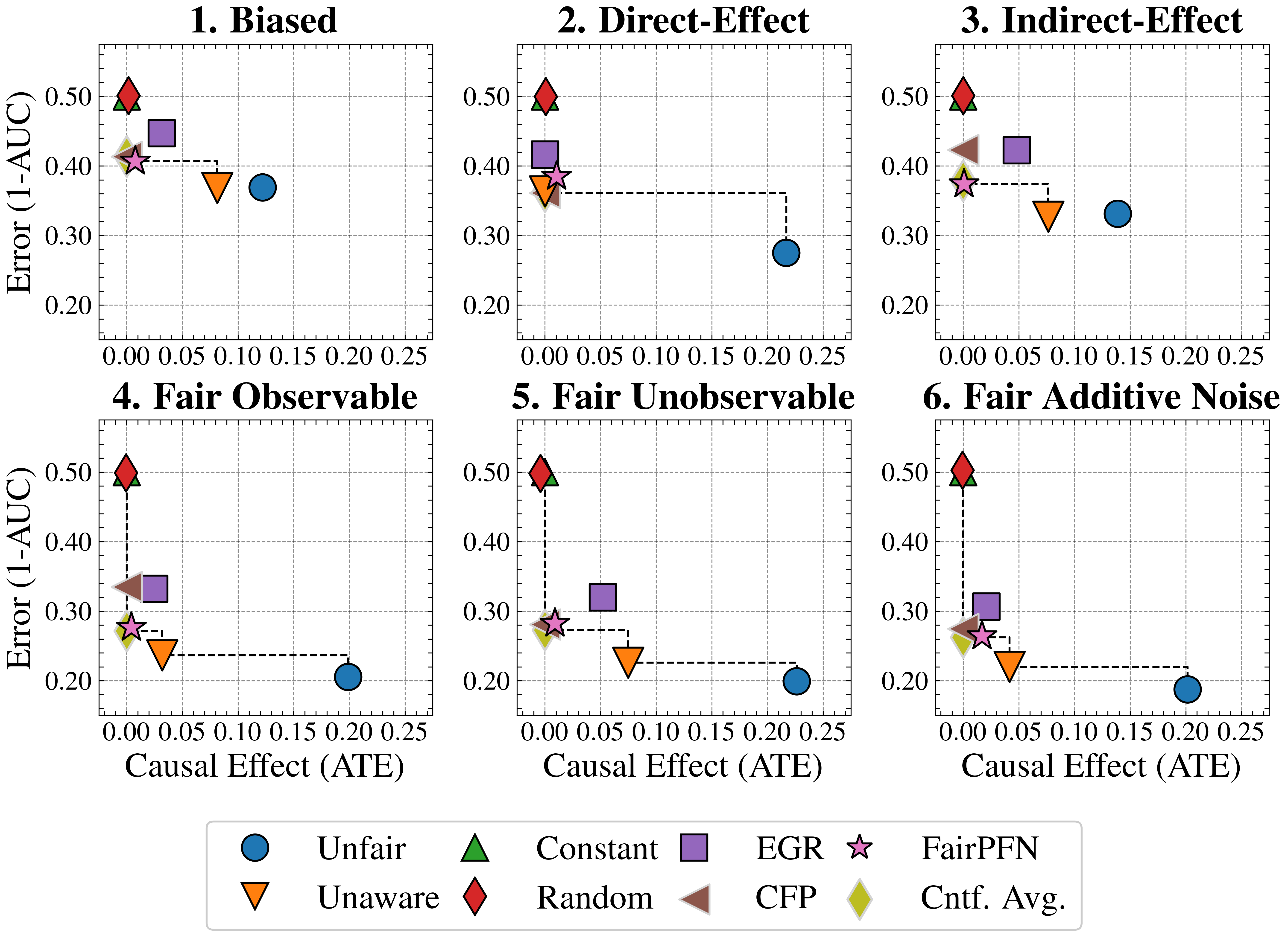
The image presents six individual scatter plots, each representing the performance of different fairness interventions under varying causal effect (ATE) levels. The y-axis represents "Error (1-AUC)", and the x-axis represents "Causal Effect (ATE)". Each plot focuses on a specific fairness setting: Biased, Direct-Effect, Indirect-Effect, Fair Observable, Fair Unobservable, and Fair Additive Noise. Multiple data series are plotted on each chart, representing different fairness algorithms. Error bars are present on some data points.
### Components/Axes
* **X-axis Label (all charts):** "Causal Effect (ATE)" - Scale ranges from 0.00 to 0.25, with markers at 0.05, 0.10, 0.15, 0.20.
* **Y-axis Label (all charts):** "Error (1-AUC)" - Scale ranges from 0.20 to 0.50, with markers at 0.20, 0.30, 0.40, 0.50.
* **Chart Titles:** 1. Biased, 2. Direct-Effect, 3. Indirect-Effect, 4. Fair Observable, 5. Fair Unobservable, 6. Fair Additive Noise.
* **Legend (bottom-center):**
* Blue Circle: Unfair
* Red Downward Triangle: Unaware
* Green Upward Triangle: Constant
* Blue Square: EGR
* Yellow Diamond: CFP
* Brown Downward Triangle: Random
* Star: FairPFN
* Light Green Diamond: Cnt. Avg.
### Detailed Analysis
Each chart will be analyzed individually, noting trends and approximate data points.
**1. Biased:**
* **Unfair (Blue Circle):** Starts at approximately (0.00, 0.35) and increases to approximately (0.25, 0.35). Relatively flat trend.
* **Unaware (Red Downward Triangle):** Starts at approximately (0.00, 0.45) and decreases to approximately (0.25, 0.30). Downward sloping trend.
* **Constant (Green Upward Triangle):** Starts at approximately (0.00, 0.40) and decreases to approximately (0.25, 0.35). Downward sloping trend.
* **FairPFN (Star):** Starts at approximately (0.00, 0.45) and decreases to approximately (0.25, 0.40). Downward sloping trend.
**2. Direct-Effect:**
* **Unfair (Blue Circle):** Starts at approximately (0.00, 0.25) and increases to approximately (0.25, 0.35). Upward sloping trend.
* **Unaware (Red Downward Triangle):** Starts at approximately (0.00, 0.40) and decreases to approximately (0.25, 0.30). Downward sloping trend.
* **Constant (Green Upward Triangle):** Starts at approximately (0.00, 0.40) and decreases to approximately (0.25, 0.35). Downward sloping trend.
* **FairPFN (Star):** Starts at approximately (0.00, 0.40) and decreases to approximately (0.25, 0.35). Downward sloping trend.
**3. Indirect-Effect:**
* **Unfair (Blue Circle):** Starts at approximately (0.00, 0.35) and increases to approximately (0.25, 0.35). Relatively flat trend.
* **Unaware (Red Downward Triangle):** Starts at approximately (0.00, 0.40) and decreases to approximately (0.25, 0.30). Downward sloping trend.
* **Constant (Green Upward Triangle):** Starts at approximately (0.00, 0.40) and decreases to approximately (0.25, 0.35). Downward sloping trend.
* **FairPFN (Star):** Starts at approximately (0.00, 0.40) and decreases to approximately (0.25, 0.35). Downward sloping trend.
**4. Fair Observable:**
* **Unfair (Blue Circle):** Starts at approximately (0.00, 0.35) and increases to approximately (0.25, 0.40). Upward sloping trend.
* **Unaware (Red Downward Triangle):** Starts at approximately (0.00, 0.40) and decreases to approximately (0.25, 0.30). Downward sloping trend.
* **Constant (Green Upward Triangle):** Starts at approximately (0.00, 0.35) and decreases to approximately (0.25, 0.30). Downward sloping trend.
* **FairPFN (Star):** Starts at approximately (0.00, 0.30) and increases to approximately (0.25, 0.35). Upward sloping trend.
**5. Fair Unobservable:**
* **Unfair (Blue Circle):** Starts at approximately (0.00, 0.30) and increases to approximately (0.25, 0.40). Upward sloping trend.
* **Unaware (Red Downward Triangle):** Starts at approximately (0.00, 0.40) and decreases to approximately (0.25, 0.30). Downward sloping trend.
* **Constant (Green Upward Triangle):** Starts at approximately (0.00, 0.40) and decreases to approximately (0.25, 0.35). Downward sloping trend.
* **FairPFN (Star):** Starts at approximately (0.00, 0.30) and increases to approximately (0.25, 0.30). Relatively flat trend.
**6. Fair Additive Noise:**
* **Unfair (Blue Circle):** Starts at approximately (0.00, 0.30) and increases to approximately (0.25, 0.40). Upward sloping trend.
* **Unaware (Red Downward Triangle):** Starts at approximately (0.00, 0.40) and decreases to approximately (0.25, 0.30). Downward sloping trend.
* **Constant (Green Upward Triangle):** Starts at approximately (0.00, 0.35) and decreases to approximately (0.25, 0.30). Downward sloping trend.
* **FairPFN (Star):** Starts at approximately (0.00, 0.30) and increases to approximately (0.25, 0.35). Upward sloping trend.
### Key Observations
* The "Unaware" algorithm consistently shows a decreasing error rate as the causal effect (ATE) increases across all fairness settings.
* The "Unfair" algorithm generally exhibits an increasing error rate with increasing causal effect, particularly in the "Fair Observable", "Fair Unobservable", and "Fair Additive Noise" settings.
* FairPFN generally performs better than Unfair and Unaware in the "Fair" settings.
* Error bars are present, indicating some variance in the results.
### Interpretation
The charts demonstrate the performance of various fairness interventions under different causal effect scenarios. The "Unaware" algorithm, while reducing error with increasing causal effect, likely does so by ignoring the fairness constraints. The "Unfair" algorithm's increasing error suggests that fairness interventions become more challenging as the causal effect grows. FairPFN appears to be a promising approach, maintaining relatively low error rates across different fairness settings. The differences in performance across the fairness settings highlight the importance of choosing an intervention appropriate for the specific causal structure of the data. The error bars suggest that the results are not deterministic and that further investigation is needed to understand the robustness of these interventions. The consistent downward trend of the "Unaware" algorithm suggests a trade-off between fairness and accuracy, as it achieves lower error by not explicitly addressing fairness concerns.
DECODING INTELLIGENCE...