## Diagram: Neural Network Architecture with MTPLoss AutoScaler
### Overview
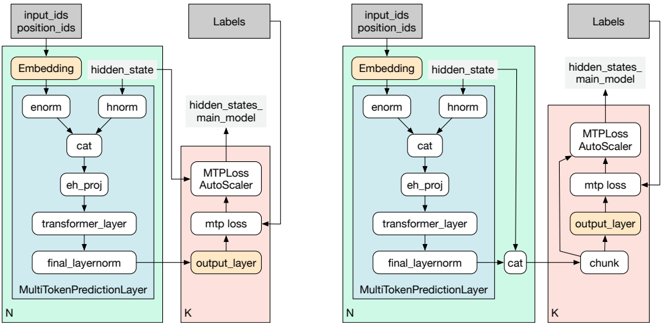
The image depicts a technical architecture diagram of a neural network model, split into two primary components:
1. **Main Model (Left Side)**: Processes input tokens through embedding, normalization, projection, transformer layers, and output generation.
2. **MTPLoss AutoScaler (Right Side)**: Handles loss calculation, scaling, and chunked processing for multi-token prediction.
### Components/Axes
#### Main Model (Left Side)
- **Inputs**:
- `input_ids` (token identifiers)
- `position_ids` (positional encodings)
- **Layers**:
- `Embedding` (token embeddings)
- `enorm` (embedding normalization)
- `hnorm` (hidden state normalization)
- `cat` (concatenation)
- `eh_proj` (embedding-to-hidden projection)
- `transformer_layer` (core transformer block)
- `final_layernorm` (final normalization)
- `output_layer` (final output generation)
- **Output**: `hidden_states_main_model` (intermediate hidden states)
#### MTPLoss AutoScaler (Right Side)
- **Inputs**:
- `hidden_states_main_model` (from main model)
- `Labels` (ground truth data)
- **Components**:
- `MTPLoss` (multi-token prediction loss calculation)
- `AutoScaler` (dynamic scaling mechanism)
- `mtp_loss` (loss value)
- `chunk` (sequence segmentation for processing)
- `output_layer` (shared with main model)
### Detailed Analysis
#### Main Model Flow
1. **Input Processing**:
- `input_ids` and `position_ids` are fed into the `Embedding` layer to generate token embeddings.
- `enorm` normalizes embeddings, followed by `hnorm` for hidden state normalization.
2. **Projection & Concatenation**:
- `eh_proj` projects embeddings to hidden dimensions, then concatenated (`cat`) with normalized states.
3. **Transformer Processing**:
- Data passes through a `transformer_layer` for contextual encoding.
4. **Final Output**:
- `final_layernorm` normalizes the transformer output, leading to the `output_layer` for predictions.
#### MTPLoss AutoScaler Flow
1. **Loss Calculation**:
- `hidden_states_main_model` and `Labels` are used to compute `MTPLoss`.
2. **Dynamic Scaling**:
- `AutoScaler` adjusts loss values based on training dynamics.
3. **Chunked Processing**:
- `chunk` segments sequences for efficient multi-token prediction.
4. **Integration**:
- The `output_layer` is shared between the main model and auto-scaler, suggesting joint optimization.
### Key Observations
- **Shared Output Layer**: The `output_layer` is common to both models, indicating collaborative optimization.
- **Chunk Mechanism**: The `chunk` component suggests handling long sequences by processing them in smaller segments.
- **Normalization Steps**: Multiple normalization layers (`enorm`, `hnorm`, `final_layernorm`) emphasize stability in training.
- **Loss Integration**: The `MTPLoss AutoScaler` directly influences the main model via shared hidden states and loss feedback.
### Interpretation
This architecture combines a standard transformer-based model with a specialized loss auto-scaler for multi-token prediction tasks. The `chunk` component implies the model is designed for efficiency with long sequences, while the `MTPLoss` and `AutoScaler` likely address challenges like class imbalance or variable-length targets. The shared `output_layer` suggests a unified training objective, where the main model and loss auto-scaler co-adapt to minimize prediction errors. The use of multiple normalization steps highlights a focus on stable gradient flow, critical for deep transformer architectures.
**Note**: No numerical data or trends are present in the diagram; the analysis is based on structural and functional relationships.