## Line Chart: Test AUROC vs. k-top Eigenvalues
### Overview
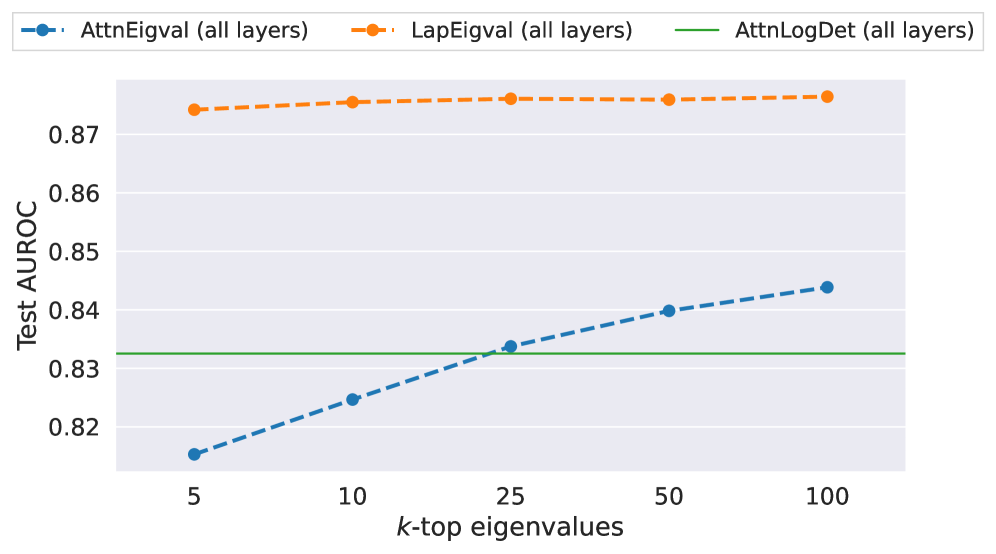
The image is a line chart comparing the performance of three different methods ("AttnEigval", "LapEigval", and "AttnLogDet") across varying numbers of top eigenvalues (k-top eigenvalues). Performance is measured by the Test Area Under the Receiver Operating Characteristic curve (AUROC).
### Components/Axes
* **X-axis:** "k-top eigenvalues" with markers at 5, 10, 25, 50, and 100.
* **Y-axis:** "Test AUROC" ranging from 0.82 to 0.87.
* **Legend:** Located at the top of the chart.
* Blue dashed line with circular markers: "AttnEigval (all layers)"
* Orange dashed line with circular markers: "LapEigval (all layers)"
* Green solid line: "AttnLogDet (all layers)"
### Detailed Analysis
* **AttnEigval (all layers):** (Blue, dashed) The line slopes upward.
* k=5: AUROC ≈ 0.816
* k=10: AUROC ≈ 0.824
* k=25: AUROC ≈ 0.833
* k=50: AUROC ≈ 0.840
* k=100: AUROC ≈ 0.844
* **LapEigval (all layers):** (Orange, dashed) The line is relatively flat, with a slight upward trend.
* k=5: AUROC ≈ 0.873
* k=10: AUROC ≈ 0.874
* k=25: AUROC ≈ 0.875
* k=50: AUROC ≈ 0.875
* k=100: AUROC ≈ 0.876
* **AttnLogDet (all layers):** (Green, solid) The line is flat.
* AUROC ≈ 0.832 for all k values.
### Key Observations
* "LapEigval (all layers)" consistently outperforms "AttnEigval (all layers)" and "AttnLogDet (all layers)" across all k values.
* "AttnLogDet (all layers)" has a constant AUROC regardless of the number of top eigenvalues used.
* "AttnEigval (all layers)" shows a positive correlation between the number of top eigenvalues and AUROC.
### Interpretation
The chart suggests that "LapEigval (all layers)" is the most effective method for this particular task, as it achieves the highest AUROC scores. Increasing the number of top eigenvalues (k) improves the performance of "AttnEigval (all layers)", but has little to no impact on "LapEigval (all layers)" and "AttnLogDet (all layers)". The consistent performance of "AttnLogDet (all layers)" indicates that its effectiveness is independent of the number of top eigenvalues considered. The data implies that the information captured by the top eigenvalues is more relevant to "AttnEigval (all layers)" than to the other two methods.