## Document Analysis: Tax Liability and Unrecognized Tax Benefits
### Overview
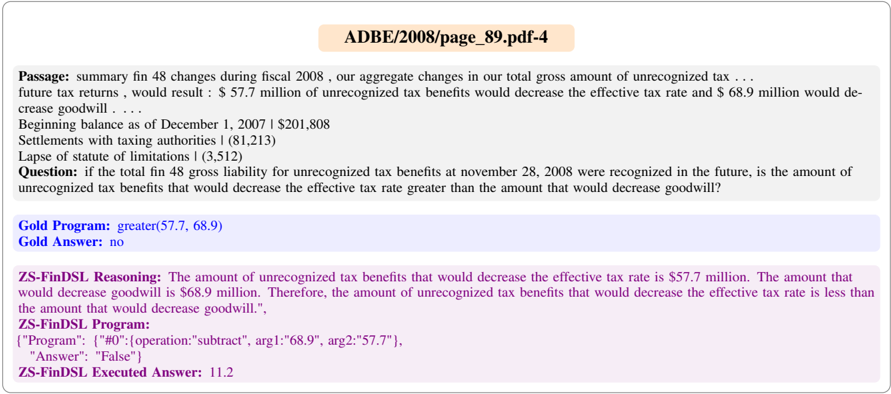
The image presents a snippet from a document, likely related to financial reporting and tax liability analysis. It includes a passage summarizing changes in unrecognized tax benefits, a question regarding the relationship between amounts decreasing the effective tax rate and goodwill, and a comparison of a "Gold Program" answer with a "ZS-FinDSL" reasoning and program execution.
### Components/Axes
* **Header:** "ADBE/2008/page\_89.pdf-4"
* **Passage:** A summary of financial changes during fiscal year 2008 related to unrecognized tax benefits.
* **Question:** A query about the relative amounts of unrecognized tax benefits affecting the effective tax rate and goodwill.
* **Gold Program:** A program that compares 57.7 and 68.9.
* **Gold Answer:** The answer provided by the "Gold Program," which is "no."
* **ZS-FinDSL Reasoning:** The reasoning provided by the ZS-FinDSL system.
* **ZS-FinDSL Program:** The program code used by the ZS-FinDSL system.
* **ZS-FinDSL Executed Answer:** The numerical result of the ZS-FinDSL program execution, which is 11.2.
### Detailed Analysis or Content Details
* **Passage:**
* Summary of fin 48 changes during fiscal 2008.
* Aggregate changes in the total gross amount of unrecognized tax.
* $57.7 million of unrecognized tax benefits would decrease the effective tax rate.
* $68.9 million would decrease goodwill.
* Beginning balance as of December 1, 2007: $201,808
* Settlements with taxing authorities: (81,213)
* Lapse of statute of limitations: (3,512)
* **Question:**
* Asks if the amount of unrecognized tax benefits that would decrease the effective tax rate is greater than the amount that would decrease goodwill.
* **Gold Program:**
* `greater(57.7, 68.9)`
* **Gold Answer:**
* `no`
* **ZS-FinDSL Reasoning:**
* States that $57.7 million would decrease the effective tax rate.
* States that $68.9 million would decrease goodwill.
* Concludes that the amount decreasing the effective tax rate is less than the amount decreasing goodwill.
* **ZS-FinDSL Program:**
* `{"Program": ["#0": {operation:"subtract", arg1:"68.9", arg2:"57.7"}, "Answer": "False"}`
* **ZS-FinDSL Executed Answer:**
* `11.2`
### Key Observations
* The passage provides financial data related to unrecognized tax benefits and their impact on the effective tax rate and goodwill.
* The question seeks to compare the magnitudes of these impacts.
* The "Gold Program" directly compares the two amounts (57.7 and 68.9) and returns "no," indicating that 57.7 is not greater than 68.9.
* The "ZS-FinDSL" system provides reasoning consistent with the "Gold Program" and executes a subtraction operation (68.9 - 57.7), resulting in 11.2.
* The ZS-FinDSL program also returns "False" as an answer, which is not consistent with the numerical result of 11.2.
### Interpretation
The document snippet presents a scenario involving the analysis of unrecognized tax benefits and their impact on financial statements. The "Gold Program" and "ZS-FinDSL" system are used to evaluate a specific question about the relative magnitudes of the impact on the effective tax rate and goodwill.
The "Gold Program" provides a direct comparison, while the "ZS-FinDSL" system offers a more detailed reasoning and program execution. The ZS-FinDSL program calculates the difference between the two amounts, resulting in 11.2. However, the ZS-FinDSL program also returns "False" as an answer, which is inconsistent with the numerical result of 11.2. This suggests a potential error or misinterpretation in the ZS-FinDSL program's logic.
The data suggests that the amount decreasing goodwill ($68.9 million) is greater than the amount decreasing the effective tax rate ($57.7 million). The ZS-FinDSL's subtraction confirms this difference numerically.