```markdown
## Diagram: System Architecture with Data Flow and Timing Labels
### Overview
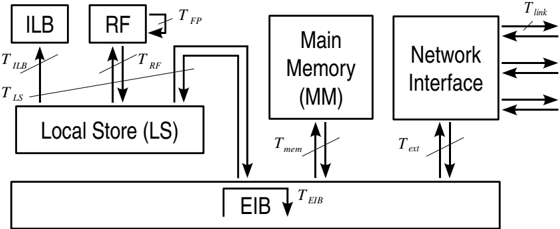
This diagram illustrates a system architecture with multiple components connected by labeled arrows representing data flow and timing delays. Key elements include the Input/Load Buffer (ILB), Request FIFO (RF), Local Store (LS), Main Memory (MM), Network Interface, and External Interface Buffer (EIB). Arrows indicate bidirectional data paths with associated time labels (e.g., T_ILB, T_mem).
### Components/Axes
- **Components**:
- ILB (Input/Load Buffer)
- RF (Request FIFO)
- LS (Local Store)
- MM (Main Memory)
- Network Interface
- EIB (External Interface Buffer)
- **Arrows/Labels**:
- **T_ILB**: Data flow from ILB to LS (upward arrow).
- **T_LS**: Data flow from LS to ILB (downward arrow).
- **T_RF**: Data flow from RF to LS (downward arrow).
- **T_FP**: Data flow from RF to FP (rightward arrow).
- **T_mem**: Data flow between LS and MM (downward arrow).
- **T_ext**: Data flow from Network Interface to MM (downward arrow).
- **T_link**: Data flow between Network Interface and external systems (horizontal arrows).
- **T_EIB**: Data flow from EIB to LS (downward arrow).
### Detailed Analysis
1. **ILB and RF**:
- ILB and RF are positioned at the top-left, feeding data into LS.
- T_ILB and T_LS indicate bidirectional communication between ILB and LS.
- T_RF shows unidirectional flow from RF to LS.
2. **Local Store (LS)**:
- Central component connected to ILB, RF, MM, and EIB.
- T_mem represents data transfer to/from MM.
3. **Main Memory (MM)**:
- Connected to LS (T_mem) and Network Interface (T_ext).
- T_ext suggests external data access via MM.
4. **Network Interface**:
- Rightmost component with bidirectional T_link arrows, indicating external communication.
- T_ext links MM to Network Interface.
5. **EIB**:
- Bottom component connected to LS (T_EIB) and MM (T_mem).
- Acts as a bridge between LS and external systems.
### Key Observations
- **Bidirectional Flow**: ILB and LS have reciprocal data paths (T_ILB/T_LS).
- **Central Role of LS**: LS is the hub for data exchange between ILB, RF, MM, and EIB.
- **External Communication**: Network Interface handles external data via T_link and T_ext.
- **Timing Hierarchy**: T_mem (LS-MM) and T_EIB (LS-EIB) suggest memory access is faster than external transfers.
### Interpretation
This diagram models a hierarchical system where:
1. **Data originates** from ILB/RF, processed in LS, and stored in MM.
2. **External data** enters via Network Interface, routed through MM to LS/EIB.
3. **Timing constraints** (e.g., T_mem < T_link) imply prioritization of internal memory access over external communication.
4. **EIB** serves as a critical intermediary for external data integration.
The architecture emphasizes minimizing latency in core operations (LS-MM) while managing external delays (