## Heatmap: Jailbreakbench ASR vs. Malicious Instruct ASR
### Overview
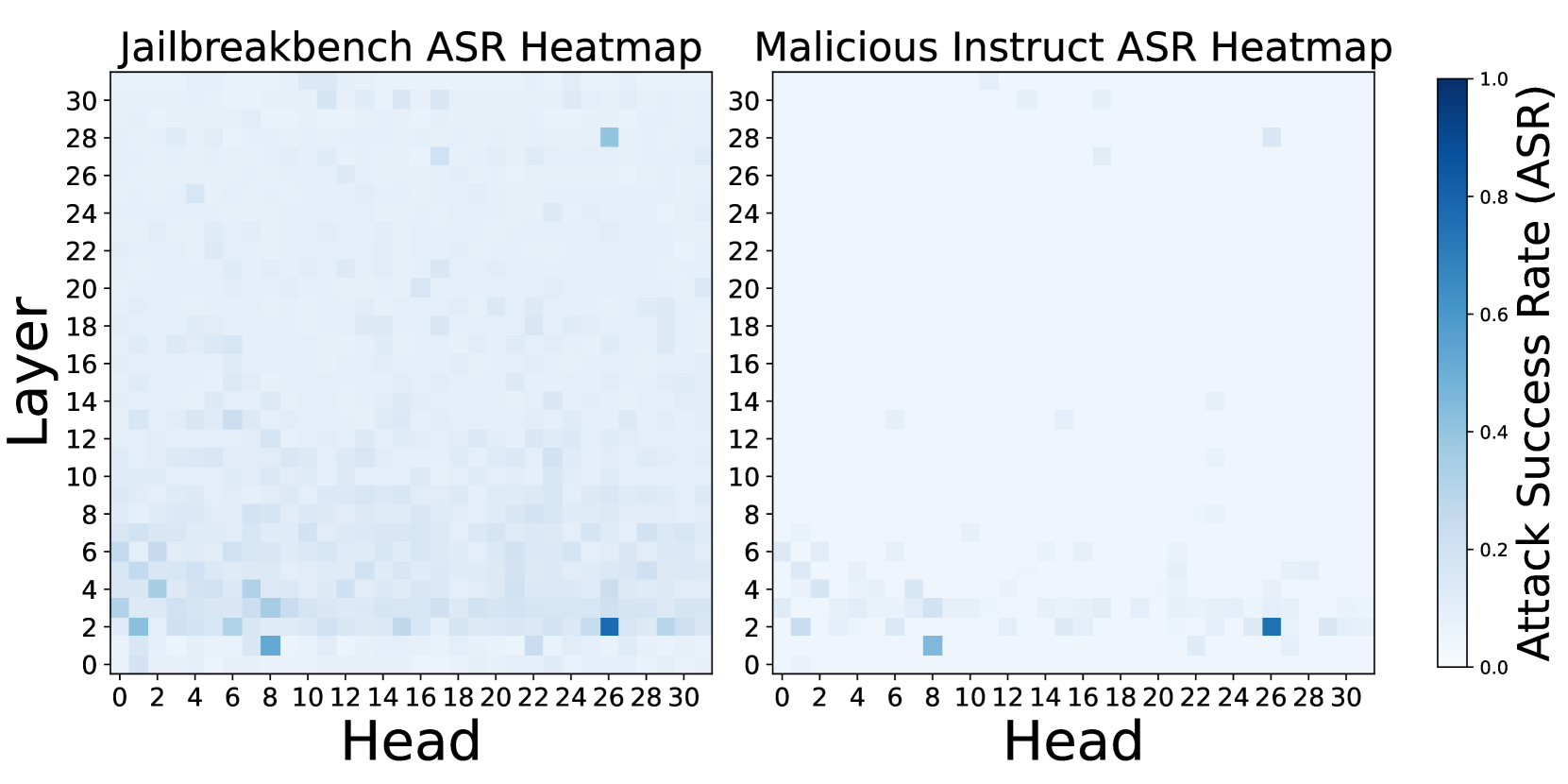
The image presents two heatmaps side-by-side, visualizing the Attack Success Rate (ASR) for "Jailbreakbench" and "Malicious Instruct" attacks across different layers and heads of a model. The heatmaps use a blue color gradient to represent the ASR, with darker shades indicating higher success rates.
### Components/Axes
* **Titles:**
* Left Heatmap: "Jailbreakbench ASR Heatmap"
* Right Heatmap: "Malicious Instruct ASR Heatmap"
* **X-axis (both heatmaps):** "Head", with tick marks from 0 to 30 in increments of 2.
* **Y-axis (both heatmaps):** "Layer", with tick marks from 0 to 30 in increments of 2.
* **Colorbar (right side):** "Attack Success Rate (ASR)", ranging from 0.0 (white) to 1.0 (dark blue) in increments of 0.2.
### Detailed Analysis
**Jailbreakbench ASR Heatmap (Left):**
* **General Trend:** The heatmap is mostly light blue, indicating generally low ASR.
* **Specific Data Points:**
* Layer 2, Head 8: ASR is approximately 0.2-0.4 (light blue).
* Layer 2, Head 26: ASR is approximately 0.4-0.6 (mid-blue).
* Layer 28, Head 28: ASR is approximately 0.4-0.6 (mid-blue).
* Layer 4, Head 2: ASR is approximately 0.2-0.4 (light blue).
* Layer 6, Head 2: ASR is approximately 0.2-0.4 (light blue).
**Malicious Instruct ASR Heatmap (Right):**
* **General Trend:** The heatmap is predominantly white, indicating very low ASR across most layers and heads.
* **Specific Data Points:**
* Layer 2, Head 26: ASR is approximately 0.4-0.6 (mid-blue).
* Layer 2, Head 8: ASR is approximately 0.2-0.4 (light blue).
* Layer 4, Head 4: ASR is approximately 0.2-0.4 (light blue).
* Layer 6, Head 2: ASR is approximately 0.2-0.4 (light blue).
* Layer 13, Head 4: ASR is approximately 0.2-0.4 (light blue).
* Layer 27, Head 26: ASR is approximately 0.2-0.4 (light blue).
* Layer 30, Head 14: ASR is approximately 0.2-0.4 (light blue).
### Key Observations
* The "Malicious Instruct" attack generally has a lower success rate compared to the "Jailbreakbench" attack.
* In both heatmaps, certain heads in the lower layers (around layer 2) show slightly higher ASR.
* The ASR is not uniformly distributed across layers and heads; some specific combinations show higher vulnerability.
### Interpretation
The heatmaps provide a visual representation of the model's vulnerability to different types of attacks across its layers and heads. The "Jailbreakbench" attack appears to be more effective overall, suggesting that the model is more susceptible to this type of adversarial input. The "Malicious Instruct" attack, on the other hand, shows very low success rates, indicating that the model is relatively robust against this specific type of attack.
The variations in ASR across different layers and heads suggest that certain parts of the model are more vulnerable than others. This information could be used to focus efforts on improving the robustness of these specific areas, potentially through techniques like adversarial training or targeted regularization. The concentration of slightly higher ASR values in the lower layers for both attacks might indicate that these layers are more critical for processing adversarial inputs or that they are more easily manipulated.