## Diagram: 6×6 Number Grid Puzzle with Blocked Cells
### Overview
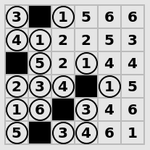
The image displays a 6×6 grid-based logic puzzle, likely a variant of Sudoku or a similar number-placement puzzle. The grid contains numerical digits (1 through 6) and solid black squares that act as blocked or separator cells. The objective appears to be filling the white cells with numbers according to specific, unstated rules.
### Components/Axes
* **Grid Structure:** A 6-row by 6-column matrix.
* **Cell Types:** Two distinct types:
1. **White Cells:** Contain a single digit from 1 to 6.
2. **Black Cells:** Completely filled with black, serving as blockers or dividers.
* **Labels/Axes:** There are no explicit row/column labels, axis titles, or legends. The grid is presented without external annotations.
### Detailed Analysis
The following is a precise transcription of the grid's content, read left-to-right, top-to-bottom. `■` denotes a black cell.
**Row 1:** `3`, `■`, `1`, `5`, `6`, `6`
**Row 2:** `4`, `1`, `2`, `2`, `5`, `3`
**Row 3:** `■`, `5`, `2`, `■`, `4`, `4`
**Row 4:** `2`, `3`, `■`, `4`, `■`, `5`
**Row 5:** `1`, `6`, `■`, `3`, `4`, `6`
**Row 6:** `5`, `■`, `3`, `4`, `6`, `1`
**Spatial Distribution of Black Cells:**
* Row 1, Column 2
* Row 3, Column 1
* Row 3, Column 4
* Row 4, Column 3
* Row 4, Column 5
* Row 5, Column 3
* Row 6, Column 2
### Key Observations
1. **Number Range:** All visible digits are within the 1-6 range, consistent with a 6x6 puzzle format.
2. **Duplicate Numbers in Rows:** Several rows contain duplicate numbers within the same row, which is atypical for standard Sudoku rules. For example:
* Row 1 has two `6`s.
* Row 2 has two `2`s.
* Row 3 has two `4`s.
* Row 5 has two `6`s.
3. **Pattern of Black Cells:** The black cells are not placed in a simple checkerboard or symmetrical pattern. Their distribution seems irregular, potentially defining separate regions or "cages" within the grid for the puzzle's logic.
4. **No Clear "Solved" State:** The presence of duplicates suggests this is either an initial puzzle state with clues, a puzzle with non-standard rules (e.g., allowing repeats in rows/columns), or an error in the puzzle's construction.
### Interpretation
This image presents a logic puzzle in its initial state. The black cells are fundamental to its structure, likely defining the boundaries of regions or "cages" where specific rules (like unique sums or number sets) apply. The duplicate numbers in rows are the most significant feature; they strongly indicate that the governing rules are **not** the classic Sudoku constraint of "each number appears exactly once per row and column."
Instead, the puzzle likely follows a different set of rules, such as:
* **Killer Sudoku/Cage Sums:** Numbers within a region (defined by black cells) must sum to a target, and numbers may repeat within a row or column if allowed by the cage boundaries.
* **Another Variant:** Rules could involve arithmetic operations, non-unique row/column constraints, or path-following.
Without the explicit rules or target sums, the puzzle is unsolvable. The image provides the *board state* but not the *ruleset*. To progress, one would need the accompanying instructions that define the purpose of the black cells and the constraints on placing numbers in the white cells. The data suggests a complex, region-based logic puzzle rather than a simple placement grid.