## Diagram: Feature Extraction and Prediction Network Generation
### Overview
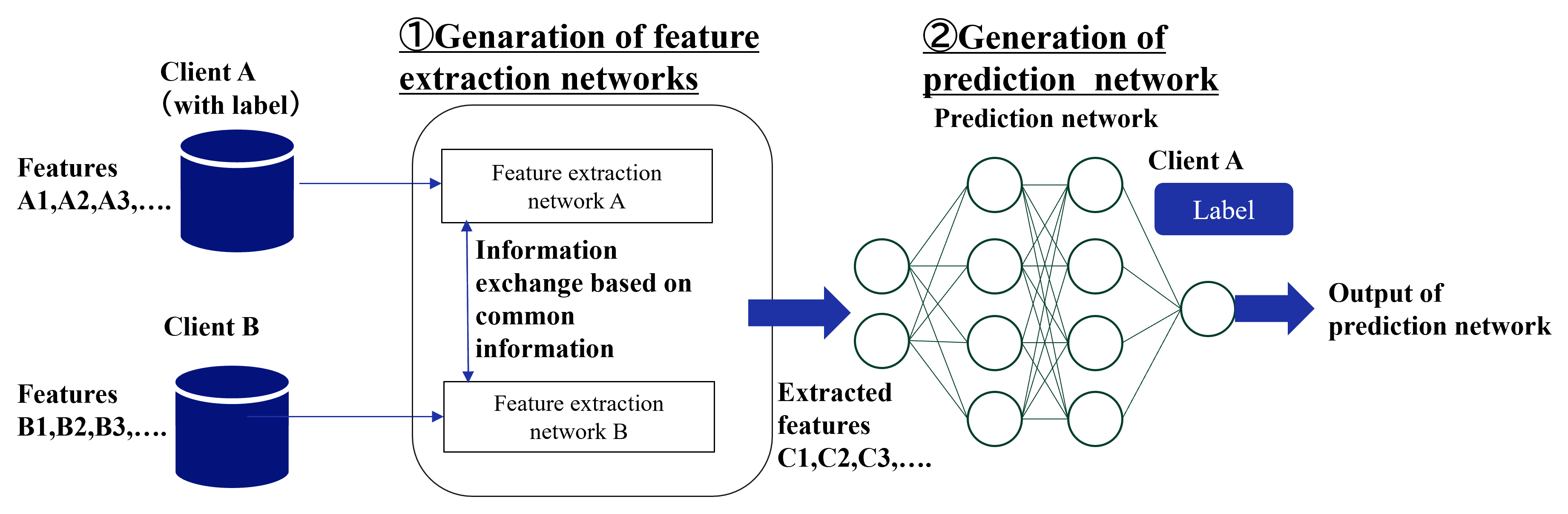
The image is a diagram illustrating the generation of feature extraction networks and a prediction network. It shows two clients (A and B) with their respective features, the process of feature extraction, information exchange, and the final prediction network.
### Components/Axes
* **Title 1:** ① Genaration of feature extraction networks
* **Title 2:** ② Generation of prediction network
* **Sub-title:** Prediction network
* **Client A:** (with label)
* **Features:** A1, A2, A3,...
* **Label:** Label
* **Client B:**
* **Features:** B1, B2, B3,...
* **Feature extraction network A**
* **Feature extraction network B**
* **Information exchange based on common information**
* **Extracted features:** C1, C2, C3,...
* **Output of prediction network**
### Detailed Analysis or Content Details
The diagram is divided into two main sections, labeled ① and ②.
**Section ①: Generation of feature extraction networks**
* Two data sources, Client A and Client B, are represented as blue cylinders.
* Client A is labeled "(with label)" and has features A1, A2, A3,...
* Client B has features B1, B2, B3,...
* Data from Client A flows into "Feature extraction network A".
* Data from Client B flows into "Feature extraction network B".
* A bidirectional arrow between the two feature extraction networks is labeled "Information exchange based on common information".
**Section ②: Generation of prediction network**
* The output of the feature extraction networks (A and B) flows into a prediction network.
* The prediction network is represented as a multi-layered neural network with interconnected nodes.
* The input to the prediction network is labeled "Extracted features C1, C2, C3,...".
* The output of the prediction network is labeled "Output of prediction network".
* A blue box labeled "Label" is associated with Client A within the prediction network.
### Key Observations
* The diagram illustrates a process where two clients contribute data to generate feature extraction networks.
* The feature extraction networks exchange information.
* The extracted features are then used to train a prediction network.
* Client A has a label associated with it, which is used in the prediction network.
### Interpretation
The diagram depicts a federated learning or distributed learning scenario where multiple clients contribute to training a model without directly sharing their raw data. The feature extraction networks likely learn representations of the data, and the information exchange allows them to learn from each other's data distributions. The prediction network then uses these extracted features to make predictions, leveraging the knowledge gained from both clients. The presence of a label for Client A suggests a supervised learning task.