## Flowchart: Collaborative Machine Learning Process with Feature Extraction and Prediction Networks
### Overview
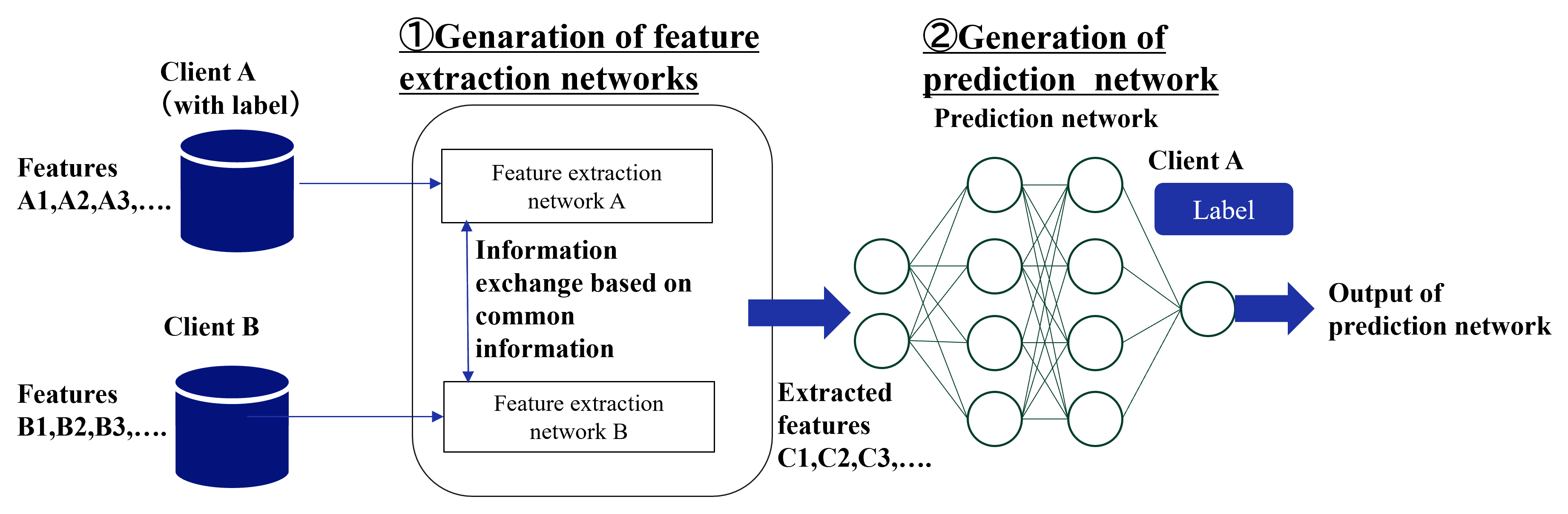
The diagram illustrates a two-stage collaborative machine learning workflow involving two clients (A and B) and shared feature extraction/prediction networks. It emphasizes information exchange between client-specific networks and a centralized prediction system.
### Components/Axes
1. **Input Data Sources**:
- Client A (with label): Contains features A1, A2, A3, ...
- Client B: Contains features B1, B2, B3, ...
- Visual representation: Blue cylindrical containers with white text labels
2. **Feature Extraction Stage**:
- Two parallel feature extraction networks:
- Network A (processes Client A's features)
- Network B (processes Client B's features)
- Information exchange mechanism: Arrows between networks indicate shared learning
3. **Prediction Stage**:
- Central prediction network with 10 interconnected nodes
- Inputs: Extracted features (C1, C2, C3, ...) and Client A's label
- Output: Final prediction result
4. **Flow Direction**:
- Left-to-right progression from data sources to final output
- Vertical connections between network layers in prediction stage
### Content Details
- **Client Data**:
- Client A: Features A1-A3+ (exact count unspecified)
- Client B: Features B1-B3+ (exact count unspecified)
- Label: Explicitly marked for Client A only
- **Network Architecture**:
- Feature extraction networks: Rectangular boxes with rounded corners
- Prediction network: 10-node interconnected structure with green edges
- **Extracted Features**:
- Labeled as C1, C2, C3, ... (exact count unspecified)
- Positioned between feature extraction and prediction stages
### Key Observations
1. Asymmetric labeling: Only Client A's data includes explicit label information
2. Bidirectional information flow: Networks A and B share common information despite initial separation
3. Centralized prediction: Final output depends on combined features from both clients
4. Node complexity: Prediction network contains 10 interconnected processing units
### Interpretation
This architecture demonstrates a federated learning approach where:
1. Client-specific feature extraction networks maintain data privacy while learning local patterns
2. Information exchange enables cross-client knowledge transfer without raw data sharing
3. The prediction network synthesizes distributed knowledge for final output
4. Client A's label suggests it may be the primary target for prediction tasks
The design prioritizes collaborative learning while maintaining data locality, with Client A's labeled data serving as the ground truth for the prediction task. The 10-node prediction network implies a complex decision-making process that integrates features from both clients' data distributions.