## Line Chart: Model Accuracy on Math Problems
### Overview
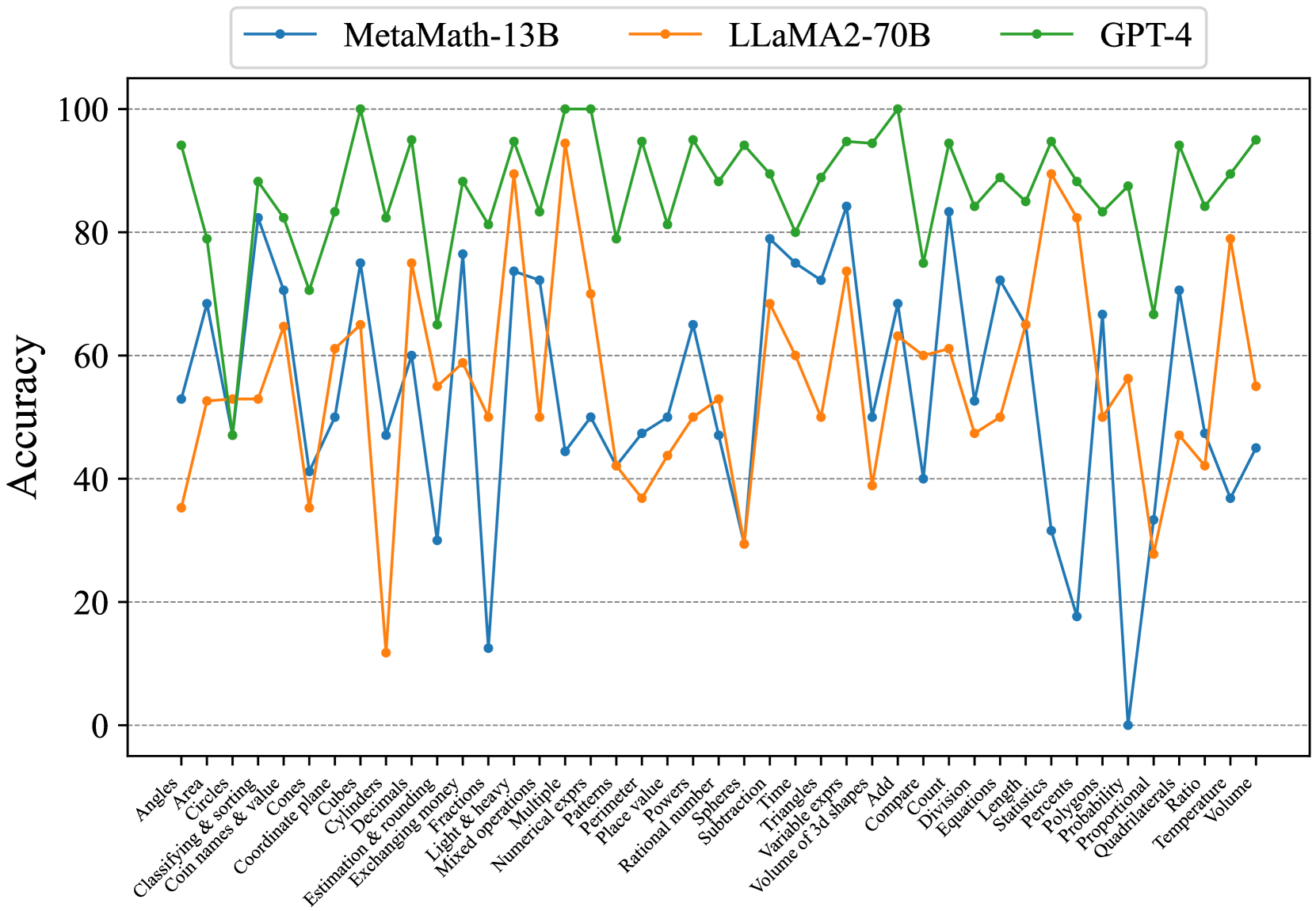
The image is a line chart comparing the accuracy of three different language models (MetaMath-13B, LLaMA2-70B, and GPT-4) on a variety of math-related tasks. The x-axis represents different math problem types, and the y-axis represents the accuracy score (from 0 to 100).
### Components/Axes
* **Title:** (Implicit) Model Accuracy on Math Problems
* **X-axis:** Math Problem Types (listed below)
* **Y-axis:** Accuracy (ranging from 0 to 100, with gridlines at intervals of 20)
* **Legend:** Located at the top of the chart.
* Blue line: MetaMath-13B
* Orange line: LLaMA2-70B
* Green line: GPT-4
### Detailed Analysis
**X-Axis Categories (Math Problem Types):**
1. Angles
2. Area
3. Circles
4. Classifying & sorting
5. Coin names & value
6. Cones
7. Coordinate plane
8. Cubes
9. Cylinders
10. Decimals
11. Estimation & rounding
12. Exchanging money
13. Fractions
14. Light & heavy
15. Mixed operations
16. Multiple
17. Numerical exprs
18. Patterns
19. Perimeter
20. Place value
21. Powers
22. Rational number
23. Spheres
24. Subtraction
25. Time
26. Triangles
27. Variable exprs
28. Volume of 3d shapes
29. Add
30. Compare
31. Count
32. Division
33. Equations
34. Length
35. Percents
36. Polygons
37. Probability
38. Proportional
39. Quadrilaterals
40. Ratio
41. Temperature
42. Volume
**Data Series Analysis:**
* **MetaMath-13B (Blue):** The accuracy fluctuates significantly across different problem types. It starts around 50-60%, dips to around 30% for "Cylinders", peaks around 70-80% for "Exchanging money", then drops sharply to near 0% for "Quadrilaterals", before recovering to around 50% for "Volume".
* Angles: ~53%
* Area: ~53%
* Circles: ~70%
* Classifying & sorting: ~70%
* Coin names & value: ~63%
* Cones: ~40%
* Coordinate plane: ~63%
* Cubes: ~30%
* Cylinders: ~30%
* Decimals: ~33%
* Estimation & rounding: ~73%
* Exchanging money: ~73%
* Fractions: ~50%
* Light & heavy: ~53%
* Mixed operations: ~47%
* Multiple: ~50%
* Numerical exprs: ~53%
* Patterns: ~77%
* Perimeter: ~73%
* Place value: ~50%
* Powers: ~77%
* Rational number: ~80%
* Spheres: ~77%
* Subtraction: ~73%
* Time: ~60%
* Triangles: ~43%
* Variable exprs: ~60%
* Volume of 3d shapes: ~43%
* Add: ~43%
* Compare: ~43%
* Count: ~63%
* Division: ~60%
* Equations: ~40%
* Length: ~33%
* Percents: ~13%
* Polygons: ~33%
* Probability: ~0%
* Proportional: ~70%
* Quadrilaterals: ~0%
* Ratio: ~43%
* Temperature: ~43%
* Volume: ~50%
* **LLaMA2-70B (Orange):** The accuracy also fluctuates, but generally stays between 35% and 95%. It has a low point around 10% for "Decimals" and peaks around 95% for "Place Value".
* Angles: ~35%
* Area: ~53%
* Circles: ~53%
* Classifying & sorting: ~63%
* Coin names & value: ~40%
* Cones: ~63%
* Coordinate plane: ~37%
* Cubes: ~13%
* Cylinders: ~13%
* Decimals: ~13%
* Estimation & rounding: ~67%
* Exchanging money: ~67%
* Fractions: ~40%
* Light & heavy: ~53%
* Mixed operations: ~93%
* Multiple: ~93%
* Numerical exprs: ~77%
* Patterns: ~93%
* Perimeter: ~93%
* Place value: ~93%
* Powers: ~40%
* Rational number: ~53%
* Spheres: ~53%
* Subtraction: ~77%
* Time: ~77%
* Triangles: ~40%
* Variable exprs: ~53%
* Volume of 3d shapes: ~20%
* Add: ~60%
* Compare: ~77%
* Count: ~60%
* Division: ~57%
* Equations: ~87%
* Length: ~93%
* Percents: ~87%
* Polygons: ~57%
* Probability: ~57%
* Proportional: ~57%
* Quadrilaterals: ~57%
* Ratio: ~57%
* Temperature: ~57%
* Volume: ~57%
* **GPT-4 (Green):** The accuracy is generally high and more consistent than the other two models, mostly staying above 80%. It peaks at 100% for several categories and dips to around 50% for "Coordinate plane".
* Angles: ~77%
* Area: ~93%
* Circles: ~77%
* Classifying & sorting: ~87%
* Coin names & value: ~50%
* Cones: ~87%
* Coordinate plane: ~50%
* Cubes: ~87%
* Cylinders: ~87%
* Decimals: ~93%
* Estimation & rounding: ~93%
* Exchanging money: ~93%
* Fractions: ~100%
* Light & heavy: ~93%
* Mixed operations: ~93%
* Multiple: ~93%
* Numerical exprs: ~93%
* Patterns: ~93%
* Perimeter: ~93%
* Place value: ~93%
* Powers: ~93%
* Rational number: ~93%
* Spheres: ~93%
* Subtraction: ~93%
* Time: ~93%
* Triangles: ~93%
* Variable exprs: ~93%
* Volume of 3d shapes: ~93%
* Add: ~93%
* Compare: ~93%
* Count: ~93%
* Division: ~93%
* Equations: ~93%
* Length: ~93%
* Percents: ~93%
* Polygons: ~93%
* Probability: ~93%
* Proportional: ~93%
* Quadrilaterals: ~93%
* Ratio: ~93%
* Temperature: ~93%
* Volume: ~93%
### Key Observations
* GPT-4 consistently outperforms MetaMath-13B and LLaMA2-70B across almost all math problem types.
* MetaMath-13B shows significant weaknesses in "Quadrilaterals" problems.
* LLaMA2-70B has a low accuracy on "Decimals" problems.
* All models show variability in accuracy depending on the problem type.
### Interpretation
The chart demonstrates the relative strengths and weaknesses of different language models in solving various math problems. GPT-4's consistently high accuracy suggests it has a more robust understanding of mathematical concepts compared to MetaMath-13B and LLaMA2-70B. The specific areas where each model struggles (e.g., MetaMath-13B with "Quadrilaterals") could indicate areas for further model training and improvement. The variability in accuracy across problem types highlights the complexity of mathematical reasoning and the challenges in developing AI models that can generalize across different mathematical domains.