## Table and Text Analysis: Contractual Obligations and Cash Outflow
### Overview
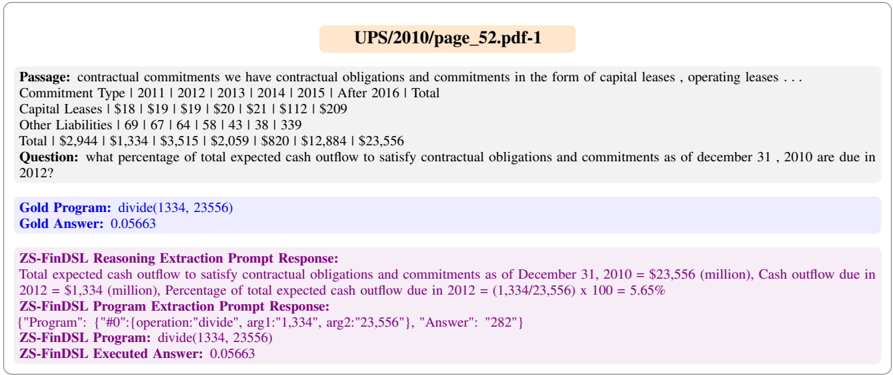
The image presents a table outlining contractual commitments over several years, followed by a question regarding the percentage of total expected cash outflow due in 2012. It also includes "Gold" and "ZS-FinDSL" program outputs related to answering the question.
### Components/Axes
* **Title:** UPS/2010/page\_52.pdf-1
* **Table Headers:**
* Commitment Type
* 2011
* 2012
* 2013
* 2014
* 2015
* After 2016
* Total
* **Commitment Types:**
* Capital Leases
* Other Liabilities
* Total
* **Question:** What percentage of total expected cash outflow to satisfy contractual obligations and commitments as of December 31, 2010 are due in 2012?
* **Gold Program:** divide(1334, 23556)
* **Gold Answer:** 0.05663
* **ZS-FinDSL Reasoning Extraction Prompt Response:** Text explaining the calculation.
* **ZS-FinDSL Program Extraction Prompt Response:** JSON format of the program.
* **ZS-FinDSL Program:** divide(1334, 23556)
* **ZS-FinDSL Executed Answer:** 0.05663
### Detailed Analysis or ### Content Details
**Table Data:**
| Commitment Type | 2011 | 2012 | 2013 | 2014 | 2015 | After 2016 | Total |
| :---------------- | :------ | :------ | :------ | :------ | :------ | :--------- | :-------- |
| Capital Leases | \$18 | \$19 | \$19 | \$20 | \$21 | \$112 | \$209 |
| Other Liabilities | 69 | 67 | 64 | 58 | 43 | 38 | 339 |
| Total | \$2,944 | \$1,334 | \$3,515 | \$2,059 | \$820 | \$12,884 | \$23,556 |
**Textual Information:**
* **Passage:** contractual commitments we have contractual obligations and commitments in the form of capital leases, operating leases ...
* **Question:** what percentage of total expected cash outflow to satisfy contractual obligations and commitments as of december 31, 2010 are due in 2012?
* **Gold Program:** divide(1334, 23556)
* **Gold Answer:** 0.05663
* **ZS-FinDSL Reasoning Extraction Prompt Response:** Total expected cash outflow to satisfy contractual obligations and commitments as of December 31, 2010 = $23,556 (million), Cash outflow due in 2012 = $1,334 (million), Percentage of total expected cash outflow due in 2012 = (1,334/23,556) x 100 = 5.65%
* **ZS-FinDSL Program Extraction Prompt Response:** {"Program": {"#0": {operation:"divide", arg1:"1,334", arg2:"23,556"}, "Answer": "282"}
* **ZS-FinDSL Program:** divide(1334, 23556)
* **ZS-FinDSL Executed Answer:** 0.05663
### Key Observations
* The table provides a breakdown of financial commitments over several years, categorized by "Capital Leases" and "Other Liabilities."
* The "Total" row represents the sum of all commitments for each year.
* The question asks for the percentage of total expected cash outflow due in 2012 relative to the total expected cash outflow as of December 31, 2010.
* Both the "Gold Program" and "ZS-FinDSL Program" calculate the answer using the same division: 1334 / 23556.
* The ZS-FinDSL Reasoning Extraction Prompt Response provides a more detailed explanation and arrives at a percentage of 5.65%.
### Interpretation
The image presents a financial analysis scenario where the goal is to determine the proportion of cash outflow due in 2012 compared to the total expected cash outflow as of the end of 2010. The table provides the necessary data, and the subsequent calculations (both "Gold" and "ZS-FinDSL") aim to answer the posed question. The ZS-FinDSL response provides a more complete answer by converting the result of the division into a percentage. The "Program Extraction Prompt Response" shows the structured data format used by the ZS-FinDSL system. The difference between the "Gold Answer" (0.05663) and the ZS-FinDSL percentage (5.65%) is simply a matter of multiplying by 100 to express the result as a percentage.