## Diagram: Numbered Grid with Directional Arrows
### Overview
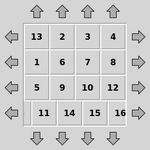
The image displays a 4x4 grid of numbered cells (1 through 16) arranged in a non-sequential order. The grid is surrounded on all four sides by outward-pointing arrows, suggesting a directional or interactive interface, such as a control pad, puzzle element, or navigation diagram.
### Components/Axes
* **Central Grid:** A 4x4 matrix of square cells, each containing a number.
* **Numbers:** The numbers 1 through 16 are present, each in a unique cell.
* **Directional Arrows:** Gray, upward-pointing arrows are positioned above each column. Gray, downward-pointing arrows are positioned below each column. Gray, left-pointing arrows are positioned to the left of each row. Gray, right-pointing arrows are positioned to the right of each row. All arrows point away from the central grid.
### Detailed Analysis
**Grid Content (Row by Row, from top to bottom):**
* **Row 1 (Top):** 13, 2, 3, 4
* **Row 2:** 1, 6, 7, 8
* **Row 3:** 5, 9, 10, 12
* **Row 4 (Bottom):** 11, 14, 15, 16
**Spatial Layout of Arrows:**
* **Top Edge:** Four arrows, each aligned with one of the four columns, pointing up.
* **Bottom Edge:** Four arrows, each aligned with one of the four columns, pointing down.
* **Left Edge:** Four arrows, each aligned with one of the four rows, pointing left.
* **Right Edge:** Four arrows, each aligned with one of the four rows, pointing right.
### Key Observations
1. **Non-Sequential Numbering:** The numbers are not arranged in a standard left-to-right, top-to-bottom order (e.g., 1 is in the second row, first column; 13 is in the first row, first column).
2. **Complete Set:** All integers from 1 to 16 are present exactly once.
3. **Symmetrical Arrow Layout:** The arrows form a perfectly symmetrical frame around the grid, with one arrow per row/column on each side.
4. **Visual Style:** The diagram uses a simple, clean aesthetic with a light gray background, white grid cells with gray borders, black numbers, and solid gray arrows.
### Interpretation
This diagram likely represents a **keypad, controller, or puzzle grid** where the arrangement of numbers is significant. The arrows strongly imply that each row and column can be activated or scrolled in the indicated direction.
The non-sequential numbering is the most critical feature. It suggests the grid is not a simple counter but encodes a specific pattern. This could be:
* A **cipher or code** where the position of a number (e.g., "13" in the top-left) is the key, not its value.
* A **sliding puzzle** (like a 15-puzzle) in a specific scrambled state, where the arrows indicate possible moves for the empty space (though no empty space is visually marked).
* A **custom input layout** for a device or game, where the physical or logical mapping of numbers to directional inputs is defined by this chart.
The primary information conveyed is the **exact spatial relationship between the numbers 1-16 and the four cardinal directions**. To use this diagram, one would need to reference the specific number at a given grid coordinate and its associated directional arrows.