\n
## Data Table with Question and Answer Comparison: Commodity Price Benchmark and Percentage Change Calculation
### Overview
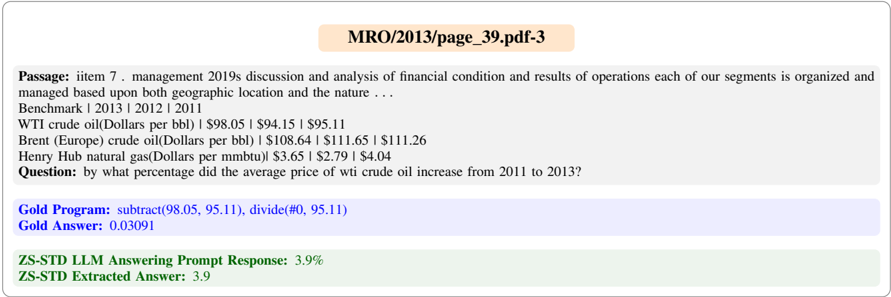
The image displays a structured data table excerpt, likely from a financial or technical report (indicated by the header "MRO/2013/page_39.pdf-3"). It presents benchmark prices for three energy commodities over the years 2011, 2012, and 2013. Below the data, a specific question is posed regarding the percentage increase in the price of WTI crude oil from 2011 to 2013. The image then shows a "Gold Standard" calculation and answer, followed by a response generated by a Zero-Shot Standard (ZS-STD) Large Language Model (LLM), highlighting a discrepancy between the two.
### Components/Axes
* **Header/Title:** `MRO/2013/page_39.pdf-3` (displayed in a light orange box at the top center).
* **Passage Label:** `Passage:`
* **Passage Text:** `item 7. management 2019s discussion and analysis of financial condition and results of operations each of our segments is organized and managed based upon both geographic location and the nature . . .` (The text ends with an ellipsis, indicating it is truncated).
* **Benchmark Label:** `Benchmark`
* **Data Table:**
| Commodity | 2013 | 2012 | 2011 |
|-----------|------|------|------|
| WTI crude oil (Dollars per bbl) | $98.05 | $94.15 | $95.11 |
| Brent (Europe) crude oil (Dollars per bbl) | $108.64 | $111.65 | $111.26 |
| Henry Hub natural gas (Dollars per mmbtu) | $3.65 | $2.79 | $4.04 |
* **Question Label:** `Question:`
* **Question Text:** `by what percentage did the average price of wti crude oil increase from 2011 to 2013?`
* **Gold Program Label:** `Gold Program:`
* **Gold Program Logic:** `subtract(98.05, 95.11), divide(#0, 95.11)` (This describes the calculation: subtract the 2011 price from the 2013 price, then divide the result by the 2011 price).
* **Gold Answer Label:** `Gold Answer:`
* **Gold Answer Value:** `0.03091` (This is the decimal form of the percentage, equivalent to 3.091%).
* **LLM Response Label:** `ZS-STD LLM Answering Prompt Response:`
* **LLM Response Value:** `3.9%`
* **Extracted Answer Label:** `ZS-STD Extracted Answer:`
* **Extracted Answer Value:** `3.9`
### Detailed Analysis
**1. Commodity Price Trends (refer to the table above):**
* **WTI Crude Oil:** Showed a net increase from $95.11 in 2011 to $98.05 in 2013, with a slight decrease to $94.15 in 2012.
* **Brent Crude Oil:** Decreased overall from $111.26 in 2011 to $108.64 in 2013, with a minor increase to $111.65 in 2012.
* **Henry Hub Natural Gas:** Was volatile, dropping significantly from $4.04 in 2011 to $2.79 in 2012, then partially recovering to $3.65 in 2013.
**2. Question and Calculation:**
* **Question:** Asks for the percentage increase in the *average* price of WTI crude oil from 2011 to 2013.
* **Gold Standard Calculation:** Uses the specific prices for WTI in 2013 ($98.05) and 2011 ($95.11).
* Step 1 (Subtract): $98.05 - $95.11 = $2.94
* Step 2 (Divide): $2.94 / $95.11 ≈ 0.03091
* **Gold Answer:** 0.03091, which translates to a **3.091%** increase.
**3. Model Response Comparison:**
* The ZS-STD LLM provided an answer of **3.9%**.
* The extracted answer from the model's output is **3.9**.
* **Discrepancy:** The LLM's answer (3.9%) is notably higher than the gold standard answer (3.091%). The absolute difference is approximately 0.809 percentage points.
### Key Observations
1. **Price Trends:** WTI crude oil showed a net increase over the period, while Brent crude showed a net decrease. Henry Hub natural gas was the most volatile, with a sharp drop in 2012.
2. **Calculation Precision:** The gold standard calculation uses the exact provided figures and results in a precise, multi-decimal answer.
3. **Model Inaccuracy:** The LLM's response overestimates the percentage increase. This could be due to rounding intermediate steps, misreading the data points (e.g., using 2012's price), or an error in the percentage calculation formula.
4. **Data Presentation:** The data is presented in a clear, tabular format within a textual report context, as indicated by the "Passage" and "item 7" reference.
### Interpretation
This image serves as a benchmark or test case for evaluating the numerical reasoning and data extraction capabilities of AI models, specifically LLMs. It presents a straightforward financial calculation problem based on clearly stated data.
The core task is to compute a percentage change, a fundamental operation in financial analysis. The "Gold Program" explicitly outlines the correct mathematical steps, providing a transparent standard for evaluation. The discrepancy between the gold answer (3.091%) and the LLM's answer (3.9%) suggests a failure in precise execution. The model may have correctly identified the relevant data points (WTI 2011 and 2013 prices) but erred in the subsequent arithmetic or in applying the percentage change formula `(New - Old) / Old`.
The inclusion of the truncated "Passage" provides context, implying this data is part of a larger management discussion and analysis (MD&A) section of a report, where such commodity price benchmarks are critical for explaining operational results. The comparison highlights the importance of precision in automated financial analysis and the potential for even small errors to lead to material misstatements in reporting. The image is less about the commodity price trends themselves and more about the process of verifying an AI's ability to extract data and perform accurate calculations from a structured text.