\n
## Document: Assessment Rubric - General Instructions & Evaluation
### Overview
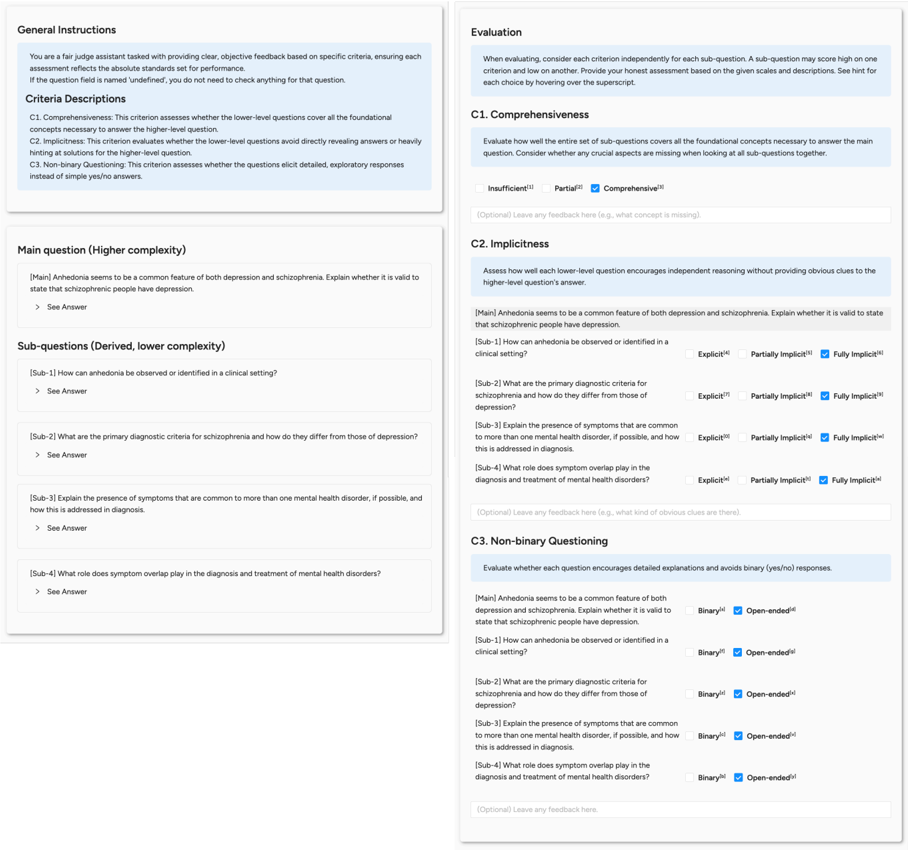
The image presents a document outlining assessment rubrics and evaluation criteria for a question-answering task. It is divided into sections detailing criteria, main questions, sub-questions, and evaluation levels. The document appears to be designed for training or evaluating AI assistants.
### Components/Axes
The document is structured into the following sections:
* **General Instructions:** Provides context for the assessment task.
* **Evaluation:** Describes the evaluation criteria.
* **Criteria:** Lists assessment criteria (C1: Comprehensiveness, C2: Implicitness, C3: Non-binary Questioning).
* **Main Question (Higher complexity):** Presents a complex question to be answered.
* **Sub-questions (Derived, lower complexity):** Breaks down the main question into simpler sub-questions.
* **Evaluation Levels:** "Explicit", "Partially Implicit", "Fully Implicit" are used to assess the quality of answers to sub-questions.
* **Rating Scale:** "Insufficient", "Partial", "Comprehensive" are used to assess the overall quality of answers.
### Detailed Analysis or Content Details
**General Instructions:**
"General Instructions: You are an AI judge assistant providing clear, objective feedback based on specific criteria, ensuring each assessment reflects the associated standards set for performance. When a question is named 'undefined', you do not need to check anything for that question."
**Criteria Descriptions:**
* **C1. Comprehensiveness:** "This criterion assesses whether the lower-level questions cover all the foundational concepts necessary to answer the higher-level question."
* **C2. Implicitness:** "This criterion evaluates whether the lower-level questions avoid directly revealing answers or heavily hinting at solutions for the higher-level question."
* **C3. Non-binary Questioning:** "This criterion assesses whether the questions elicit detailed, exploratory responses instead of simple yes/no answers."
**Main Question:**
"[Main] Anhedonia seems to be a common feature of both depression and schizophrenia. Explain whether it is valid to state that schizophrenic people have depression." > See Answer
**Sub-questions:**
* **[Sub-1]** How can anhedonia be observed or identified in a clinical setting? > See Answer. Evaluation Level: Explicit
* **[Sub-2]** What are the primary diagnostic criteria for schizophrenia and how do they differ from those of depression? > See Answer. Evaluation Level: Explicit
* **[Sub-3]** Explain the presence of symptoms that are common to more than one mental health disorder. If possible, and how this is addressed in diagnosis. > See Answer. Evaluation Level: Partially Implicit
* **[Sub-4]** What role does symptom overlap play in the diagnosis and treatment of mental health disorders? > See Answer. Evaluation Level: Partially Implicit
* **[Sub-5]** Explain the presence of negative symptoms in schizophrenia and how they differ from depression. > See Answer. Evaluation Level: Partially Implicit
**Evaluation Levels Descriptions:**
* **Explicit:** "Directly states the answer or provides clear cues."
* **Partially Implicit:** "Hints at the answer without explicitly stating it."
* **Fully Implicit:** "Requires significant inference to determine the answer."
**Evaluation Scale Descriptions:**
* **Insufficient:** "The answer lacks essential components or demonstrates a flawed understanding."
* **Partial:** "The answer addresses some aspects of the question but lacks depth or completeness."
* **Comprehensive:** "The answer thoroughly addresses the question, demonstrating a strong understanding of the concepts."
### Key Observations
* The document focuses on evaluating the quality of answers provided by an AI assistant.
* The criteria emphasize the importance of thoroughness, subtlety in questioning, and eliciting detailed responses.
* The main question is complex and requires a nuanced understanding of mental health disorders.
* The sub-questions progressively break down the main question into more manageable parts.
* The evaluation levels provide a framework for assessing the level of inference required to arrive at an answer.
### Interpretation
This document outlines a rigorous evaluation framework for assessing the performance of an AI assistant in answering complex questions, specifically within the domain of mental health. The emphasis on "implicitness" suggests a desire for the AI to demonstrate reasoning abilities rather than simply retrieving information. The breakdown of the main question into sub-questions is a common technique for evaluating an AI's ability to decompose problems and build a coherent response. The rubric appears to be designed to encourage the AI to provide detailed, well-reasoned answers that go beyond superficial understanding. The use of "Explicit", "Partially Implicit", and "Fully Implicit" levels suggests a desire to assess the AI's ability to understand and respond to questions that require varying degrees of inference. The document is a clear example of a structured approach to evaluating the capabilities of AI systems in complex reasoning tasks.