## Scatter Plot: Energy vs. Number of Satisfied Clauses
### Overview
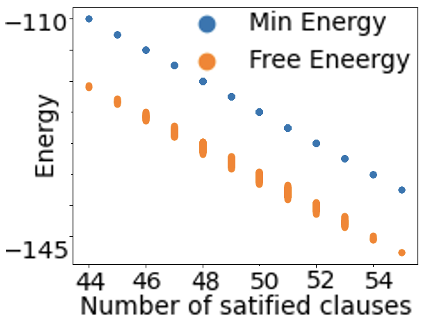
The image is a scatter plot comparing "Min Energy" and "Free Energy" against the "Number of satisfied clauses." Both energy types decrease as the number of satisfied clauses increases.
### Components/Axes
* **X-axis:** "Number of satified clauses" ranging from 44 to 54 in increments of 2.
* **Y-axis:** "Energy" ranging from -145 to -110.
* **Legend (Top-Right):**
* Blue circle: "Min Energy"
* Orange circle: "Free Eneergy"
### Detailed Analysis
* **Min Energy (Blue):** The blue data points represent the "Min Energy." The trend is downward, indicating that the minimum energy decreases as the number of satisfied clauses increases.
* At 44 satisfied clauses, Min Energy is approximately -110.
* At 46 satisfied clauses, Min Energy is approximately -113.
* At 48 satisfied clauses, Min Energy is approximately -118.
* At 50 satisfied clauses, Min Energy is approximately -123.
* At 52 satisfied clauses, Min Energy is approximately -130.
* At 54 satisfied clauses, Min Energy is approximately -135.
* **Free Energy (Orange):** The orange data points represent the "Free Energy." The trend is also downward, indicating that the free energy decreases as the number of satisfied clauses increases.
* At 44 satisfied clauses, Free Energy is approximately -120.
* At 46 satisfied clauses, Free Energy is approximately -125.
* At 48 satisfied clauses, Free Energy is approximately -130.
* At 50 satisfied clauses, Free Energy is approximately -135.
* At 52 satisfied clauses, Free Energy is approximately -140.
* At 54 satisfied clauses, Free Energy is approximately -145.
### Key Observations
* Both "Min Energy" and "Free Energy" decrease as the "Number of satisfied clauses" increases.
* "Free Energy" is consistently lower than "Min Energy" for the same number of satisfied clauses.
* The rate of decrease appears to be relatively consistent for both energy types across the range of satisfied clauses.
### Interpretation
The data suggests that increasing the number of satisfied clauses in a system leads to a reduction in both the minimum energy and the free energy of the system. This could indicate that satisfying more clauses leads to a more stable and energetically favorable state. The consistent difference between "Min Energy" and "Free Energy" might represent a constant energy barrier or entropic contribution. The downward trend is expected, as satisfying more constraints typically leads to a lower energy state in optimization problems.